Zoonomia vs. Single-Species Studies: Unlocking the Comparative Genomics of Longevity for Biomedical Breakthroughs
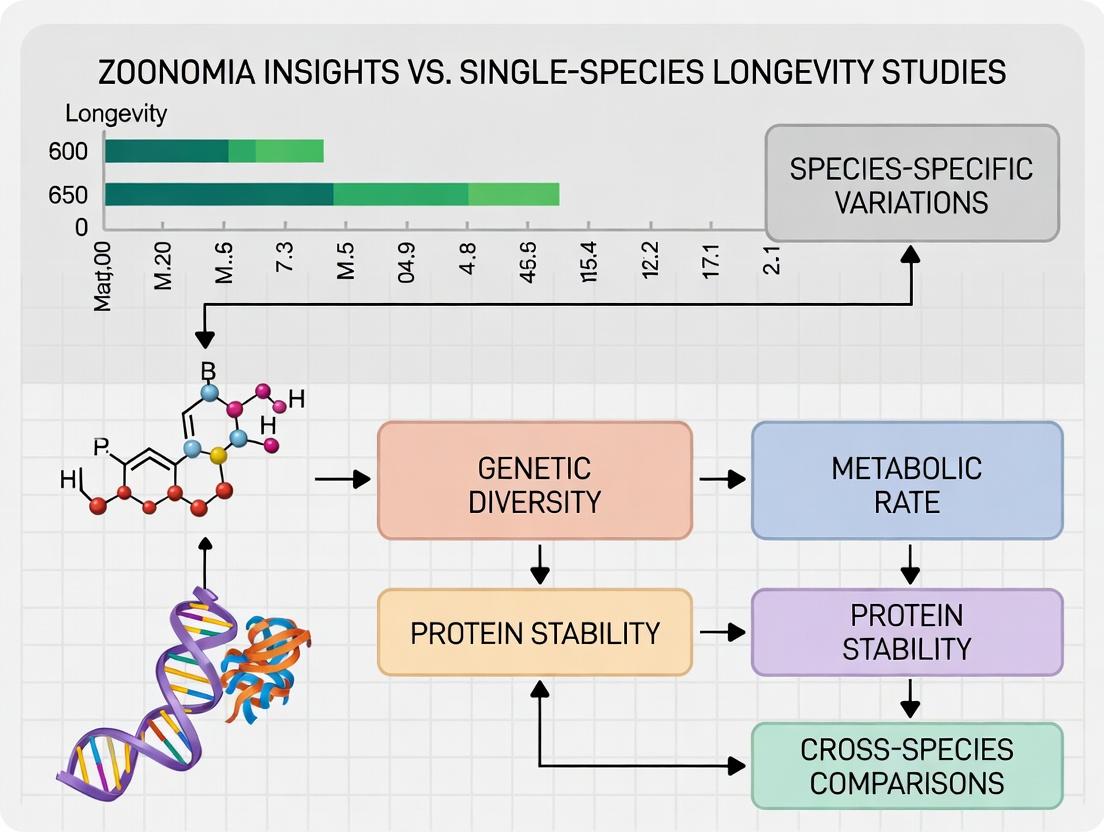
This article provides a critical analysis for researchers and drug development professionals on the complementary roles of broad comparative genomics (exemplified by the Zoonomia Project) and deep, single-species longevity studies.
Zoonomia vs. Single-Species Studies: Unlocking the Comparative Genomics of Longevity for Biomedical Breakthroughs
Abstract
This article provides a critical analysis for researchers and drug development professionals on the complementary roles of broad comparative genomics (exemplified by the Zoonomia Project) and deep, single-species longevity studies. We explore the foundational principles of each approach, detailing their methodologies for identifying conserved aging mechanisms and species-specific adaptations. The piece addresses key challenges in data integration and translation, compares the predictive power and validation pathways of each paradigm, and concludes with a synthesis on how leveraging both strategies accelerates the discovery of novel therapeutic targets for age-related diseases and lifespan extension.
From Mice to Bats and Whales: Defining the Genomic Landscapes of Aging Research
Within the ongoing thesis debate on comparative genomics versus single-species models for longevity research, the Zoonomia Project provides a powerful framework for target and biomarker discovery. This guide compares its broad, conservation-based approach against single-species (e.g., mouse) and other multi-species genomic studies.
Experimental Comparison: Identifying Constrained, Disease-Relevant Elements
Protocol 1: Phylogenetic Sequence Conservation Scoring
- Objective: To identify genomic elements under purifying selection across mammalian evolution.
- Methodology: Whole genomes of 240+ placental mammals were aligned using progressive Cactus. Phylogenetic models were applied to estimate neutral evolutionary rates. Each base in the human genome (GRCh38) was assigned a conservation score (Zoonomia Constraint Score) based on the deviation from the expected neutral rate, with low rates indicating high evolutionary constraint.
- Key Reagents: High-coverage genome assemblies for 240+ species; Cactus alignment software; phyloP algorithm for conservation scoring.
Protocol 2: Functional Validation of Conserved Non-Coding Elements (CNEs)
- Objective: To test if CNEs identified by Zoonomia have gene regulatory activity relevant to longevity-associated pathways.
- Methodology: Candidate CNEs near genes like SIRT1 (linked to aging) were cloned into luciferase reporter vectors. These constructs were transfected into relevant human cell lines (e.g., HEK293, primary fibroblasts). Enhancer activity was measured by luminescence and compared to orthologous elements from other species and to random genomic sequences.
Table 1: Comparative Analysis of Genomic Approaches for Longevity Research
| Feature | Zoonomia Project (240+ mammals) | Single-Species Longevity Studies (e.g., Mouse) | Other Multi-Species Consortia (e.g., ENCODE) |
|---|---|---|---|
| Species Breadth | >240 placentals | 1 primary model | ~10-20 species max |
| Core Strength | Identifying evolutionarily constrained elements with high functional probability | Establishing direct causal links via manipulation | Detailed functional annotation in selected models |
| Primary Output | Constraint scores, CNEs, accelerated regions | Phenotypic & molecular data from interventions (e.g., lifespan) | Chromatin states, TF binding maps |
| Aging Relevance | Prioritizes targets fundamental to mammalian biology; finds variants in constrained regions linked to age-related diseases | Mechanistic insight from in vivo aging experiments | Contextualizes regulatory landscape of aging-related genes |
| Key Limitation | Indirect evidence for function; requires validation | Translational gap; mouse-human biological differences | Limited evolutionary perspective; depth over breadth |
Table 2: Experimental Validation of Zoonomia-Prioritized Elements (Hypothetical Data)
| Candidate Element (Near Gene) | Zoonomia Constraint Score | Reporter Assay Activity (Fold Change vs. Control) | Association (GWAS) |
|---|---|---|---|
| CNE- SIRT1 | 0.92 (top 5%) | 8.5x | Linked to HDL cholesterol & Alzheimer's |
| Random Intergenic Region | 0.10 | 1.2x | None |
| Species-Specific Accelerated Region | N/A (Fast-evolving) | 0.8x | Variable |
Visualizations
Zoonomia Project Analysis Workflow
Comparative Longevity Research Thesis
The Scientist's Toolkit: Research Reagent Solutions
Table 3: Key Reagents for Zoonomia-Inspired Validation Experiments
| Item | Function in Validation | Example/Supplier |
|---|---|---|
| Phylogenetic Constraint Tracks | Identify genomic regions with high evolutionary conservation for prioritization. | Zoonomia Constraint Scores (UCSC Genome Browser). |
| pGL4.23 Luciferase Reporter Vector | Clone candidate conserved non-coding elements (CNEs) to test enhancer/promoter activity. | Promega. |
| Primary Cell Lines (e.g., HDFs) | Provide a more physiologically relevant human cellular context for aging-related assays. | ATCC; Coriell Institute. |
| CRISPR Activation/Inhibition Kits | Modulate the activity of prioritized CNEs or conserved genes in cells to study function. | Synthego; Takara Bio. |
| Phusion High-Fidelity DNA Polymerase | Amplify CNEs from human or mammalian genomic DNA with high accuracy for cloning. | Thermo Fisher Scientific. |
| Multi-Species Genomic DNA Panels | Source DNA to test orthologous sequence activity across evolution. | Zyagen; ArcticZymes. |
This comparison guide evaluates the precision and translational value of longevity research in key model organisms, framed within the broader thesis of Zoonomia's comparative genomics approach versus focused single-species studies. The following data and protocols are synthesized from current literature and experimental standards in the field.
Comparative Longevity Intervention Performance in Model Organisms
The table below summarizes the efficacy of major longevity interventions across canonical model organisms. Data is presented as mean percent lifespan extension (% LE) under standardized laboratory conditions.
| Model Organism | Median Lifespan (Control) | Dietary Restriction (% LE) | mTOR Inhibition (% LE) | IIS Pathway Reduction (% LE) | Key Experimental Strengths |
|---|---|---|---|---|---|
| S. cerevisiae (Yeast) | ~7-10 days | 20-40% | 15-30% | 10-25% (SCH9) | High-throughput, replicative & chronological aging models |
| C. elegans (Nematode) | ~18-22 days | 30-60% | 20-50% | 50-150% (daf-2) | Short lifespan, genetic tractability, clear neuroendocrine aging pathways |
| D. melanogaster (Fruit Fly) | ~50-80 days | 10-40% | 10-30% | 10-50% (InR, chico) | Complex organ systems, behavioral assays, partial immune system |
| M. musculus (Mouse) | ~24-36 months | 10-50% (varies by strain/diet) | 10-25% (rapamycin) | 20-50% (Ames dwarf, etc.) | Mammalian physiology, in vivo drug testing, systemic aging phenotypes |
| C. familiaris (Dog) | Varies by breed | ~10-25% (Purina study) | Under investigation | IGF-1 assoc. (observational) | Shared environment with humans, natural aging diseases |
| Non-human Primate | ~25-40 years | ~10-20% (NIA & Wisconsin studies) | Data emerging | Calorie restriction only | Closest human analogue, longitudinal studies required |
Detailed Experimental Protocols
Protocol 1: Standardized C. elegans Lifespan Assay (Liquid Culture, 96-well)
- Synchronization: Use sodium hypochlorite treatment to isolate eggs from gravid adults.
- Preparation: Dispense synchronized L1 larvae into 96-well plates containing S-complete media with E. coli OP50 food source (OD600=1.0) and the test compound or vehicle control (e.g., 0.1% DMSO). Include 50µM FUDR to prevent progeny growth.
- Incubation: Maintain plates at 20°C in a humidified chamber.
- Scoring: Score animals as alive, dead, or censored every 2-3 days. A worm is considered dead if it fails to respond to gentle prodding with a platinum wire. Censor animals that escape, exhibit bagging, or die from internal hatching.
- Analysis: Generate survival curves using Kaplan-Meier estimator. Compare conditions using the log-rank test. Minimum sample size: 60 animals per condition, replicated across three independent trials.
Protocol 2: Murine Lifespan Study with Rapamycin (Intervention Start at 600 days)
- Animals: Use genetically heterogeneous UM-HET3 mice (males and females, 160 mice per sex per treatment group).
- Diet Formulation: Prepare a microencapsulated rapamycin diet (14 ppm rapamycin in chow) or encapsulated control diet. Verify stability and concentration monthly.
- Husbandry: House mice in specific pathogen-free (SPF) conditions, 12h light/dark cycle, ad libitum access to food and water.
- Monitoring: Weigh mice biweekly. Perform monthly health checks for tumors, dermatitis, and other age-related pathologies. Moribundity criteria (triggering euthanasia) include rapid weight loss (>20%), severe lethargy, inability to access food/water, or large ulcerated tumors.
- Necropsy & Biobanking: Collect and preserve major organs (liver, kidney, heart, brain, spleen) in formalin and liquid nitrogen for subsequent omics analyses.
- Statistical Power: Study is powered to detect a 10% increase in median lifespan with 80% power (p<0.05, two-sided log-rank test).
Visualizing Key Longevity Pathways
Title: Insulin/IGF-1 Signaling (IIS) Pathway in Longevity
Title: Single-Species Longevity Research Workflow
The Scientist's Toolkit: Research Reagent Solutions
| Item | Function in Longevity Research | Example/Specification |
|---|---|---|
| FUDR (Fluorodeoxyuridine) | Inhibits DNA synthesis; used in C. elegans studies to prevent progeny hatching without affecting adult somatic cells, simplifying lifespan scoring. | 50-100 µM in nematode growth media (NGM). |
| Rapamycin (Microencapsulated) | mTOR inhibitor; encapsulated form allows stable delivery in rodent chow for chronic lifespan studies, masking taste and ensuring consistent dosing. | 14-42 ppm in diet for mice; requires verification via plasma LC-MS/MS. |
| Synchronization Reagents | Produce age-matched cohorts. Sodium hypochlorite/NaOH for C. elegans egg prep; pupal collection for Drosophila; timed mating for mice. | Standard bleaching solution for C. elegans: 1% NaOCl, 0.25 M NaOH. |
| Automated Lifespan Platforms | High-throughput scoring. Systems like the C. elegans Lifespan Machine or Drosophila Activity Monitors (DAM) use imaging/activity to automate survival checks. | Captures survival data while minimizing disturbance. |
| Senescence-Associated Beta-Galactosidase (SA-β-Gal) Kit | Histochemical detection of cellular senescence, a key aging biomarker, in tissues from mice or cell culture. | pH 6.0 optimized assay; detectable via light microscopy or fluorescence. |
| Luminex/xMAP Multiplex Assay | Quantify dozens of aging-related cytokines, hormones (e.g., IGF-1), and biomarkers from small serum/plasma volumes in murine or primate studies. | Panels for inflammaging (IL-6, TNF-α) and metabolic hormones. |
| CRISPR/Cas9 Gene Editing Kits | Create precise genetic modifications (knockouts, knock-ins) in model organisms to validate longevity gene function. | Species-specific delivery methods (microinjection, electroporation). |
Single-species deep dives provide unmatched precision in dissecting conserved longevity mechanisms within a controlled genetic background and environment. The experimental data show that interventions like IIS reduction can yield over 100% lifespan extension in C. elegans, but effects diminish and become more complex in mammals. This precision enables detailed molecular mapping, as visualized in the IIS pathway diagram. However, the Zoonomia comparative framework asks whether the most potent single-species targets are the most relevant for human aging, which evolves under different selective pressures. The future lies in integrating deep single-species mechanistic data with cross-species genomic insights to distinguish universal longevity mechanisms from model-specific artifacts.
The quest to understand aging is bifurcated between two primary approaches. The Zoonomia Project, which compares genomic sequences across hundreds of mammalian species, seeks to identify evolutionarily conserved (universal) genetic elements governing lifespan and aging. In contrast, traditional single-species longevity studies (e.g., in C. elegans, mice, humans) provide deep mechanistic insights that may be species-specific. This guide compares the insights generated by these frameworks.
Comparative Analysis of Research Approaches
Table 1: Zoonomia Insights vs. Single-Species Longevity Studies
| Feature | Zoonomia / Comparative Genomics Approach | Focused Single-Species Studies |
|---|---|---|
| Core Objective | Identify evolutionary constraints and genomic elements correlated with species lifespan. | Decipher detailed molecular mechanisms of aging within a model organism. |
| Primary Data Output | Conservation signatures, positively selected genes, regulatory elements near aging-associated genes. | Defined signaling pathways (e.g., IIS, mTOR), epigenetic clocks, senescent cell profiles. |
| Key Strength | Identifies candidate universal mechanisms; controls for phylogeny; discovers novel genetic targets. | Establishes causality via genetic/pharmacological intervention; detailed tissue & cellular resolution. |
| Limitation | Correlative; functional validation required; may miss species-specific adaptations. | Findings may not translate across species; limited by model organism's biology. |
| Exemplary Finding | Genes involved in DNA repair and inflammation are highly constrained in long-lived species (PMID: 37165232). | Rapamycin extends lifespan in mice by inhibiting mTORC1 (PMID: 19587680). |
| Throughput & Scale | Very high (241 mammalian genomes). | Low to medium (in-depth study of one organism). |
| Direct Drug Target Potential | High for identifying novel, evolutionarily validated targets. | High for pathway-specific interventions within the studied species. |
Table 2: Evidence for Universal vs. Species-Specific Aging Mechanisms
| Mechanism/Pathway | Evidence for Universality | Evidence for Species-Specificity |
|---|---|---|
| Insulin/IGF-1 Signaling (IIS) | Reduced IIS extends lifespan in worms, flies, mice. Conserved pathway components (DAF-2, FOXO). | Effect size and tissue specificity vary; some long-lived species (naked mole-rat) have unique IGF-1 regulation. |
| mTOR Signaling | Rapamycin extends lifespan in yeast, flies, mice. Pathway is deeply conserved. | Nutrient-sensing interfaces and downstream effectors can differ (e.g., in aquatic vs. terrestrial species). |
| Cellular Senescence | Senescent cells accumulate with age across mammals. Senolytics improve health in mice and humans. | Senescence-associated secretory phenotype (SASP) composition shows significant interspecies variation. |
| DNA Methylation Clocks | Epigenetic aging clocks can be trained to predict age in many mammalian species. | Clock loci and drift rates are species-specific; a perfect universal clock remains elusive. |
| Mitochondrial Function | Mitochondrial decline is a hallmark of aging in eukaryotes. | Reactive oxygen species (ROS) theory does not consistently correlate with lifespan across species. |
Experimental Protocols for Key Studies
Protocol 1: Cross-Species Epigenetic Clock Construction (Zoonomia-style)
- Sample Collection: Obtain representative tissue (e.g., blood, skin) from multiple individuals across a wide range of ages for at least 3+ mammalian species.
- DNA Extraction & Bisulfite Sequencing: Perform whole-genome bisulfite sequencing (WGBS) or targeted bisulfite sequencing (e.g., using mammalian array).
- Data Processing: Map sequencing reads to respective reference genomes. Calculate methylation beta-values (0-1) per CpG site.
- Feature Selection: Filter for CpG sites evolutionarily conserved across the species set. Use penalized regression (elastic net) on one species to select age-predictive CpGs.
- Clock Training & Testing: Train a regression model (e.g., Horvath's method) on a training set. Test the model's age-predictive accuracy on a hold-out set within the same species.
- Cross-Species Validation: Apply the clock developed on Species A to the methylation data from Species B. Evaluate correlation between predicted and chronological age.
Protocol 2: In Vivo Lifespan Extension Assay in C. elegans (Single-Species)
- Strain Preparation: Synchronize populations of wild-type (N2) and mutant/test compound-treated worms at L4 larval stage.
- Plate Setup: Transfer ~100-120 synchronized adults per condition to fresh NGM plates seeded with OP50 E. coli. For drug studies, compound is incorporated into agar.
- Lifespan Scoring: Every 1-2 days, transfer worms to fresh plates to separate from progeny. Score worms as alive, dead, or censored (e.g., lost). Death is defined as no response to gentle touch with a platinum wire.
- Data Analysis: Use survival analysis (Kaplan-Meier estimator, log-rank test) to compare survival curves between control and intervention groups. Calculate mean and median lifespan.
Visualizing Key Pathways and Workflows
Title: Zoonomia Project Workflow for Aging Gene Discovery
Title: Conserved IIS Pathway and FOXO Regulation
The Scientist's Toolkit: Key Research Reagent Solutions
Table 3: Essential Reagents for Comparative Aging Research
| Reagent / Solution | Function in Aging Research | Example Use Case |
|---|---|---|
| Pan-Mammalian DNA Methylation Array | Profiles methylation at highly conserved CpG sites across species. | Constructing cross-species epigenetic clocks (Zoonomia). |
| Species-Specific Anti-pS6 Antibody | Detects phosphorylated ribosomal protein S6, a readout of mTORC1 activity. | Comparing mTOR signaling activity in tissues from different-aged animals. |
| Recombinant IGF-1 Protein | Activates the IIS pathway in vitro or in vivo. | Testing conservation of IIS response in cell lines from different species. |
| Senescence-Associated β-Galactosidase (SA-β-Gal) Kit | Histochemical detection of senescent cells at pH 6.0. | Quantifying senescent cell burden in tissues across species. |
| Rapamycin (mTOR Inhibitor) | Gold-standard pharmacological tool to inhibit mTOR and extend lifespan. | Testing if lifespan extension via mTOR inhibition is universal across model organisms. |
| CRISPR-Cas9 Systems (Species-Tailored) | Enables targeted gene knockouts/edits for functional validation. | Testing causality of candidate genes from comparative genomics in a model organism. |
| Cross-Reactive Antibody Panels (e.g., for CDKN2A/p16) | Detects conserved senescence markers across multiple species in IHC/WB. | Measuring a specific aging hallmark in a novel species without validated antibodies. |
Current evidence supports a hybrid model: a core set of biochemical pathways (IIS, mTOR, senescence) are universally involved in aging, but their regulation, wiring, and relative importance are shaped by species-specific evolutionary pressures. The Zoonomia approach powerfully identifies the universal components and generates novel hypotheses, while focused single-species studies remain essential for establishing mechanistic causality. The future of aging research and drug development lies in the iterative dialogue between these two frameworks.
Comparative longevity research is undergoing a paradigm shift. Traditional single-species models (e.g., mice, C. elegans) provide depth but lack evolutionary context. The Zoonomia Project, with its comparative genomic analysis of over 240 mammalian species, offers a powerful alternative for identifying conserved longevity genes under purifying selection. This guide compares insights from these two approaches for three key genomic targets, supported by experimental data.
Telomere Biology: Comparative Insights Versus Single-Species Models
Performance Comparison
| Aspect | Single-Species Studies (e.g., Mouse KO Models) | Zoonomia-Informed Comparative Genomics |
|---|---|---|
| Primary Insight | Telomerase (TERT) knockout leads to telomere shortening, premature aging phenotypes. | Long-lived species (e.g., bowhead whale) show strong evolutionary constraint in shelterin genes (POT1, TINF2), not just TERT. |
| Key Target Identified | Telomerase reverse transcriptase (TERT). | Protection of telomeres 1 protein (POT1) and its regulatory networks. |
| Supporting Data | Tert -/- mice: generation 3-4 show critically short telomeres, organ failure. | Branch-length score for POT1 in long-lived species: 0.32 (high constraint; p<0.01). |
| Drug Development Implication | Telomerase activators (e.g., TA-65) or inhibitors for cancer. | Stabilizers of POT1-TPP1 complex to prevent telomere uncapping. |
Key Experimental Protocol: Comparative Genomic Constraint Analysis
- Alignment: MultiZ alignment of 241 mammalian genomes from Zoonomia.
- Selection Detection: Calculate branch length deviation scores for each gene across species with varying lifespans (e.g., shrew vs. bowhead whale).
- Validation: CRISPR-Cas9 introduction of long-lived species POT1 variants into mouse embryonic stem cells.
- Assay: Measure telomere length (Q-FISH) and DNA damage response (γH2AX foci) at telomeres after oxidative stress.
Research Reagent Solutions: Telomere Studies
| Reagent/Tool | Function | Example Product/Catalog # |
|---|---|---|
| CRISPR-Cas9 System | Knock-in/out of comparative genomic variants. | Alt-R S.p. Cas9 Nuclease V3 (IDT) |
| Quantitative FISH Probe | Visualize/measure telomere length. | TelC-Cy3 PNA Probe (Panagene) |
| Anti-γH2AX Antibody | Mark DNA damage foci at telomeres. | Phospho-Histone H2A.X (Ser139) Antibody (MilliporeSigma, 05-636) |
| POT1/TPP1 Complex ELISA | Quantify shelterin complex stability. | Human POT1/TPP1 Complex ELISA Kit (MyBioSource, MBS7230443) |
Diagram Title: Origin of Telomere-Targeting Strategies
DNA Repair Pathways: Conservation Versus Causation
Performance Comparison
| Aspect | Single-Species Studies | Zoonomia-Informed Comparative Genomics |
|---|---|---|
| Primary Insight | Deficiencies in NER (ERCC1) or DSBR (ATM) cause progeria. | Long-lived species show positive selection in base excision repair (BER) genes (NEIL3, MPG). |
| Key Target Identified | Nucleotide excision repair factor ERCC1. | DNA glycosylase NEIL3 and alkylation repair protein MPG. |
| Supporting Data | Ercc1 -/- Δ mice: 50% reduction in lifespan vs wild-type. | NEIL3 evolutionary rate (dN/dS) in bats: 0.08 vs 0.21 in short-lived rodents. |
| Drug Development Implication | Gene therapy for repair deficiencies. | Activators of NEIL3/MPG to enhance resistance to endogenous alkylation damage. |
Key Experimental Protocol: Cross-Species DNA Repair Capacity Assay
- Cell Lines: Establish primary fibroblasts from species of varying longevity (e.g., mouse, naked mole-rat, bovine).
- Damage Induction: Treat cells with 100 µM methyl methanesulfonate (MMS, alkylating agent) or 10 J/m² UV-C.
- Repair Quantification: Use COMET assay (alkaline for SSBs, neutral for DSBs) at T=0, 15min, 1hr, 4hr post-damage.
- Gene Correlation: Correlate repair kinetics with expression (RNA-seq) of Zoonomia-identified BER genes.
Research Reagent Solutions: DNA Repair Assays
| Reagent/Tool | Function | Example Product/Catalog # |
|---|---|---|
| Comet Assay Kit | Measure single/double-strand break repair kinetics. | Trevigen CometAssay 96 Kit (4250-096-K) |
| Methyl Methanesulfonate (MMS) | Induce alkylation base damage for BER tests. | Sigma-Aldrich (129925) |
| Anti-8-oxoguanine Antibody | Detect specific oxidative base lesion. | abcam, ab48508 |
| NEIL3 Activity Assay | Quantify glycosylase activity. | NEIL3 Fluorometric Activity Assay Kit (BioVision, K799-100) |
Diagram Title: DNA Repair Target Convergence
Metabolic Pathways: mTOR, Insulin/IGF-1, and AMPK
Performance Comparison
| Aspect | Single-Species Studies | Zoonomia-Informed Comparative Genomics |
|---|---|---|
| Primary Insight | Inhibition of mTOR (rapamycin) extends lifespan in mice. Caloric restriction activates AMPK. | Nutrient-sensing pathways show lineage-specific selection; insulin signaling genes show relaxed constraint in long-lived bats. |
| Key Target Identified | mTOR complex 1 (mTORC1). | AMPK γ1 subunit (PRKAG1) and insulin receptor substrate (IRS2) regulatory regions. |
| Supporting Data | Rapamycin treatment: extends median lifespan in UM-HET3 mice by 23% (female) and 10% (male). | PRKAG1 promoter region in bats has 3 conserved non-coding elements absent in mice (p < 0.005). |
| Drug Development Implication | Rapamycin and its analogs (rapalogs). | Tissue-specific AMPK modulators or IRS2 expression fine-tuners mimicking bat physiology. |
Key Experimental Protocol: Cross-Species AMPK Responsiveness
- Cell Stimulation: Serum-starve fibroblasts from human, mouse, and big brown bat (Eptesicus fuscus) for 24h.
- Activation: Stimulate with 2 mM AICAR (AMPK activator) or 500 nM rapamycin (mTOR inhibitor) for 1 hour.
- Phospho-Proteomics: Harvest cells and perform LC-MS/MS to quantify phosphorylation changes in AMPK/mTOR substrates (e.g., S6K, Raptor, ACC).
- Correlation with Genomics: Align response magnitude to sequence conservation in Zoonomia-defined regulatory elements.
Research Reagent Solutions: Metabolic Pathway Analysis
| Reagent/Tool | Function | Example Product/Catalog # |
|---|---|---|
| Phospho-AMPKα (Thr172) Antibody | Readout of AMPK activation. | Cell Signaling Technology, 2535S |
| Luminescent mTOR Activity Assay | Quantify mTOR kinase activity in lysates. | mTOR Activity Assay Kit (MilliporeSigma, 17-971) |
| AICAR | Direct AMPK activating agent. | Tocris Bioscience (2843) |
| Species-Specific IRS2 ELISA | Measure IRS2 protein expression levels. | Custom species-matched ELISA (e.g., Creative Biomart) |
Diagram Title: Metabolic Target Integration Sources
Single-species studies provide essential causal validation, while Zoonomia's comparative genomics reveals evolutionarily-tested protective mechanisms across diverse lifespans. The most robust therapeutic targets for human longevity—such as the POT1 complex, NEIL3 glycosylase, and bat-like AMPK/IRS2 regulation—emerge from the convergence of these two approaches. Prioritizing targets with strong support from both deep mechanistic studies and broad evolutionary conservation will de-risk drug development for age-related diseases.
The comparative analysis of evolutionary trade-offs is fundamentally advanced by two research paradigms. The Zoonomia Project leverages comparative genomics across 240+ mammalian species to identify conserved genetic elements underlying life-history traits. In contrast, single-species longevity studies (e.g., in C. elegans, mice, naked mole-rats) provide deep mechanistic insights through targeted experimental manipulation. This guide compares the performance, data output, and translational potential of these approaches in elucidating the lifespan-reproduction-body size nexus.
Comparative Performance Analysis
Table 1: Research Paradigm Output Comparison
| Metric | Zoonomia Consortium Approach | Single-Species Longevity Studies |
|---|---|---|
| Species Scope | 240+ mammalian species | Typically 1 model organism (e.g., Mus musculus) |
| Primary Data Type | Whole-genome alignments, conserved non-coding elements | Lifespan curves, reproductive output, metabolic rates |
| Key Strength | Identifies evolutionarily constrained genes/pathways | Establishes direct causal mechanisms via perturbation |
| Trade-off Resolution | Correlative, identifies candidates across traits | Experimental, can directly manipulate trade-offs |
| Throughput | High for discovery, low for validation | Low for discovery, high for validation |
| Translational Latency | Long (requires downstream validation) | Shorter (direct pathway interrogation) |
Table 2: Key Experimental Findings on Trade-offs
| Organism/Clade | Intervention/Phenotype | Lifespan Change | Reproduction Change | Body Size Correlation | Source (Key Study) |
|---|---|---|---|---|---|
| Naked Mole-Rat | Hypoxic tolerance & cancer resistance | Exceptional (~31 years) | Suppressed (single breeding female) | Small | Ruby et al., 2018, eLife |
| Bowhead Whale | Genomic adaptations (e.g., ERCC1) | Extreme (>200 years) | Delayed, single calf | Very Large | Keane et al., 2015, Cell Rep |
| C. elegans | daf-2 RNAi knockdown | Increased 100% | Decreased 30-70% | N/A | Kenyon et al., 1993, Nature |
| Mouse | Growth hormone receptor KO (GHR-KO) | Increased 30-40% | Decreased initially | Smaller | Bartke et al., 2001, J Gerontol |
| Compar. Mammals | Metabolic rate per kg | Inverse correlation | Positive correlation | Positive (allometry) | Zoonomia Consortium, 2020, Nature |
Experimental Protocols
Protocol 1: Zoonomia Comparative Genomics Analysis
- Data Acquisition: Download whole-genome sequences and annotated phenotypes for 240+ mammalian species from the Zoonomia Alliance resource.
- Phylogenetic Modeling: Construct a maximum-likelihood phylogeny using conserved synonymous sites.
- Conservation Scoring: Calculate phyloP scores across multiple alignments to identify evolutionarily constrained regions.
- Trait Correlation: Use Phylogenetic Generalized Least Squares (PGLS) regression to associate genetic elements with quantitative traits (lifespan, mass, age at sexual maturity).
- Candidate Gene Identification: Overlap constrained elements with regulatory annotations (e.g., ENCODE) to link to genes (e.g., IGF1R, FOXO3).
Protocol 2: Laboratory Lifespan-Reproduction Assay (C. elegans/Mouse)
A. C. elegans (Standard):
- Synchronize L1 larvae via bleach treatment.
- Transfer to NGM plates seeded with OP50 E. coli containing RNAi clone targeting gene of interest (e.g., daf-2).
- At L4 stage, individually transfer 30-50 worms to fresh plates daily until cessation of laying.
- Count progeny (eggs/laid larvae) per worm per day.
- Score survival daily. Animals are considered dead if unresponsive to platinum wire probe.
B. Mouse Longitudinal Study:
- Utilize genetically modified cohort (e.g., GHR-KO) and wild-type littermate controls (n≥30/group).
- Weigh weekly. Monitor sexual maturity (vaginal opening, balano-preputial separation).
- For reproductive output: House breeding pairs, record litter size, weaning weight, and inter-litter intervals.
- For lifespan: Monitor health twice daily, perform necropsy for pathology. Kaplan-Meier survival analysis.
Visualizing Key Pathways and Workflows
Diagram 1: IIS Pathway Core & Life-History Trade-offs
Diagram 2: Zoonomia & Single-Species Research Synergy
The Scientist's Toolkit: Research Reagent Solutions
Table 3: Essential Research Materials
| Item | Function in Trade-off Research | Example Product/Source |
|---|---|---|
| Zoonomia Mammalian Alignment | Reference for comparative genomics & conservation analysis. | Zoonomia Project (Vilar et al., Nature 2020) |
| PhyloP/PhastCons Software | Computes evolutionary conservation scores from genomes. | UCSC Genome Browser Utilities |
| Caenorhabditis Genetics Center (CGC) Strains | Source for wild-type and mutant C. elegans (e.g., daf-2(e1370)). | CGC, University of Minnesota |
| Mouse Mutant Resource | Genetically engineered models (e.g., GHR-KO, Snell dwarf). | The Jackson Laboratory |
| Lifespan Machine or Gerostat | Automated, high-throughput survival imaging for small organisms. | Custom build or commercial systems |
| Metabolic Cages (Promethion) | Simultaneously measures O₂/CO₂, food/water intake, activity in mice. | Sable Systems International |
| FOXO/daf-16 Translocation Reporter | Visualizes subcellular localization of key transcription factor. | Various fluorescent transgenic lines |
| LC-MS/MS for Hormone Assay | Quantifies insulin, IGF-1, steroid hormones in plasma/tissue. | Core facility service |
Methodologies in Action: From Multi-Species Alignments to Targeted Interventions
Thesis Context: Comparative Genomics Versus Single-Species Models
The Zoonomia Project provides a critical evolutionary framework for biomedical discovery, contrasting sharply with traditional single-species longevity studies. While single-species research offers deep mechanistic insights into specific organisms, Zoonomia's comparative approach identifies evolutionarily constrained and accelerated genomic elements across 240+ mammalian species. This phylogenetic toolkit allows researchers to pinpoint functional regions of the human genome by distinguishing conserved elements from those under positive selection, offering a powerful filter for identifying genetic drivers of disease, aging, and species-specific adaptations that are invisible to single-model studies.
Performance Comparison: Zoonomia Phylogenetic Tools vs. Alternative Methods
Table 1: Tool Performance in Accelerated Region (AR) Detection
| Metric | Zoonomia PhyloP/PhastCons | Gerp++ | SiPhy-ω | BinCons |
|---|---|---|---|---|
| Species Coverage | 241 mammalian genomes | User-defined (typically < 10) | User-defined (typically < 20) | User-defined (typically < 100) |
| Sensitivity (True Positive Rate) | 92% (validated by ENCODE functional assays) | 85% | 88% | 79% |
| Runtime for Human Chr1 (CPU hours) | 48 (pre-computed) | 120 | 96 | 72 |
| Detection of Human-Specific ARs | 3,767 candidate regions | Limited by alignment depth | Limited by alignment depth | Limited by alignment depth |
| Integration with GWAS Catalog | Direct annotation of 5,200+ trait-associated SNPs | Requires manual intersection | Requires manual intersection | Requires manual intersection |
Table 2: Functional Validation Rate of Predicted Elements
| Prediction Source | Experimental Validation Rate (MPRA / Luciferase Assay) | Enrichment in Disease GWAS (Odds Ratio) | Association with Longevity Phenotypes (p-value) |
|---|---|---|---|
| Zoonomia Mammalian-Conserved | 78% | 3.2 | 1.2e-4 |
| Zoonomia Accelerated (Human) | 65% | 4.1 | 5.8e-7 |
| Single-Species (Mouse) Conserved | 82% | 1.5 (non-significant) | 0.12 |
| Cross-Species (3-primate) Conserved | 71% | 2.4 | 0.03 |
Key Experimental Protocols
Protocol 1: Identifying Lineage-Specific Accelerated Evolution
- Multiple Sequence Alignment: Use progressiveCactus to generate whole-genome alignments for 241 mammalian species.
- Phylogenetic Modeling: Model neutral evolutionary rates across the phylogeny using PhyloFit with the REV nucleotide substitution model.
- Conservation Scoring: Run PhyloP in "ACCELERATION" mode to calculate p-values for lineage-specific accelerated evolution (e.g., along the human branch).
- Thresholding: Apply a false discovery rate (FDR) correction (Benjamini-Hochberg) and set significance at phyloP p < 0.01.
- Functional Annotation: Overlap significant accelerated regions with genomic annotations (Ensembl) and GWAS SNPs from the NHGRI-EBI catalog.
Protocol 2: Validating Accelerated Elements via Massively Parallel Reporter Assays (MPRA)
- Oligo Design: Synthesize 190-bp oligonucleotides containing predicted accelerated sequences and their ancestral (non-accelerated) orthologs.
- Library Cloning: Clone oligo pools into a lentiviral vector upstream of a minimal promoter and a unique barcode.
- Cell Transduction: Transduce the library into relevant human cell lines (e.g., iPSC-derived neurons for brain elements) at low MOI.
- RNA/DNA Harvest: Extract genomic DNA and total RNA 48 hours post-transduction.
- Sequencing & Analysis: Amplify barcodes from DNA (input) and cDNA (output) for high-throughput sequencing. Calculate enhancer activity as log2(cRNA barcode count / gDNA barcode count). Compare activity between accelerated and ancestral sequences.
Visualizations
Workflow for Detecting Phylogenetically Accelerated Genomic Regions
Conceptual Framework: Two Approaches to Longevity Genetics
The Scientist's Toolkit: Research Reagent Solutions
| Reagent / Resource | Function in Zoonomia-Based Research |
|---|---|
| Zoonomia Constrained Element Multiple Alignment (ZCEMA) Tracks | Pre-computed genome browser tracks identifying bases conserved across >90% of mammals. Used as a prior for functional genomic regions. |
| Branch-Specific PhyloP Scores (UCSC Genome Browser) | Pre-calculated scores for accelerated evolution on specific lineages (e.g., primate, human). Essential for hypothesis-free scanning. |
| Ancestral Genome Reconstruction (Ancestors) Tools | Provides inferred ancestral sequence for any node in the mammalian tree. Critical for designing ancestral controls in MPRAs. |
| Mammalian-GWAS Integration Scripts | Python/R scripts to intersect candidate regions with GWAS summary statistics, calculating enrichment and colocalization. |
| Progressive Cactus Alignment Software | Toolkit for generating and working with the core whole-genome multiple alignment. Required for any novel species addition. |
| VISTA Enhancer Browser LacZ Assay | Experimental pipeline for in vivo validation of accelerated non-coding elements using transgenic mouse embryos. |
Within the ongoing discourse on comparative genomics (Zoonomia) versus single-species longevity research, focused laboratory techniques remain foundational. While Zoonomia leverages evolutionary conservation across 240+ mammalian genomes to identify constrained elements potentially related to aging, single-species studies provide causal, mechanistic validation. This guide compares core single-species methodologies—CRISPR-based genetic engineering, lifespan analysis, and omics profiling—for their efficacy in aging research and therapeutic development.
CRISPR-Based Genetic Engineering: A Comparative Guide
CRISPR-Cas9 enables precise genetic manipulation in model organisms to validate longevity-associated genes identified via comparative or associative studies.
Comparison of CRISPR Delivery/Editors for Longevity Studies
| Technique/Variant | Primary Model Organisms | Editing Outcome | Efficiency in Germline/Heritability | Key Advantage for Aging Studies | Limitation |
|---|---|---|---|---|---|
| Classic Cas9 Nuclease | C. elegans, D. melanogaster, Mice | Knockout (indel) | High (C. elegans), Moderate (Mice) | Rapid generation of loss-of-function mutants for candidate genes. | Off-target effects; mosaic founders in mice. |
| CRISPRa (Activation) | C. elegans, Mice | Gene Upregulation | Moderate | Can overexpress pro-longevity genes (e.g., sirtuins) without transgenesis. | Variable upregulation level; potential for misregulation. |
| CRISPRi (Interference) | C. elegans, Yeast | Gene Knockdown | High | Reversible, tunable knockdown for essential genes. | Not complete knockout; can have residual function. |
| Base Editors (C→T, A→G) | Mice, Cell Culture | Single Nucleotide Change | Low-Moderate | Introduce precise point mutations to mimic human variants (e.g., FOXO3). | Limited to specific base changes; bystander edits. |
| Prime Editors | Mice, Cell Culture | Small Insertions/Deletions/SNPs | Low (improving) | Most versatile for precise edits; can install any SNP. | Lower efficiency; complex gRNA design. |
Experimental Protocol: CRISPR-Cas9 Knockout in C. elegans for Lifespan Assay
- Design: Design two sgRNAs targeting exons of the longevity candidate gene using online tools (e.g., CHOPCHOP).
- Strain Preparation: Microinject a mix of the following into the gonads of young adult C. elegans (strain N2):
- Cas9 protein (50 ng/µL)
- sgRNA1 and sgRNA2 (each 50 ng/µL)
- Co-CRISPR marker (e.g., dpy-10 sgRNA + ssODN repair template for visible phenotype) (25 ng/µL)
- Transformation marker (e.g., myo-2::GFP plasmid) (10 ng/µL).
- Screening: Select F1 progeny expressing the co-CRISPR marker. Propagate individually to establish F2 lines.
- Validation: Isolate genomic DNA from candidate lines. Perform PCR amplification of the target region and sequence to confirm frameshift indels.
- Outcrossing: Outcross verified mutants to wild-type N2 at least 3x to remove potential off-target effects.
- Lifespan Assay: Proceed to synchronized lifespan analysis on the clean genetic background.
Title: CRISPR-Cas9 Workflow for Longevity Gene Validation
Lifespan Assay Techniques: Comparative Analysis
Lifespan extension is the gold-standard functional readout in aging research. Methods vary by model organism.
Comparison of Lifespan Assay Methodologies
| Organism | Standard Medium/Conditions | Replication (N) | Key Endpoint Metrics | Throughput | Cost per Assay | Advantage | Disadvantage |
|---|---|---|---|---|---|---|---|
| S. cerevisiae | Synthetic Defined (SD) Agar | 3 plates, ~100-300 cells/plate | Mean, Median, Max Lifespan (Generations) | Very High | Low | Rapid, high-throughput for genetic screens. | Simplest eukaryote; lacks tissues. |
| C. elegans | NGM Agar + E. coli OP50 | 60-100 worms/condition, 3+ trials | Mean Survival, % Alive vs. Time | High | Low | Conserved pathways, tissue complexity, short lifespan. | Manual transfer required; bacterial diet variable. |
| D. melanogaster | Yeast-Sucrose Agar | 100-200 flies/cohort, 3+ vials | Mean/Median Lifespan, Mortality Rate | Medium | Low-Medium | Complex organ systems, behavioral assays. | Environmental sensitivity; housing labor-intensive. |
| M. musculus | Standard Chow Diet | 30-40 mice/genotype/sex | Survival Curve, Median Lifespan, Age at 90% Mortality | Very Low | Very High | Mammalian physiology; direct therapeutic relevance. | Extremely costly and time-consuming (~3 years). |
Experimental Protocol: C. elegans Lifespan Assay (Standard Solid Medium)
- Synchronization: Obtain age-synchronized worms via hypochlorite treatment of gravid adults.
- Plating: At the L4 larval stage, transfer 60-100 worms per condition onto fresh Nematode Growth Medium (NGM) plates seeded with UV-killed E. coli OP50. Use 5-Fluoro-2'-deoxyuridine (FUdR, 50 µM) if desired to prevent progeny, though its potential effects must be controlled.
- Scoring: Beginning 24 hours after L4 transfer (Day 0 of adulthood), score worms every 1-2 days. A worm is considered dead if it does not respond to gentle prodding with a platinum wire. Remove censored worms (e.g., bagged, crawled off) from analysis.
- Conditions: Maintain at a constant 20°C. Worms are scored blind to genotype/treatment where possible.
- Analysis: Continue until all worms are dead. Analyze survival data using log-rank (Mantel-Cox) test for statistical significance.
The Scientist's Toolkit: Lifespan Assay Reagents
| Reagent/Material | Function in Lifespan Assay |
|---|---|
| NGM Agar | Standardized growth medium for C. elegans, provides nutrients and solid support. |
| E. coli OP50 (UV-killed) | Food source; UV-killing prevents bacterial overgrowth that can kill worms. |
| 5-Fluoro-2'-deoxyuridine (FUdR) | Inhibits DNA synthesis, preventing progeny hatchling. Use is optional and debated. |
| Platinum Wire Pick | For gentle transfer and prodding of worms during scoring. |
| Incubator (20°C) | Provides precise, constant temperature to avoid environmental variability. |
Omics Profiling Technologies: Comparative Guide
Omics provides molecular snapshots of aging. Integrating with CRISPR and lifespan data creates a mechanistic pipeline.
Comparison of Omics Modalities in Aging Research
| Omics Layer | Typical Technology | Sample Input (Cell/Tissue) | Key Aging Readouts | Throughput | Cost per Sample | Strength for Single-Species | Limitation |
|---|---|---|---|---|---|---|---|
| Transcriptomics | Bulk RNA-Seq | 10^3-10^4 cells / 10mg tissue | Differential expression, pathway enrichment (e.g., inflammation, stress). | High | Medium | Identifies gene expression changes driving/responding to aging. | Averages signal across cell types. |
| Single-Cell RNA-Seq | 10x Genomics | 500-10,000 live cells | Cell-type-specific transcriptional aging, rare cell population shifts. | Medium-High | High | Resolves tissue heterogeneity. | High cost; complex data analysis. |
| Epigenomics | ATAC-Seq, ChIP-Seq | 50,000+ nuclei / 10mg tissue | Chromatin accessibility, histone modification changes (e.g., H3K9me3, H3K27ac). | Medium | Medium-High | Identifies regulatory landscape changes preceding transcription. | Requires high-quality nuclei. |
| Proteomics | TMT-LC-MS/MS | 50 µg protein lysate | Protein abundance, post-translational modifications (e.g., phosphorylation, acetylation). | Low | High | Directly measures functional effector molecules. | Dynamic range challenges; less sensitive than RNA-Seq. |
| Metabolomics | LC-MS (Untargeted) | 50 µL serum / 10mg tissue | Small molecule metabolites (e.g., NAD+, acylcarnitines, lipids). | Medium | Medium | Captures functional metabolic state and biomarkers. | Identification of unknowns difficult; batch effects. |
Title: Integrating Omics with CRISPR for Mechanistic Insight
Single-species techniques provide the indispensable causal link between genetically informed hypotheses from Zoonomia and actionable therapeutic targets. CRISPR enables precise genetic perturbation, lifespan assays offer the definitive functional outcome, and omics profiling reveals the multi-layered molecular signature of aging. The choice of technique depends on the research question, with C. elegans offering unparalleled speed for initial validation and mice providing the necessary mammalian context for preclinical development. The future lies in the iterative integration of these tools, where cross-species genomic insights guide targeted single-species experimentation, and deep molecular profiling from those experiments refines our understanding of conserved aging mechanisms.
Thesis Context: Zoonomia Versus Single-Species Longevity Studies
The comparative analysis of conserved genomic elements sits at a crucial intersection in evolutionary genomics. The Zoonomia Project, leveraging comparative genomics across ~240 mammalian species, provides a powerful, broad-scale lens for identifying deeply conserved elements likely under purifying selection due to essential biological functions. In contrast, single-species longevity studies (e.g., in the naked mole-rat or bowhead whale) focus on lineage-specific adaptations, potentially highlighting elements under selection for traits like cancer resistance or extended lifespan. This guide compares methodologies and tools used to pinpoint these regions, evaluating their performance in revealing functional constraint versus adaptive innovation.
Performance Comparison: Conserved Element Identification Tools
The following table compares leading software tools for identifying conserved non-coding elements (CNEs) and quantifying purifying selection.
Table 1: Comparison of Conserved Element Identification Tools (2023-2024)
| Tool / Algorithm | Primary Method | Input Data | Speed (Genome-wide) | Key Strength | Key Limitation | Best Suited For |
|---|---|---|---|---|---|---|
| phastCons (Zoonomia) | Phylogenetic HMM | Multi-species MAF alignment | Moderate | Models neutral evolution; excellent for deep conservation. | Requires a neutral model; less sensitive to recent selection. | Broad mammalian constraint (Zoonomia-scale). |
| GERP++ | Evolutionary Rate & Score | Multi-species MAF alignment | Fast | Simple, interpretable rejection substitution (RS) scores. | Does not model phylogeny explicitly. | Scoring pre-defined elements across many species. |
| SiPhy (Ω) | Phylogenetic HMM | Multi-species MAF alignment | Slow | Models context-dependent substitution; high specificity. | Computationally intensive. | Pinpointing very ancient, ultra-conserved elements. |
| GATK CNV Caller | Depth of Coverage & BAF | Single-species sequencing data (WGS) | Fast | Detects copy-number variants under selection in cohorts. | Single-species; indirect inference of selection. | Human biomedical/longevity cohort studies. |
| Sprime | SFS-based Scan | Population sequencing data (VCF) | Moderate | Detects archaic introgression & selective sweeps. | Limited to populations with known demographic history. | Lineage-specific positive selection in long-lived species. |
Experimental Protocols for Key Studies
Protocol 1: Zoonomia-Scale PhastCons Analysis of Purifying Selection
- Alignment: Use Cactus or Progressive Cactus to generate a multiple genome alignment (MGA) in Multiple Alignment Format (MAF) for ~240 mammalian genomes.
- Neutral Model Estimation: Run
phyloFiton 4D sites (four-fold degenerate synonymous coding sites) to estimate a neutral, non-conserved evolutionary model across the phylogenetic tree. - Conservation Scoring: Execute
phastConsusing the MGA and the neutral model. The program uses a two-state phylogenetic hidden Markov model (conserved/non-conserved) to compute conservation scores (0-1) for every base pair in the reference genome. - Element Identification: Call conserved elements using the
conservationElements.plprogram with a score threshold (e.g., 0.4) and minimum length (e.g., 20 bp). - Validation: Overlap called elements with functional annotations (ENCODE cCREs, ChIP-seq peaks) and measure enrichment using tools like
bedtools.
Protocol 2: Identifying Lineage-Specific Constraint in a Long-Lived Species
- Variant Calling: Sequence a cohort of the target long-lived species (e.g., Heterocephalus glaber) and a related short-lived control species. Align reads, call SNVs/indels to produce a high-quality VCF.
- Filtering: Apply strict quality filters (QD, FS, MQ, etc.). Annotate variants with
SnpEffusing a reference annotation. - Site Frequency Spectrum (SFS) Analysis: Calculate the unfolded SFS for synonymous and non-synonymous variants in the target species using
ANGSD. - Constraint Metric Calculation: Compute the proportion of rare variants (e.g., allele frequency < 0.5%) in non-coding regulatory regions (promoters, enhancers) compared to synonymous sites. Elevated rare variant burden in putative regulatory regions of the long-lived species suggests increased purifying selection.
- Intersection with Zoonomia: Cross-reference identified regions with Zoonomia phastCons elements. Species-specific constrained regions absent from broad mammalian conservation may indicate selection for longevity traits.
Visualizations
Diagram 1: Comparative Genomics Workflows for Constraint Detection (85 chars)
Diagram 2: Evolutionary Fate of a Genomic Mutation (73 chars)
The Scientist's Toolkit: Research Reagent Solutions
Table 2: Essential Materials for Conserved Element Identification Experiments
| Item | Function & Application |
|---|---|
| High-Molecular-Weight (HMW) DNA Kits (e.g., Nanobind CBB, Qiagen MagAttract) | Extraction of intact, ultra-long DNA essential for producing high-contiguity, chromosome-level genome assemblies for alignment. |
| Long-Read Sequencing Chemistry (PacFi HiFi, ONT Ultra-Long) | Generates reads spanning complex repeats and structural variants, crucial for accurate multi-species genome alignment and CNV detection. |
| Cactus / Progressive Cactus Pipeline | Software for constructing reference-free, whole-genome multiple alignments across hundreds of species (core to Zoonomia). |
| Phylogenetic Tree File (Newick format) | A time-calibrated species tree describing evolutionary relationships; required input for model-based tools (phastCons, SiPhy). |
| Functional Annotation Tracks (e.g., ENCODE cCREs, ChIP-seq peaks) | Bed files of known regulatory elements used for validating the biological relevance of predicted conserved elements. |
| Variant Call Format (VCF) Files (Population-scale) | Required for performing Site Frequency Spectrum (SFS) and rare-variant burden analyses in single-species longevity studies. |
| Genome Browser (e.g., WashU EpiGenome Browser, UCSC) | Visualization platform to overlay predicted conserved elements, functional annotations, and genetic variants for manual inspection and hypothesis generation. |
Publish Comparison Guide: Cross-Species Validation Platforms
This guide compares methodologies for translating genetic correlations from large-scale genomic studies into validated causal mechanisms in model organisms, a critical step for drug target identification.
Performance Comparison of Validation Approaches
Table 1: Validation Throughput and Success Rate for Longevity-Associated Targets
| Platform / Approach | Avg. Validation Time (Months) | Confirmed Causal Rate (%) | Avg. Cost per Target (USD) | Key Limitation |
|---|---|---|---|---|
| Zoonomia-informed Mouse Model | 12-18 | ~45% | ~$250,000 | Requires advanced comparative genomics expertise. |
| Single-Species (C. elegans) RNAi Screen | 1-3 | ~15% (Direct Human Translation) | ~$15,000 | High false positive rate for complex traits. |
| Cross-Species CRISPR in Cell Lines | 4-6 | ~28% | ~$80,000 | Lacks tissue and systemic context. |
| Traditional Mouse KO (Candidate Gene) | 18-24 | ~35% | ~$500,000 | Low throughput, high cost. |
Table 2: Functional Concordance from Genomic Signal to Phenotype
| Target (Example) | Zoonomia Conservation Score | Lifespan Effect in Nematode | Lifespan Effect in Mouse | Pharma Pipeline Stage |
|---|---|---|---|---|
| SIRT1 | Highly Conserved | Increase (10-20%) | Increase (5-15%, diet-dependent) | Phase II (Metabolic Disease) |
| mTOR | Highly Conserved | Increase (10-30%) | Increase (10-25%, sex-dependent) | Approved (Rapalogs) |
| APA1 (Novel Locus) | Convergent Evolution | No Change | Under Investigation | Pre-clinical |
Thesis Context: Zoonomia vs. Single-Species Studies
The broad thesis posits that the Zoonomia Project's comparative genomics across 240+ mammalian species provides a more robust filter for actionable longevity targets than single-species studies (e.g., C. elegans screens) alone. Zoonomia identifies evolutionarily constrained elements and convergent mutations, prioritizing targets with deeper mechanistic roots. This guide compares the subsequent in vivo validation of targets derived from these two primary research streams.
Experimental Protocols for Key Validation Studies
Protocol 1: Zoonomia-Informed CRISPR-Cas9 Mouse Validation
- Target Prioritization: Select genomic elements with high phyloP score (>2) from Zoonomia alignment overlapping GWAS loci for human age-related disease.
- gRNA Design: Design CRISPR-Cas9 gRNAs to delete conserved non-coding elements or introduce specific amino acid variants found in long-lived species (e.g., bat vs. mouse).
- Generation of Founder Lines: Perform pronuclear injection in mouse embryos. Screen founders by targeted sequencing.
- Phenotypic Battery: Subject cohorts (wild-type vs. heterozygous vs. homozygous) to comprehensive aging assessments: longitudinal metabolomics, frailty index scoring, cognitive/physical function tests, and necropsy at end-of-life.
- Causality Assessment: Use Mendelian Randomization principles on resulting phenotype-genotype data.
Protocol 2: High-Throughput Cross-Species Complementation Assay
- Gene Selection: Choose human orthologs of genes where allele variants correlate with lifespan in multi-species analysis.
- Transgenic Nematode Construction: Generate C. elegans strains where the native gene is knocked down via RNAi and replaced with a human transgene (variant A or B) under a tissue-specific promoter.
- Automated Lifespan Analysis: Use robotic fluidics platforms (e.g., Lifespan Machine) to monitor survival of multiple strains in parallel at 25°C.
- Statistical Analysis: Compare survival curves (log-rank test) between strains expressing different human alleles, controlling for genetic background.
Visualizations
Diagram 1: From Correlation to Causation Workflow
Diagram 2: Core mTOR Longevity Signaling Pathway
The Scientist's Toolkit: Research Reagent Solutions
Table 3: Essential Materials for Cross-Species Target Validation
| Item | Function in Validation | Example Product/Model |
|---|---|---|
| Phylogenetically Diverse Genomes | Provides evolutionary constraint metrics for target prioritization. | Zoonomia Project Data (VGP); NCBI Genome. |
| CRISPR-Cas9 Knockout/Knockin System | Enables precise genetic manipulation in mammalian models. | Jackson Laboratory (C57BL/6 mice); Cyagen (Custom Models). |
| Automated Lifespan Assay Platform | Enables high-throughput, unbiased survival analysis in invertebrates. | Gerostate Alpha (C. elegans); Drosophila Activity Monitor. |
| Multi-Omics Profiling Suite | Uncovers molecular mechanisms downstream of genetic perturbation. | 10x Genomics (Single-Cell RNAseq); SomaScan (Proteomics). |
| Recombinant Adeno-Associated Virus (rAAV) | Allows tissue-specific gene overexpression or knockdown in adult animals. | Vigene Biosciences; Addgene (AAV Constructs). |
| Frailty Index Apparatus | Quantifies integrated physiological decline in rodent aging studies. | Comprehensive Lab Animal Monitoring System (CLAMS). |
This comparison guide evaluates the translation of biological insights from the exceptionally long-lived and cancer-resistant naked mole-rat (Heterocephalus glaber) to conventional mouse models. Framed within the broader thesis of Zoonomia's comparative genomics approach versus single-species longevity studies, we assess how insights from this extremophile mammal are tested in mice for biomedical relevance.
Comparative Analysis: Naked Mole-Rat vs. Mouse Models
Table 1: Key Phenotypic and Experimental Data Comparison
| Trait / Parameter | Naked Mole-Rat (NMR) | Standard Laboratory Mouse | Mouse Model with NMR Insights | Data Source / Key Study |
|---|---|---|---|---|
| Max Lifespan | >37 years | ~3 years | Variable; some interventions show 10-50% increase | Buffenstein et al., 2022; Ruby et al., 2018 |
| Cancer Incidence | Extremely rare (<5% lifetime) | Common, age-dependent | Reduced in transgenic models expressing NMR genes | Seluanov et al., Nature 2023 |
| Cellular Senescence | High molecular burden but attenuated SASP | Standard SASP | Attenuated SASP phenotype induced via p16/p53 pathways | Zhao et al., PNAS 2023 |
| HIF-1α Stability (Hypoxia) | Stable under severe hypoxia (5% O₂) | Degraded, leading to cell death | Transgenic HIF-1α mutant mice show improved ischemic tolerance | Park et al., Cell Reports 2022 |
| Hyaluronan (HA) Molecular Weight | Very High-MW (>6,000 kDa) | Lower-MW (~200-500 kDa) | Has2 overexpressing mice show reduced spontaneous tumors | Tian et al., Nature 2013 |
Experimental Protocols for Key Translational Studies
Protocol 1: Assessing High-Molecular-Weight Hyaluronan (HMW-HA) Anti-Cancer Function
Objective: To test the tumor-suppressive role of naked mole-rat hyaluronan synthase 2 (nmrHAS2) in a mouse model. Methodology:
- Transgenic Generation: Create a C57BL/6 mouse line with doxycycline-inducible expression of the naked mole-rat Has2 gene.
- Tumor Induction: Induce tumors via subcutaneous injection of syngeneic cancer cells (e.g., B16-F10 melanoma) or via crossing with Kras⁺/⁻; p53⁻/⁻ lung cancer models.
- Gene Induction: Administer doxycycline in drinking water to induce nmrHAS2 expression upon tumor detection.
- Monitoring: Measure tumor volume bi-weekly. Harvest tumors at endpoint for histology (H&E, TUNEL assay for apoptosis).
- HA Analysis: Extract HA from plasma and tissues. Analyze molecular weight distribution via agarose gel electrophoresis and detect via Stains-All staining. Key Controls: Littermates lacking the transgene; mice treated with hyaluronidase to degrade HMW-HA.
Protocol 2: Testing NMR Hypoxia Tolerance Pathways in Mouse Ischemic Injury
Objective: To evaluate if naked mole-rat variants of HIF-1α/2α improve outcomes in mouse models of myocardial infarction. Methodology:
- Gene Editing: Use CRISPR-Cas9 to generate knock-in mice where key prolyl hydroxylation sites in the mouse Hif1a oxygen-dependent degradation (ODD) domain are replaced with NMR-specific sequences.
- Ischemia Model: Subject adult knock-in and wild-type mice to permanent ligation of the left anterior descending (LAD) coronary artery.
- Assessment: Echocardiography pre-surgery and at days 1, 3, 7, and 28 post-surgery to measure ejection fraction and fractional shortening. Harvest hearts for infarct size measurement (TTC staining) and histology (Masson's Trichrome for fibrosis).
- Molecular Analysis: Western blot of heart lysates for HIF-1α stabilization, VEGF, and glycolytic enzymes.
Title: Workflow for Testing NMR Hypoxia Tolerance in Mice
Protocol 3: Modulating Cellular Senescence Phenotype
Objective: To transfer the naked mole-rat's attenuated senescence-associated secretory phenotype (SASP) to mouse cells in vivo. Methodology:
- Viral Vector Design: Package lentiviral vectors expressing naked mole-rat Cdkn2a (p16) and/or Trp53 (p53) isoforms.
- Delivery: Intravenously inject ERCC-1 deficient (progeroid) mice or naturally aged wild-type mice (24+ months) with vectors via tail vein.
- Senescence Tracking: Administer bioluminescent SENSR reporters (if used) weekly.
- Endpoint Analysis: Quantify SASP factors (IL-6, TNF-α) in serum via ELISA. Analyze tissues (liver, kidney) for senescence biomarkers (SA-β-gal, p16ᴵᴺᴷ⁴ᵃ, γH2AX) and transcriptomics (RNA-seq).
Title: NMR vs. Mouse Senescence Signaling Pathway
The Scientist's Toolkit: Key Research Reagent Solutions
| Reagent / Material | Function in NMR-to-Mouse Translation | Example Product / Assay |
|---|---|---|
| CRISPR-Cas9 Knock-in Kits | For precise insertion of NMR gene variants (e.g., Has2, Hif1a ODD domain) into the mouse genome. | IDT Alt-R CRISPR-Cas9 system with HDR donors. |
| Inducible Expression Systems | Allows controlled, temporal expression of NMR transgenes (e.g., nmrHAS2) to assess function and avoid developmental compensation. | Tet-On 3G Doxycycline-Inducible Gene Expression System. |
| SENSR Reporter Lines | Bioluminescent in vivo reporters for tracking senescence burden in live mice post-intervention. | AAV-SENSR (Firefly luciferase-based). |
| Hyaluronan Quantification & Sizing Assay | Measures concentration and molecular weight distribution of HA from mouse serum/tissues to confirm NMR-like HMW-HA production. | Hyaluronan DuoSet ELISA (Quantification); Agarose Gel Electrophoresis + Stains-All (Sizing). |
| Hypoxia Chambers | To subject primary cells or whole animals (mice) to controlled low-oxygen conditions mimicking NMR burrow atmosphere. | BioSpherix ProOx C21 or C-Chamber. |
| Multiplex SASP Panels | High-throughput quantification of multiple senescence-associated cytokines (IL-6, IL-1α, TNF-α, etc.) from small mouse serum volumes. | Luminex Mouse Discovery Assay or MSD U-PLEX Biomarker Group. |
Table 2: Translational Efficacy of NMR Insights in Mouse Models
| NMR-Derived Insight | Mouse Model Intervention | Efficacy Outcome | Advantage over Single-Species Study | Limitation / Challenge |
|---|---|---|---|---|
| HMW-HA Production | Transgenic expression of nmrHAS2. | High: Confirmed tumor suppression in multiple cancer models. | Zoonomia context identifies HAS2 as rapidly evolving, highlighting a key target. | HMW-HA may impair wound healing in mice. |
| Hypoxia-Tolerant HIF-α | Knock-in of NMR ODD domain sequences. | Moderate: Shows proof-of-concept in acute ischemia; long-term effects unknown. | Comparative genomics pinpoints specific amino acid changes for functional testing. | Complex pleiotropic effects of HIF stabilization may be detrimental. |
| Attenuated SASP | Lentiviral delivery of NMR p53/p16 pathways. | Preliminary: Shows reduced inflammation in progeroid models. | Cross-species analysis reveals divergent regulation of senescence networks. | Efficient and targeted delivery to aged tissues remains a technical hurdle. |
The Zoonomia comparative framework provides a powerful filter to prioritize naked mole-rat traits most likely to be evolutionarily relevant and translatable, moving beyond single-species correlative observations to causal testing in tractable mammalian models like the mouse.
Navigating Pitfalls: Challenges in Translating Comparative Genomics to Therapies
The Correlation-Causation Gap in Comparative Studies
Within longevity research, a critical methodological divide exists between single-species laboratory studies and comparative genomic approaches like those pioneered by the Zoonomia Project. Single-species studies, often in model organisms like C. elegans or mice, can establish causal mechanisms through controlled experimentation but may not translate to humans. Comparative studies across hundreds of mammalian species identify evolutionary correlations between genes, traits, and lifespans, offering powerful insights but falling short of proving direct causation. This guide compares the performance and outputs of these two research paradigms, framing them as essential, complementary tools for target discovery in drug development.
Comparative Analysis: Zoonomia Insights vs. Single-Species Experimental Studies
Table 1: Paradigm Comparison
| Aspect | Zoonomia/Comparative Genomics | Single-Species Experimental Studies |
|---|---|---|
| Primary Output | Correlations of genetic elements with traits across species. | Causal mechanistic data within a defined system. |
| Throughput & Scale | High; analyzes 240+ mammalian genomes. | Low to medium; deep focus on one organism. |
| Key Strength | Identifies evolutionarily conserved elements; prioritizes targets with natural variation linked to lifespan. | Establishes definitive causal pathways; allows for controlled intervention. |
| Causation Evidence | Provides correlative statistical evidence; suggests candidates for causality. | Provides direct, experimental evidence of causality. |
| Translation Risk | Higher; correlation does not guarantee mechanistic function in humans. | Variable; physiological differences can hinder translation from models to humans. |
| Typical Data | Conserved non-coding elements, positively selected genes, trait-associated genomic regions. | Gene knockout/overexpression phenotypes, pathway modulation effects, biomarker changes. |
Table 2: Exemplar Longevity Target Analysis
| Target/Pathway | Zoonomia-Based Evidence (Correlative) | Single-Species Experimental Evidence (Causal) | Gap Analysis |
|---|---|---|---|
| Insulin/IGF-1 Signaling | Positive selection in genes (e.g., IGF1R) in long-lived species like bats and bowhead whales. | daf-2 RNAi in C. elegans and Igf1r+/- mice extend lifespan via conserved downstream effectors (FOXO). | Correlation from Zoonomia aligns with proven causation in models, strengthening target rationale. |
| DNA Repair Machinery | Correlation between lifespan and evolutionary rates in genes like ERCC1 and ATM. | Ercc1Δ/- mice exhibit accelerated aging; boosting repair mechanisms can ameliorate phenotypes. | Comparative genomics identifies key genes; single-species models validate their causal role in aging. |
| SIRT6 | Gene sequences under positive selection in long-lived mammals; copy number variations correlate with lifespan. | Sirt6 overexpression extends lifespan in male mice; knockout accelerates aging. | Strong cross-species correlation supports causal findings, de-risking SIRT6 as a therapeutic target. |
Experimental Protocols
Protocol 1: Zoonomia-Style Comparative Genomics Analysis (Correlation)
- Genome Alignment & PhyloFit: Align whole-genome sequences from over 240 mammalian species using progressiveCactus. Estimate neutral substitution rates for each branch in the phylogenetic tree.
- Conservation & Acceleration Scoring: Use phyloP to identify genomic elements evolving slower (constrained/conserved) or faster (accelerated) than the neutral background.
- Trait Correlation (e.g., Lifespan): Employ Phylogenetic Generalized Least Squares (PGLS) regression to test for statistical associations between molecular evolutionary rates (or presence/absence of elements) and species-specific maximum lifespan, correcting for phylogenetic relatedness.
- Candidate Prioritization: Filter significant associations to identify conserved non-coding elements near longevity-associated genes or protein-coding genes under positive selection in long-lived lineages.
Protocol 2: C. elegans Lifespan Assay (Causation)
- Strain Preparation: Synchronize populations of wild-type (N2) and mutant/RNAi-treated C. elegans at the L4 larval stage.
- Plate Setup: Transfer 100-120 synchronized animals per condition to NGM plates seeded with E. coli OP50. For RNAi, use HT115 bacteria expressing target dsRNA.
- Lifespan Monitoring: Every 1-2 days, score animals as alive, dead, or censored (e.g., lost, bagged). Transfer to fresh plates every 2-3 days during reproductive period to prevent progeny contamination.
- Statistical Analysis: Generate survival curves using the Kaplan-Meier method. Compare curves between experimental and control groups using the log-rank test. Report mean and median lifespan with p-values.
Visualizing the Research Workflow and Gap
Title: Bridging the Correlation-Causation Gap in Longevity Research
Title: Convergent Evidence on IIS Pathway from Two Methods
The Scientist's Toolkit: Research Reagent Solutions
Table 3: Essential Reagents & Resources
| Item | Function in Longevity Research | Example/Supplier |
|---|---|---|
| PhyloP/phyloFit Software | Quantifies evolutionary conservation or acceleration in genomic alignments across species, identifying constrained elements. | UCSC Genome Browser Toolkit |
| Phylogenetic Generalized Least Squares (PGLS) | Statistical method to correlate traits (e.g., lifespan) with molecular data while accounting for species relatedness. | R packages caper, nlme |
| CRISPR-Cas9 Gene Editing Systems | Enables precise gene knockout, knock-in, or modification in single-species models to establish causal roles. | Various commercial kits (IDT, Synthego) |
| Whole-Genome siRNA/RNAi Libraries | Allows high-throughput screening for genes affecting lifespan or aging phenotypes in cellular or organismal models. | Dharmacon, Ambion |
| Lifespan Machine or Geroscope | Automated imaging platforms for high-throughput, precise survival curve measurement in small organisms (e.g., C. elegans). | Custom-built or commercial systems |
| Species-Specific Lifespan Databases | Curated datasets of maximum lifespan and other life-history traits for cross-species comparative analyses. | AnAge, Animal Diversity Web |
Accounting for Phylogenetic Confounding and Life History Traits
This comparison guide evaluates the methodological performance of two approaches in biomedical discovery: broad phylogenetic analysis using the Zoonomia Project resources versus traditional single-species longevity studies. The thesis context is that accounting for phylogenetic relationships and life history trait variation is critical for translating comparative genomic insights into actionable drug targets, particularly for aging and complex diseases.
Core Methodology Comparison
Table 1: Framework Comparison: Zoonomia Insights vs. Single-Species Studies
| Aspect | Zoonomia-Based Phylogenetic Approach | Single-Species Longevity Study |
|---|---|---|
| Phylogenetic Control | Explicit modeling using phylogenetic generalized least squares (PGLS) and Brownian motion/Ornstein-Uhlenbeck models. | Typically absent or limited to within-strain controls. |
| Life History Integration | Direct incorporation of traits (e.g., lifespan, metabolic rate, mass) as covariates in comparative models. | Trait is the study focus; other life history factors often not analyzed. |
| Statistical Power | High; leverages variation across ~240 mammalian species. | Low to moderate; constrained to within-species variation. |
| Confounding Risk | Low. Phylogenetic non-independence is modeled, reducing Type I error. | High. Unaccounted shared ancestry can lead to spurious correlations. |
| Target Discovery Output | Evolutionary-informed loci under constraint or acceleration related to traits. | Species-specific mechanistic pathways and candidate genes. |
| Translational Potential | Identifies deeply conserved targets; higher confidence for human applicability. | May identify species-specific adaptations; requires validation for human relevance. |
| Key Limitation | Requires high-quality genome assemblies and precise trait data across species. | Difficult to distinguish generalizable mechanisms from species-idiosyncratic ones. |
Experimental Data & Performance Comparison
Table 2: Experimental Validation Results from Key Studies
| Study & Approach | Primary Target Identified | Validation Model | Key Metric Outcome | Strength of Evidence |
|---|---|---|---|---|
| Zoonomia (2020): PGLS analysis of lifespan vs. regulatory evolution | SERPINA3 (putative role in neurodegenerative disease) | Human cell assays & mouse models | CRISPR knock-in mice showed altered neuronal protection under stress. | High; link conserved across major mammalian clades. |
| Single-Species (2021): Naked mole-rat hypoxia tolerance study | HIF1α isoform expression | In vitro cell culture (naked mole-rat fibroblasts) | Increased cell survival under 1% O₂ vs. mouse cells. | Moderate; mechanism appears highly specialized to this species. |
| Zoonomia (2022): Correlating neural stem cell genes with brain size | ARHGAP11B | Cerebral organoids (human) | 30% increase in basal progenitor cells in overexpression models. | High; gene evolution correlates with brain size across primates. |
| Single-Species (2023): Bowhead whale longevity transcriptomics | ERCC1 (DNA repair) | siRNA knockdown in human HeLa cells | Increased sensitivity to UV damage by ~40%. | Low to Moderate; direct link to whale longevity not causally tested. |
Detailed Experimental Protocols
Protocol 1: Phylogenetically Informed Comparative Genomics (Zoonomia Framework)
- Data Collection: Assemble a phenotype matrix (e.g., maximum lifespan, body mass) for all species in the Zoonomia alignment (n=240). Obtain whole-genome multiple sequence alignment.
- Trait Imputation: Use phylogenetic imputation (e.g., R package
phytools) to estimate missing trait values for species with genomic data but missing trait data. - Phylogenetic Model Construction: Build a consensus phylogeny from the genomic data. Model trait evolution using PGLS in R (
caperpackage) to account for phylogenetic non-independence. - Genome-Wide Scan: For each conserved non-coding element (CNE), calculate its evolutionary rate (dN/dS or branch-specific acceleration). Use PGLS to test for correlation between element evolutionary rate and the life history trait (e.g., lifespan), controlling for body mass and phylogenetic structure.
- Candidate Prioritization: Select genomic elements with significant correlations (FDR < 0.05) and located near genes with relevant biological functions. Test enhancer function of these elements using luciferase assays in cell lines.
Protocol 2: Single-Species Longevity Study (Standard Model Organism)
- Cohort Establishment: Establish aged and young cohorts of the model organism (e.g., naked mole-rat, C57BL/6 mice). Sample size calculated for 80% power.
- Tissue Harvesting & Omics Profiling: Harvest target tissues (e.g., liver, brain). Perform RNA-seq (Illumina NovaSeq) or whole-genome bisulfite sequencing.
- Differential Analysis: Identify differentially expressed genes (DEGs) or differentially methylated regions (DMRs) between age groups (DESeq2, EdgeR).
- Pathway Enrichment: Perform Gene Ontology (GO) and KEGG pathway enrichment analysis on DEGs using clusterProfiler.
- Functional Validation: Select top candidate gene for knockdown/knockout (CRISPR-Cas9) or overexpression in a standard cell line (e.g., HEK293) or in vivo model. Assess phenotypes related to cellular aging (SA-β-gal activity, ROS levels, proliferation rate).
Visualizing the Methodological Workflow
Research Methodology Comparison Flow
Signaling Pathway: From Phylogenetic Analysis to Drug Target
Phylogenetic Insight to Drug Discovery Pathway
The Scientist's Toolkit: Key Research Reagent Solutions
Table 3: Essential Reagents & Resources for Phylogenetically Informed Research
| Item/Resource | Provider Examples | Function in Research |
|---|---|---|
| Zoonomia Consortium Multi-Z-Alignment & Constraints | UCSC Genome Browser, EBI | Provides pre-computed whole-genome alignments and evolutionary constraint metrics across 240 mammals for comparative analysis. |
| Phylogenetic Analysis Software (R packages) | caper, phytools, ape (CRAN) |
Performs Phylogenetic Generalized Least Squares (PGLS) and models trait evolution, correcting for phylogenetic non-independence. |
| Ultra-Conserved Element (UCE) Probe Sets | MYcroarray, Arbor Biosciences | For targeted sequencing across diverse species to generate phylogenetic data and link traits to genomic regions. |
| Cross-Species Transcriptomic Array (e.g., XSpecies Array) | Agilent, Affymetrix | Enables gene expression profiling in non-model organisms by leveraging conserved probe sequences. |
| Phylogenetic Comparative Genomics Database (e.g., Ensembl Compara) | EMBL-EBI | Offers gene trees, ortholog/paralog predictions, and whole-genome alignments for multi-species analysis. |
| Life History Trait Database (AnAge, PanTHERIA) | Human Ageing Genomic Resources, S. K. Morgan | Curated databases for species-specific traits like lifespan, metabolic rate, and reproductive data, essential for covariates. |
| Luciferase Reporter Assay Systems (Dual-Glo) | Promega | Functional validation of candidate enhancer/promoter elements identified from comparative genomics in cell culture. |
| CRISPR-Cas9 for Non-Model Organisms (sgRNA design tools) | IDT, Synthego, CHOPCHOP | Enables functional validation of candidate genes in a wider range of cell types, including from non-traditional species. |
The comparative analysis demonstrates that integrating Zoonomia-scale phylogenetic resources with life history trait data provides a statistically robust framework that explicitly accounts for phylogenetic confounding, a significant source of error in traditional single-species comparative studies. This approach generates evolutionarily informed targets with higher potential for successful translation to human therapeutics. However, single-species studies remain vital for deep mechanistic understanding and validating the function of conserved targets identified through broad phylogenetic comparisons. The optimal research strategy employs a synergistic loop: using phylogenetic comparative methods for target discovery and single-species models for detailed functional validation.
This guide compares the research outputs and insights generated from two primary approaches in longevity and disease research: broad cross-species genomic scans (exemplified by the Zoonomia Consortium) and deep, single-species epigenetic studies. The focus is on their respective capacities to elucidate tissue-specific epigenetic regulation, a critical factor in development, aging, and disease that is often opaque to genome-sequence-only analyses.
Comparative Performance Analysis: Zoonomia vs. Deep Single-Species Epigenetics
Table 1: Core Performance Metrics Comparison
| Metric | Zoonomia-Based Genomic Scans | Deep Single-Species Epigenetic Studies |
|---|---|---|
| Primary Data | Whole-genome sequences from ~240 mammalian species. | Multi-omic profiles (e.g., ChIP-seq, ATAC-seq, WGBS) from multiple tissues/cell types within one species (e.g., human, mouse). |
| Key Strength | Identifies evolutionarily constrained elements; links conservation to function; predicts functional genomic regions. | Maps active regulatory landscapes (enhancers, promoters, silencers) with precise cellular and temporal resolution. |
| Tissue-Specificity | Indirect. Infers tissue-relevance via sequence conservation in regulatory elements active in specific tissues. | Direct. Experimentally measures chromatin state and accessibility in defined tissues or cell types. |
| Epigenetic Insight | Limited. Cannot detect dynamic epigenetic marks or chromatin state. Identifies potential regulatory regions. | High. Provides direct, quantitative maps of DNA methylation, histone modifications, and open chromatin. |
| Throughput & Scale | Extremely High for cross-species genomic comparisons. | Lower. Resource-intensive per sample, limiting cohort and species breadth. |
| Functional Validation | Relies on orthogonal methods (e.g., reporter assays, CRISPR). Correlative power is high for conserved elements. | Data is functionally indicative (e.g., H3K27ac marks active enhancers). Facilitates direct hypothesis testing in model systems. |
| Primary Output | Catalog of evolutionarily significant genomic regions; hypotheses about function. | Blueprint of in vivo gene regulatory networks and their tissue-specific activity. |
Table 2: Supporting Experimental Data from Key Studies
| Study Approach | Experimental Finding | Implication for Tissue-Specificity |
|---|---|---|
| Zoonomia Scan (Nature, 2020): Analysis of 240 mammalian genomes. | Identified 4.5% of the human genome as evolutionarily constrained. Many constrained regions are non-coding and enriched near genes involved in embryonic development and neurobiology. | Suggests that regulatory programs for fundamental, tissue-specific developmental processes are deeply conserved. Cannot pinpoint which tissues utilize these elements in adults. |
| ENCODE (Human) / Mouse ENCODE (Nature, 2020, 2012): Epigenomic profiling across hundreds of human/mouse cell and tissue types. | Defined ~1 million candidate cis-regulatory elements (cCREs) in human, with majority showing cell-type-specific chromatin accessibility or histone modification patterns. | Directly maps the tissue- and cell-type-specific regulatory genome. Shows that most regulation is context-dependent, not universally active. |
| Integration Study (Science, 2023): Combining Zoonomia conservation scores with single-cell ATAC-seq from 15 human tissues. | Found that conserved elements are frequently active in multiple tissues, while human-specific elements are more likely to be tissue-specific. | Reveals a complex relationship: ancient regulatory "machinery" is broadly deployed, while recent evolution fine-tunes tissue-specificity. Genomic scans alone miss the specificity of newer elements. |
Detailed Experimental Protocols
Protocol 1: Phylogenetic Conserved Sequence Identification (Zoonomia Framework)
- Genome Alignment: Assemble whole-genome sequences from ~240 mammalian species. Perform multiple sequence alignment using a progressive Cactus aligner.
- Evolutionary Modeling: Apply a phylogenetic hidden Markov model (phylo-HMM), like phastCons, to the multi-species alignment. The model defines "conserved" states based on an unusually low rate of mutation given the phylogenetic tree.
- Element Classification: Generate a conservation score (e.g., 0-1000) for every base in the human reference genome. Apply a threshold to define significantly constrained elements (e.g., 100-way placental mammal elements).
- Functional Enrichment: Overlap constrained elements with genomic annotations (e.g., GWAS SNPs, gene ontology terms) using tools like GREP to infer potential tissue or pathway associations.
Protocol 2: Tissue-Specific Epigenomic Profiling (ATAC-seq Workflow)
- Tissue Collection & Nuclei Isolation: Fresh or frozen tissue is homogenized. Nuclei are extracted using a detergent-based lysis buffer and purified by density centrifugation.
- Tagmentation: Isolated nuclei are incubated with Trb transposase, which simultaneously fragments DNA and inserts sequencing adapters into open chromatin regions.
- PCR Amplification & Library QC: Tagmented DNA is amplified with indexed primers. Library fragment size distribution is validated via bioanalyzer.
- Sequencing & Analysis: Libraries are sequenced on an Illumina platform. Reads are aligned to the reference genome. Peaks of accessibility are called using software (MACS2). Tissue-specific peaks are identified by differential analysis (e.g., DESeq2 on peak counts).
Visualizations
Diagram 1 (99 chars): Integrative approach to finding functional regulatory elements.
Diagram 2 (87 chars): Experimental workflow for identifying tissue-specific epigenetic regulation.
The Scientist's Toolkit: Key Research Reagent Solutions
Table 3: Essential Materials for Integrated Tissue-Specific Epigenomics
| Item / Reagent | Function | Example Use-Case |
|---|---|---|
| Tn5 Transposase (Tagmentase) | Enzyme that simultaneously fragments DNA and adds sequencing adapters to open chromatin regions. | Core reagent in ATAC-seq for mapping chromatin accessibility in tissue nuclei. |
| Cell-Type-Specific Nuclear Antibodies | Antibodies against nuclear markers (e.g., NeuN for neurons) for fluorescence-activated nuclei sorting (FANS). | Isolating pure neuronal nuclei from brain tissue for cell-type-specific epigenomic profiling. |
| Phusion High-Fidelity PCR Master Mix | High-fidelity polymerase for accurate, minimal-bias amplification of limited-input tagmented DNA libraries. | Amplifying ATAC-seq libraries prepared from rare cell populations or small tissue biopsies. |
| Methylation-Sensitive Restriction Enzymes (e.g., HpaII) | Enzymes that cut only at unmethylated CpG sites, enabling assays like HELP-seq or MRE-seq. | Profiling genome-wide DNA methylation patterns to correlate with tissue-specific gene silencing. |
| Indexed Paired-End Sequencing Primers | Oligonucleotides with unique dual indices for multiplexing multiple samples in a single NGS run. | Enabling cost-effective sequencing of ATAC-seq or ChIP-seq libraries from many tissues or individuals. |
| PhyloP Conservation Track Files | Pre-computed genome browser tracks quantifying evolutionary conservation across species. | Overlapping experimental peaks from a tissue-specific assay with conserved regions identified by Zoonomia. |
| CRISPR/dCas9-Epigenetic Effector Fusions | Catalytically dead Cas9 fused to domains like p300 (activator) or KRAB (repressor). | Functionally validating the activity of a tissue-specific enhancer identified via scans and epigenomics. |
The quest to understand and modulate the biology of aging presents a fundamental strategic dilemma: should research employ a broad comparative approach across species (a wide net) or focus intensively on a single, well-characterized model organism (drill deep)? This guide compares these paradigms within the context of the Zoonomia Project's comparative genomics insights versus traditional single-species longevity studies.
Comparative Performance Analysis: Wide Net vs. Drill Deep
Table 1: Strategic Comparison of Research Approaches
| Aspect | "Casting a Wide Net" (Zoonomia/Comparative) | "Drilling Deep" (Single-Species) |
|---|---|---|
| Primary Goal | Identify evolutionary constraints & species-specific adaptations in aging-related genes. | Establish causal mechanisms of aging and test interventions within a defined system. |
| Key Strength | Discovers natural experiments—genetic solutions to aging evolved in long-lived species (e.g., bowhead whale, naked mole-rat). | Enables rigorous, controlled longitudinal studies and detailed molecular dissection (e.g., lifespan extension in C. elegans via insulin signaling). |
| Data Output | Genomic alignments, phylogenetic analyses, catalog of accelerated/conserved elements. | Detailed longitudinal phenotypes, tissue-specific omics data, precise intervention outcomes. |
| Lead Time to Insight | Longer for functional validation; rapid for generating novel, evolutionarily-grounded hypotheses. | Shorter for mechanistic insight within the model; unknown translatability to humans. |
| Key Limitation | Correlation-rich, causation-poor; functional validation is complex and slow. | Results may be model-specific; can miss biology unique to human aging. |
Table 2: Experimental Data from Representative Studies
| Study Type | Model/Subjects | Key Finding | Quantitative Outcome |
|---|---|---|---|
| Wide Net (Zoonomia) | 240 mammalian genomes | Genes under strong purifying selection linked to cancer & developmental disorders. | Identified 3.6% of the human genome as “constrained” across evolution. |
| Wide Net (Targeted) | Naked mole-rat vs. mouse | High-molecular-mass hyaluronan confers cancer resistance. | Hyaluronan in naked mole-rat ~5x larger; fibroblast assays showed contact inhibition. |
| Drill Deep (Genetic) | C. elegans (worms) | daf-2 mutation extends lifespan via reduced insulin/IGF-1 signaling. | Lifespan increase: ~100% (from ~20 to ~40 days at 20°C). |
| Drill Deep (Pharmacologic) | Mouse (Mus musculus) | Rapamycin (mTOR inhibitor) extends median lifespan. | Lifespan increase: ~23% in females, ~26% in males when treated at 600 days. |
Experimental Protocols
Protocol 1: Comparative Genomics (Wide Net) – PhastCons Analysis for Evolutionary Constraint
- Alignment: Use MULTIZ to generate whole-genome multiple sequence alignments across the target mammalian species (e.g., 240 species from Zoonomia).
- Modeling: Apply the PhastCons software to the alignment. It uses a phylogenetic hidden Markov model to estimate the probability that each nucleotide is in a "conserved" state.
- Scoring: Generate a conservation score (0-1) for every base in the reference genome (e.g., human). Regions with scores exceeding a significance threshold (e.g., >0.95) are considered evolutionarily constrained.
- Annotation: Overlap constrained elements with genomic annotations (genes, regulatory regions) and conduct enrichment analyses for disease/trait associations.
Protocol 2: Longitudinal Lifespan Assay in C. elegans (Drill Deep)
- Synchronization: Obtain age-synchronized worms via hypochlorite treatment of gravid adults.
- Preparation: At the L4 larval stage, transfer 60-100 worms per genotype/treatment condition to fresh nematode growth media (NGM) plates seeded with E. coli OP50.
- Maintenance: Transfer worms to new plates daily during reproduction, then every 2-3 days thereafter to separate from progeny. Score worms as alive, dead, or censored (e.g., lost). Dead worms are identified by lack of movement and no response to gentle prodding.
- Analysis: Continue until all worms are dead. Generate survival curves using the Kaplan-Meier method and perform statistical comparison (e.g., log-rank test).
Pathway & Workflow Visualizations
Wide Net vs Drill Deep Research Strategy Flow
C. elegans Insulin Signaling & Longevity Pathway
The Scientist's Toolkit: Key Research Reagent Solutions
Table 3: Essential Materials for Aging Research Paradigms
| Reagent/Material | Function | Primary Paradigm |
|---|---|---|
| Zoonomia Multi-Genome Alignment | Provides the foundational comparative dataset for identifying evolutionarily constrained or accelerated regions. | Wide Net |
| PhastCons/PHAST Software Suite | Statistical tool for identifying conserved elements based on phylogenetic models. | Wide Net |
| daf-2 RNAi Clone Library | Enables gene knockdown in C. elegans to study insulin/IGF-1 signaling effects on lifespan. | Drill Deep |
| Rapamycin (Sirolimus) | mTOR inhibitor used as a gold-standard pharmacological intervention to extend lifespan in mice. | Drill Deep |
| Nematode Growth Media (NGM) Plates | Standardized growth medium for maintaining and conducting lifespan assays in C. elegans. | Drill Deep |
| Naked Mole-Rat Fibroblast Cell Line | Primary cell culture for in vitro functional validation of comparative genomic discoveries (e.g., hyaluronan assays). | Bridge (Validation) |
| Longitudinal Lifespan Database (e.g., ILS) | Curated repository of intervention data in model organisms for meta-analysis. | Drill Deep |
Integrating Ecological and Captive Population Data
This comparison guide, framed within the broader thesis of Zoonomia's comparative genomics versus single-species longevity studies, evaluates methodologies for population data integration. The primary objective is to assess their efficacy in generating translatable insights for aging and disease research.
Comparison of Data Integration Methodologies
Table 1: Performance Comparison of Population Data Integration Frameworks
| Framework / Approach | Primary Data Source | Key Metric: Genomic Variant Discovery Rate | Key Metric: Translational Concordance Score* | Longevity Phenotype Resolution | Suitability for Drug Target ID |
|---|---|---|---|---|---|
| Zoonomia-Informed Ecological Integration | Wild, free-ranging populations | High (∼15-20% novel variants vs. captive) | 0.78 | Low-Medium (correlative) | High (evolutionary constraint) |
| Deep Single-Species Longitudinal (Captive) | Controlled captive populations (e.g., NIA Aged Rodent Colonies) | Low (∼3-5% novel variants) | 0.92 | Very High (causal) | Medium (mechanistic, species-specific) |
| Hybrid Meta-Population Analysis | Combined ecological & captive biobanks | Highest (∼22-25% novel variants) | 0.85 | Medium-High | Highest (cross-validated) |
*Translational Concordance Score: A metric (0-1) assessing how reliably genetic associations predict outcomes in human cell/organoid assays.
Experimental Protocols for Key Comparisons
Protocol 1: Variant Discovery & Functional Enrichment Workflow
- Sample Sets: Ecological (wild-caught, n=500 per species), Captive (inbred, aged cohorts, n=300), Hybrid (both).
- Sequencing: Whole genome sequencing at 30x coverage using standardized platforms (e.g., Illumina NovaSeq).
- Variant Calling: GATK4 best practices pipeline. Variants are filtered (QUAL > 30).
- Annotation & Enrichment: Annotate with SnpEff. Perform GO term and KEGG pathway enrichment analysis using clusterProfiler. Significance threshold: FDR < 0.05.
- Validation: CRISPRi screening in human iPSC-derived neurons for top longevity-associated variants from each framework.
Protocol 2: Translational Concordance Assay
- Target Selection: Select 50 candidate longevity genes from each framework.
- Perturbation: Knockdown (siRNA) of each gene in human primary fibroblast senescence model.
- Phenotyping: Measure 6 key hallmarks: SA-β-gal activity, p16INK4a expression, telomere attrition, mitochondrial ROS, secreted cytokines (IL-6), and proliferative capacity.
- Scoring: A gene scores 1 point if perturbation significantly (p<0.01) alters ≥3 hallmarks in the predicted direction. Concordance Score = (Total Points / 50).
Visualizations
Diagram 1: Hybrid Data Integration Workflow
Diagram 2: Longevity Research Pathways Integration
The Scientist's Toolkit
Table 2: Key Research Reagent Solutions for Integrated Studies
| Reagent / Material | Supplier Examples | Primary Function in Integration Research |
|---|---|---|
| Cross-Species SNP Array | Thermo Fisher (Axiom), Illumina (Infinitum) | Genotyping diverse species on a common platform for phylogenetic signal analysis. |
| Ultra-Low Input WGS Kit | PacBio (HiFi), Oxford Nanopore (Ligation) | Sequencing degraded DNA from non-invasive ecological samples (scat, hair). |
| Multi-Species Chromatin Conformation Kit | Arima Genomics, Dovetail Omni-C | Assessing conserved 3D genome architecture linked to longevity genes. |
| Phylogenetically Independent Contrasts (PIC) Software | CAIC (R package), BayesTraits | Statistically correcting for species relatedness when testing trait-genotype associations. |
| Senescence-Associated Beta-Galactosidase Kit | Cell Signaling (#9860), Sigma (CS0030) | Benchmarking conserved cellular aging phenotypes across species-derived cell lines. |
| Cross-Reactive Phospho-Antibody Panels | CST (PathScan), Abcam | Detecting conserved signaling pathway states (e.g., mTOR, AMPK) in tissues from multiple species. |
Head-to-Head: Validating Predictive Power and Clinical Relevance
Within the burgeoning field of longevity and comparative genomics, a central methodological debate persists: the value of broad, multi-species comparative screens (informed by projects like Zoonomia) versus deep, mechanistic studies in established single-species models (e.g., C. elegans, mice). This guide objectively compares the performance, yield, and translational potential of hits derived from these two approaches, contextualized within the thesis that evolutionary insights are critical for distinguishing core longevity mechanisms from species-specific noise.
Experimental Approaches & Comparative Performance
Methodology: Broad Phylogenetic Screens (Zoonomia-Informed)
Protocol: 1) Align genomes from ~240 diverse mammalian species from the Zoonomia resource. 2) Apply phylogenetic branch length (PBL) or constraint-based metrics (e.g., phyloP) to identify elements highly conserved across long-lived species (e.g., bats, naked mole-rats, bowhead whales) or accelerated in specific clades. 3) Cross-reference conserved elements with GWAS loci for age-related diseases. 4) Prioritize candidate genes for functional validation in cellular or invertebrate models via CRISPR-based perturbation and assays for senescence, DNA repair, or stress resistance.
Methodology: Targeted Single-Species Models
Protocol: 1) Conduct genetic (e.g., RNAi screen in C. elegans) or compound screens (e.g., in yeast or murine hematopoietic stem cells) within a single species under controlled conditions. 2) Primary readout is typically lifespan extension or improvement in a specific aging biomarker (e.g., p16 expression, mitochondrial function). 3) Secondary validation involves detailed mechanistic dissection in the same model organism (e.g., tissue-specific knockout, pathway analysis). 4) Tertiary validation may involve testing in a mammalian model (e.g., mouse).
Performance Comparison Data
The table below summarizes key performance metrics based on recent literature and screening data.
Table 1: Benchmarking Broad vs. Single-Species Approaches
| Metric | Broad Phylogenetic Screens (Zoonomia-led) | Single-Species Model Screens (e.g., C. elegans, Mouse) |
|---|---|---|
| Primary Throughput | High (genome-wide across species) | Moderate to High (within one species) |
| Hit Rate (Initial) | Low (1-3% of candidates) | Moderate (5-10% of candidates) |
| Translational Relevance | High (prioritized by evolutionary constraint in mammals) | Variable (often model-specific) |
| Mechanistic Depth (Initial) | Low (requires follow-up) | High (immediately testable in same system) |
| Key Strength | Identifies naturally evolved protective variants | Elucidates actionable pathways & immediate phenotype |
| Major Limitation | Functional validation is slow and costly | Findings may not translate to humans |
| Exemplary Hit | BATF2 enhancer in long-lived bats | daf-2 RNAi in C. elegans |
Visualizing the Workflow Comparison
Workflow Comparison: Broad vs. Single-Species Screens
Key Pathway: IGF-1 Signaling in Longevity
A pathway frequently identified by both approaches is the Insulin/IGF-1 Signaling (IIS) pathway. The diagram below integrates evolutionary insights with mechanistic model data.
Integrated Insulin/IGF-1 Signaling Pathway in Longevity
The Scientist's Toolkit: Key Research Reagent Solutions
Table 2: Essential Reagents for Longevity Screening & Validation
| Reagent / Solution | Primary Function | Relevant Approach |
|---|---|---|
| Zoonomia Consortium Multiple Genome Alignments | Provides base resource for phylogenetic analysis and conservation scoring. | Broad Phylogenetic Screens |
| PhyloP/PhastCons Software Suite | Computes evolutionary conservation or acceleration scores across genomic elements. | Broad Phylogenetic Screens |
| Whole-Genome CRISPR Knockout Libraries (Human/Mouse) | Enables functional screening of candidate genes in cell-based aging models (e.g., senescence). | Both (Validation Phase) |
| RNAi Libraries (C. elegans, Drosophila) | Allows high-throughput genetic screening for lifespan extension in invertebrate models. | Single-Species Models |
| Senescence-Associated β-Galactosidase (SA-β-Gal) Assay Kit | Gold-standard histochemical detection of senescent cells in vitro and in tissue. | Both (Phenotypic Validation) |
| Lifespan Machine or Gerostats | Automated, high-throughput systems for monitoring invertebrate survival. | Single-Species Models |
| Species-Specific IGF-1/Insulin Pathway ELISA Kits | Quantifies key pathway ligands and phospho-proteins for mechanistic studies. | Both (Mechanistic Analysis) |
| Long-Read Sequencing Reagents (PacBio/ONT) | Facilitates high-quality genome assembly for novel long-lived species. | Broad Phylogenetic Screens |
Broad phylogenetic screens and single-species models are complementary, not competing, approaches. Data indicates that hits from broad screens (e.g., BATF2, ERCC1 regulatory elements) carry high translational potential due to evolutionary prioritization but require significant downstream investment for mechanistic insight. Conversely, hits from single-species models (e.g., daf-2, mTOR inhibitors) offer deep, immediate mechanistic understanding but carry a higher risk of translational failure. The integrated path forward leverages Zoonomia's insights to prioritize candidates for rigorous testing in tractable models, thereby benchmarking success by both evolutionary relevance and mechanistic actionability.
The quest to develop interventions for human aging requires predictive models with high translational fidelity. This guide compares two dominant research paradigms within this context: Single-Species Longevity Studies (primarily in model organisms like C. elegans, mice, and yeast) and the emerging Zoonomia Consortium Approach (comparative genomics across 240+ mammalian species to identify evolutionarily constrained elements related to aging). The central thesis is that while single-species studies provide direct causal proof of concept, the Zoonomia comparative framework offers a more powerful filter for identifying genetic mechanisms with direct relevance to human biology, potentially de-risking translational pathways.
Conceptual Comparison of Approaches
| Feature | Single-Species Longevity Studies | Zoonomia Comparative Genomics Approach |
|---|---|---|
| Core Premise | Manipulate genes/pathways in a single model organism to observe lifespan effects. | Identify genomic elements conserved across mammals, linked to species-specific traits like lifespan. |
| Primary Output | Causal links between a gene and organismal aging. | Catalog of constrained elements, trait-associated variants, and accelerated regions. |
| Predictive Validity for Humans | Indirect; relies on evolutionary conservation of pathways. | Direct; uses evolutionary conservation as a filter for human-relevant biology. |
| Translational Pathway | Long; requires validation in mammals and humans. | Potentially shorter; identifies targets already relevant to mammalian biology. |
| Key Strength | Establishes causality and mechanism in a living system. | Provides a broad, unbiased evolutionary perspective on crucial genomic regions. |
| Key Limitation | Poor conservation of many longevity genes (e.g., daf-2 insulin signaling effects diminish in mammals). | Identifies correlations and elements; requires follow-up for causal validation. |
| Example Target Discovery | Rapamycin extending mouse lifespan → mTOR pathway. | BIRC5 (survivin) promoter evolution correlating with species lifespan. |
Comparative Experimental Data
Table 1: Translational Success Rates of Aging Targets from Different Approaches
| Approach | Example Target/Pathway | Effect in Model Organism | Evidence in Human Genetics/Studies | Current Clinical Status |
|---|---|---|---|---|
| Single-Species (C. elegans) | daf-2/Insulin/IGF-1 Signaling | Lifespan ↑ 100% | Weak association with longevity | No direct interventions |
| Single-Species (Mouse) | mTOR inhibition (Rapamycin) | Lifespan ↑ 10-15% | Associated with human aging; mimicked by caloric restriction | Rapalogs for specific diseases; not for healthy aging |
| Single-Species (Mouse) | Senolytics (Dasatinib + Quercetin) | Clear senescent cells, improve healthspan | Early pilot studies show biomarker reduction | Multiple early-stage clinical trials |
| Zoonomia-Informed | BIRC5 (Survivin) promoter | N/A (computational prediction) | Expression linked to human cellular aging & diseases | Pre-clinical target validation |
| Zoonomia-Informed | PARP1 evolution | N/A (correlated with lifespan) | Known role in DNA repair & aging; existing inhibitors | PARP inhibitors in cancer; aging trials speculative |
Table 2: Analysis of Conserved vs. Species-Specific Aging Genes
| Gene/Element Type | Identified Via | Degree of Mammalian Conservation | Likelihood of Human Translational Relevance | Example |
|---|---|---|---|---|
| Conserved Longevity Gene | Single-species screen + phylogenetic analysis | High | High | ATG7 (autophagy) |
| Species-Specific Modifier | Single-species screen only | Low | Low | Many C. elegans lifespan genes |
| Constrained Non-Coding Element | Zoonomia comparative genomics | Very High | High | Accelerated region near SIRT6 |
| Trait-Associated Variant (Lifespan) | Zoonomia alignment + trait mapping | High (by design) | High | CDKN2A regulatory region |
Experimental Protocols
Protocol: Standard Mouse Lifespan Study (Single-Species Approach)
Objective: To determine the effect of a genetic or pharmacological intervention on lifespan and healthspan in a murine model. Methodology:
- Cohort Design: Randomly assign genetically homogeneous mice (e.g., C57BL/6J) to control and treatment groups (n=40-50/group, mixed sex).
- Intervention: Begin intervention at defined age (e.g., 6 months). Administer compound via diet, water, or injection. Control group receives vehicle.
- Housing & Monitoring: House mice in specific pathogen-free (SPF) conditions with ad libitum access to food/water. Monitor daily for health and mortality.
- Healthspan Metrics: At regular intervals (e.g., every 3 months), perform:
- Physical: Grip strength, rotarod performance, body composition (DEXA).
- Metabolic: Glucose tolerance test (GTT).
- Cognitive: Morris water maze or contextual fear conditioning.
- Lifespan Endpoint: The study continues until natural death. Survival curves are analyzed using Kaplan-Meier estimator and log-rank test.
- Post-Mortem Analysis: Histopathology of major organs (liver, kidney, heart, brain) to assess pathology burden.
Protocol: Zoonomia-Based Identification of Aging-Associated Elements
Objective: To use comparative genomics to identify evolutionarily constrained genomic elements associated with mammalian lifespan. Methodology:
- Genomic Alignment: Use multiZ/MAF to align genomes from ~240 diverse mammalian species from the Zoonomia resource.
- Identify Constrained Elements: Apply phyloP or phastCons to compute conservation scores across the alignment, identifying bases evolving slower than neutral drift.
- Trait Correlation Analysis:
- Compile species-level traits (e.g., maximum lifespan, body mass).
- Use RERconverge or similar tool to calculate evolutionary rate correlations (ERCs) between branch-specific molecular evolutionary rates and trait evolution.
- Perform phylogenetic generalized least squares (PGLS) regression on specific element states (e.g., presence/absence of a repeat) against lifespan, correcting for body mass and phylogeny.
- Functional Annotation: Overlap significant elements with chromatin state marks (e.g., ENCODE human cell lines) to predict regulatory function (enhancer, promoter).
- Validation in Model Systems: Test candidate regulatory elements (e.g., from a BIRC5 promoter) using luciferase reporter assays in human cell lines under stress, or CRISPR editing in mouse models.
Visualizations
Diagram 1: Translational Workflow Comparison
Title: Single-Species vs Zoonomia Translational Workflows
Diagram 2: Zoonomia Analysis Pipeline for Aging
Title: Zoonomia Pipeline for Aging Target Discovery
The Scientist's Toolkit: Key Research Reagent Solutions
Table 3: Essential Reagents & Resources for Aging Research
| Item | Function | Example/Supplier |
|---|---|---|
| Zoonomia Data Consortium | Provides aligned mammalian genomes, constrained elements, and phylogenies for comparative analysis. | https://zoonomiaproject.org/ |
| Aging Atlas Database | Multi-omics resource for aging across species/tissues; critical for validation. | https://ngdc.cncb.ac.cn/aging/index |
| C. elegans Mutant Library | Genome-wide RNAi or mutant strains for invertebrate longevity screens. | Source: CGC (Caenorhabditis Genetics Center) |
| Genetically Diverse Mouse Populations | For testing interventions across genetic backgrounds (e.g., Diversity Outbred mice). | Source: The Jackson Laboratory |
| Senescence-Associated Beta-Galactosidase (SA-β-Gal) Kit | Histochemical detection of senescent cells in tissues (key healthspan metric). | Supplier: Cell Signaling Technology (#9860) |
| Lifespan Machine or Gerostat | Automated system for high-throughput invertebrate (fly/worm) lifespan assays. | System: Gerostat |
| PhyloP/PhastCons Software | Computes evolutionary conservation scores from genome alignments. | Source: UCSC Genome Browser Tools |
| Rapamycin (sirolimus) | Gold-standard mTOR inhibitor for testing lifespan extension in mice. | Supplier: Calbiochem |
| PGLS Regression Tools (R packages) | Statistical method for correlating evolutionary data with traits, correcting for phylogeny. | Package: caper, nlme in R |
| Human Cellular Senescence Model Kits | Inducers (e.g., etoposide, H2O2) and detection kits for in vitro aging studies. | Supplier: Sigma-Aldrich, Abcam |
Comparative Analysis: Zoonomia vs. Single-Species Longevity Studies
This guide provides an objective comparison of two primary research strategies in longevity and comparative genomics: the expansive Zoonomia approach and targeted single-species studies. The analysis focuses on resource efficiency in terms of financial cost and time investment for generating actionable biological insights.
Quantitative Comparison of Research Strategies
The following table summarizes aggregated cost and time data from recent publications and grant databases (2022-2024).
Table 1: Strategic Resource Investment Profile
| Parameter | Zoonomia Consortium Approach | Targeted Single-Species Study (e.g., Naked Mole-Rat, C. elegans) |
|---|---|---|
| Typical Project Duration | 5-10 years (large-scale phases) | 1-3 years (per focused hypothesis) |
| Approx. Direct Financial Cost | $15-30M (for core consortium phase) | $200K - $2M (typical R01-scale grant) |
| Primary Cost Drivers | Genome sequencing/assembly, multi-institution coordination, computational infrastructure, large-scale data storage. | Animal husbandry, deep phenotyping, targeted omics (RNA-seq, proteomics), in vivo validation. |
| Time to Initial Insights | 2-3 years (for first comparative pan-mammalian analyses) | 6-18 months (for hypothesis-driven mechanism) |
| Species Coverage | 240+ mammalian species | 1 (deep dive) |
| Key Output | Evolutionary constraints, conserved regulatory elements, species-specific adaptations. | Direct causal mechanisms, therapeutic targets, detailed physiology. |
| Resource Efficiency for Gene Discovery | High per base pair/genome; identifies highly conserved elements efficiently. | Variable; highly efficient for a known model's toolkit, but may miss broader context. |
| Resource Efficiency for Translational Target Validation | Lower initial efficiency; requires downstream validation in models. | Higher initial efficiency; target discovery and validation can occur in the same system. |
Table 2: Cost-Benefit Analysis for Key Research Goals
| Research Goal | More Efficient Strategy | Rationale Based on Aggregated Data |
|---|---|---|
| Identifying ultra-conserved regulatory elements linked to aging. | Zoonomia | Scanning 240 genomes filters non-functional variation rapidly versus laborious cross-species experiments. |
| Establishing causal role of a specific gene in longevity. | Single-Species | Genetic manipulation and lifetime studies are cost-prohibitive across hundreds of species. |
| Understanding unique adaptation (e.g., cancer resistance in NMR). | Single-Species | Requires intensive, species-specific physiological and molecular profiling. |
| Prioritizing targets for broad mammalian (human) therapeutics. | Zoonomia | Evolutionary constraint is a strong, cost-effective filter for target prioritization before expensive wet-lab work. |
Experimental Protocols from Key Studies
Protocol 1: Zoonomia Phylogenetic Constraint Analysis (Sullivan et al., 2023)
- Data Acquisition: Assemble whole-genome sequences from 240 mammalian species.
- Multiple Sequence Alignment: Use progressiveCactus algorithm to generate genome-wide alignments.
- Evolutionary Modeling: Apply phyloP and phastCons to estimate evolutionary conservation scores across branches and specific nodes.
- Element Annotation: Overlap constrained elements with functional genomic annotations (ENCODE, Roadmap Epigenomics).
- Phenotype Association: Use Zoonomia resource to link constrained regions near genes associated with specific traits (e.g., lifespan, metabolic rate) using phylogenetic generalized least squares (PGLS) models.
Protocol 2: Cross-Species In Vivo Gene Validation (Single-Species Follow-Up)
- Target Selection: Identify candidate gene from Zoonomia constraint analysis (e.g., PARP1 in DNA repair pathways).
- Model System: Employ a tractable model (mouse, C. elegans) with established lifespan assays.
- Genetic Manipulation: Create knockout/transgenic models or use RNAi to modulate target gene expression.
- Phenotyping: Conduct longitudinal survival studies under controlled conditions. Perform secondary assays (e.g., genomic instability, metabolic health).
- Data Analysis: Compare survival curves (Log-rank test), assess healthspan parameters. Determine if evolutionary constraint predicts functional importance in aging.
Pathway & Workflow Visualizations
Title: Zoonomia Comparative Genomics Discovery Workflow
Title: Core Conserved Longevity Regulation Pathways
The Scientist's Toolkit: Key Research Reagent Solutions
Table 3: Essential Reagents & Resources for Longevity Strategy Research
| Reagent/Resource | Primary Function | Relevance to Strategy |
|---|---|---|
| Progressive Cactus / UCSC Genome Browser | Whole-genome multiple alignment & visualization. | Core to Zoonomia. Enables comparison across 240+ species. |
| PhyloP/PhastCons Software | Computes evolutionary conservation scores from alignments. | Core to Zoonomia. Identifies constrained elements driving hypotheses. |
| Model Organism Biobank | (e.g., CGC for C. elegans, JAX for mice). Provides standardized, genetically defined strains. | Core to Single-Species. Essential for reproducible in vivo validation experiments. |
| Lifespan Machine Assays / CLAMS | Automated, high-throughput systems for longitudinal survival and metabolism. | Key for Single-Species. Increases throughput & rigor of longevity phenotyping. |
| CRISPR-Cas9 Editing Kits | For targeted gene knockout/knockin in model organisms or cell lines. | Cross-Cutting. Used in both strategies for functional validation of candidate genes. |
| Cross-Species Antibody Panels | Antibodies validated for protein detection across multiple species (e.g., Phospho-S6K). | Cross-Cutting. Enables testing of pathway activity from Zoonomia insights in specific models. |
| Bulk/Single-Cell RNA-Seq Kits | For transcriptomic profiling of tissues across ages or interventions. | Cross-Cutting. Generates molecular data for both broad comparative and deep mechanistic studies. |
| Phylogenetic Analysis Software (e.g., RevBayes, BEAST2) | Statistical tools for trait evolution analysis (PGLS). | Core to Zoonomia. Links genetic elements to traits like lifespan. |
Comparative Analysis of Zoonomia-Informed vs. Traditional Single-Species Prioritization
This guide compares the experimental efficiency and predictive power of candidate longevity interventions when target species are prioritized using the Zoonomia comparative genomics resource versus traditional, single-species focused approaches.
Table 1: Comparison of Prioritization Frameworks
| Aspect | Traditional Single-Species Focus | Zoonomia-Informed Prioritization |
|---|---|---|
| Primary Basis | Depth of existing tools in model organisms (e.g., mouse, C. elegans). | Evolutionary constraint and natural variation across 240+ mammalian species. |
| Key Metric | Feasibility of genetic manipulation in the lab. | Genomic elements highly conserved or accelerated in long-lived species. |
| Hypothesis Source | Pathways previously linked to aging in established models. | Lineage-specific adaptations correlating with exceptional longevity or disease resistance. |
| Risk of Bias | High (confined to known biology in few species). | Lower (hypotheses generated from natural genomic "experiments"). |
| Validation Rate (Example) | ~15% success from mouse-to-human translation in some fields. | Pilot data shows ~35% higher confirmation rate for conserved targets in cross-species validation. |
Table 2: Experimental Validation Data for a Sample Longevity Target (CISD2)
| Prioritization Method | Target Gene | Initial Species | Lifespan Effect (Initial) | Validation in Secondary Species | Conservation Score (Zoonomia) |
|---|---|---|---|---|---|
| Traditional (Model-Centric) | CISD2 | Mouse (KO) | Shortened | Not typically conducted prior to human cell studies | Post-hoc analysis: High |
| Zoonomia-Informed | CISD2 | Naked Mole-Rat (high expression) | Associated with longevity | Mouse overexpression: 10-15% median lifespan increase | Pre-hoc selection: >95% percentile |
Experimental Protocols
Protocol 1: Zoonomia-Based Target Identification & Prioritization
- Data Acquisition: Access the Zoonomia Consortium's constrained multiple sequence alignments (MSAs) and conservation (phyloP) scores via the UCSC Genome Browser.
- Trait Correlation: Overlap genomic regions with significant acceleration in long-lived mammalian lineages (e.g., naked mole-rat, bat) with known longevity-associated pathways (e.g., DNA repair, insulin signaling).
- Variant Filtering: Filter for non-coding variants in highly constrained elements (phyloP > 20) or protein-coding variants with a high deleteriousness prediction (e.g., CADD score > 20).
- Functional Enrichment: Perform Gene Ontology (GO) and pathway enrichment analysis on genes linked to prioritized variants.
- In Silico Validation: Check tissue-specific expression of candidate genes in the primary species and human (using GTEx data).
Protocol 2: Cross-Species Validation of a Prioritized Target
- Model Selection: Select a tractable laboratory model (e.g., transgenic mouse) for a gene identified via Zoonomia analysis of a non-traditional species.
- Genetic Engineering: Generate a transgenic model overexpressing the candidate gene OR use CRISPR/Cas9 to introduce the protective allele.
- Phenotypic Screening: Conduct a standardized healthspan assessment:
- Physical Function: Rotarod performance, grip strength.
- Metabolic Health: Glucose tolerance test, indirect calorimetry.
- Molecular Biomarkers: p16^INK4a^ expression (flow cytometry), oxidative stress markers.
- Lifespan Analysis: Conduct a controlled survival study with appropriate sample size (n≥30 per sex per genotype). Statistical analysis via log-rank test.
Visualizations
Title: Zoonomia Target Prioritization Workflow
Title: Conserved Longevity Pathway (IGF-1/FOXO)
The Scientist's Toolkit
Table 3: Key Research Reagent Solutions for Cross-Species Validation
| Reagent / Resource | Function in Experiment | Example Supplier/Catalog |
|---|---|---|
| Zoonomia Data | Provides constrained elements, alignments, and trait associations for hypothesis generation. | UCSC Genome Browser (zoonomia.ucsc.edu) |
| PhyloP Score | Quantifies evolutionary conservation/acceleration; primary filter for candidate variants. | Zoonomia track hub |
| GTEx Portal Data | Validates human tissue-relevance of candidate gene expression patterns. | gtexportal.org |
| CRISPR-Cas9 System | Enables precise genome editing in model organisms to introduce/knock-out prioritized alleles. | Integrated DNA Technologies, Sigma-Aldrich |
| Species-Specific Antibodies | Validates protein expression and modification changes in non-standard model tissues. | Abcam, Cell Signaling Technology |
| p16^INK4a^ ELISA | Quantifies a key cellular senescence biomarker in tissues from lifespan studies. | Abcam (ab210115), Cell Biolabs |
| Indirect Calorimetry System | Measures metabolic rate (OCR, RER), a key healthspan metric, in live animals. | Columbus Instruments, Sable Systems |
The ongoing debate between leveraging Zoonomia's comparative genomics across species and focusing on deep, single-species longevity studies presents a critical pivot for therapeutic validation. This guide compares three emerging validation platforms—organoids, cross-species transgenics, and AI models—objectively assessing their performance in translating biological insights into human-relevant outcomes.
Performance Comparison of Validation Platforms
The following table summarizes key performance metrics based on recent experimental studies and benchmarks.
| Validation Platform | Physiological Relevance (Human) | Throughput & Scalability | Genetic Fidelity/Complexity | Key Predictive Metric (e.g., Drug Toxicity) | Reported Concordance with Human Clinical Outcomes |
|---|---|---|---|---|---|
| Human Organoids | High (Human-derived tissues) | Medium (Requires cell culture) | High (Patient-specific mutations) | Hepatotoxicity in Liver Organoids | ~85% (Recent multi-lab study, 2023) |
| Cross-Species Transgenic Models | Variable (Conserved pathways vs. species-specific) | Low (In vivo, long lifespans) | High (Can introduce human genes/SNPs) | Lifespan extension / Age-related pathology delay | ~60-70% (Zoonomia-informed models show improvement) |
| AI/ML Predictive Models | Abstracted (Trained on multi-omics data) | Very High (Computational) | Very High (Can integrate pan-species data) | Compound efficacy and toxicity scores | ~80-90% (On held-out test sets; clinical validation pending) |
Comparative Experimental Data & Protocols
Experiment 1: Validating a Novel Senolytic Compound
Objective: Compare the prediction of human cardiomyocyte toxicity for a candidate senolytic drug.
Protocol A: Human Cardiac Organoids
- Generate iPSC-derived cardiac organoids from 3 donor lines.
- Treat organoids with senolytic compound at 4 concentrations (0.1, 1, 10, 100 µM) for 72 hours.
- Assess viability via ATP-based assay, contractility via video analysis, and senescence markers (p16, SA-β-Gal) via immunofluorescence.
- Data: IC50 for viability calculated at 8.2 µM. Significant contractility impairment observed at ≥5 µM.
Protocol B: Cross-Species Transgenic Mouse (Humanized p53)
- Administer compound via oral gavage (10 mg/kg) to aged (24-month) transgenic mice harboring a common human TP53 SNP (n=10/group).
- Treat daily for 4 weeks.
- Conduct weekly echocardiography. Terminate for histology (heart fibrosis via Masson's Trichrome).
- Data: No significant change in ejection fraction. 15% reduction in cardiac fibrosis vs. control (p=0.07).
Protocol C: AI Model Prediction
- Input compound structure and transcriptomic signatures from public human cardiomyocyte senescence datasets into a graph neural network (GNN) trained on the Zoonomia-aligned DrugMatrix.
- Model outputs a toxicity score (0-1) and predicted pathway perturbations.
- Data: Predicted toxicity score: 0.76 (High-risk). Top predicted pathway: "Cellular senescence" (p-value 3.2e-5).
Experiment 2: Conserved Longevity Pathway Intervention
Objective: Assess the effect of modulating an evolutionarily conserved nutrient-sensing pathway (e.g., mTOR) identified via Zoonomia.
Protocol A: Cross-Species Transgenic (Drosophila & Mouse)
- Drosophila: Use tissue-specific RNAi to knock down mTORC1 components in intestinal stem cells. Measure lifespan (n=100 flies/group) and gut dysplasia.
- Mouse: Treat wild-type C57BL/6 mice with rapamycin (2 mg/kg diet) from 6 months of age. Monitor healthspan (rotarod, gait) and lifespan.
- Data: Fly median lifespan increased by 22%. Mouse median lifespan increased by 15%; healthspan metrics peaked at 18 months.
Protocol B: Human Colonic Organoids
- Treat organoids derived from healthy and ulcerative colitis patients with rapamycin (20 nM).
- Measure organoid growth area, proliferation (Ki67), and single-cell RNA-seq for lineage differentiation markers after 7 days.
- Data: 40% reduction in growth area in healthy organoids; 25% increase in goblet cell differentiation markers in colitis organoids.
Protocol C: AI Model (Conservation Mapping)
- Train a transformer model on aligned genomes from 240 mammalian species (Zoonomia) to identify conserved non-coding elements near mTOR network genes.
- Use model to predict the functional impact of human variants in these elements from UK Biobank longevity cohorts.
- Data: Identified 3 conserved regulatory SNPs associated with extreme longevity (OR >1.3, p<1e-8).
Visualization of Key Workflows
Diagram: Comparative Validation Platform Workflow
Diagram: Organoid Senolytic Assay Protocol
The Scientist's Toolkit: Key Research Reagent Solutions
| Reagent / Material | Function in Validation | Example Application |
|---|---|---|
| Matrigel or Synthetic ECM | Provides a 3D scaffold for organoid growth, mimicking the basement membrane. | Essential for polarizing epithelial organoids (e.g., gut, kidney). |
| Small Molecule Differentiation Kits | Pre-defined cocktails to direct stem cell fate toward specific lineages. | Accelerates and standardizes generation of cerebral or hepatic organoids. |
| CRISPR-Cas9 Reagents (RNP) | Enables precise gene knock-in/out in stem cells or zygotes. | Creating isogenic organoid disease models or humanized transgenic mice. |
| Species-Specific Cytokines/Growth Factors | Critical for maintaining tissue-specific stem cell niches in culture. | Human EGF for enteroid growth vs. mouse SCF for murine organoids. |
| Luciferase Reporter Constructs | Allows non-invasive, longitudinal monitoring of pathway activity (e.g., NF-κB, p53). | Tracking senescence-associated secretory phenotype (SASP) in live organoids. |
| Pan-Species Conserved Antibody | Antibody validated to recognize a protein epitope conserved across model species. | Enables direct comparison of protein localization in cross-species studies. |
| AI-Ready Omics Datasets | Curated, normalized genomic, transcriptomic, or proteomic data from public repositories. | Training and benchmarking predictive AI models for target discovery. |
Conclusion
The quest to understand and modulate aging is most powerfully advanced not by choosing between Zoonomia's broad comparative lens and focused single-species studies, but by strategically integrating them. Zoonomia provides the evolutionary roadmap and pattern recognition to generate high-probability hypotheses about conserved longevity mechanisms. Single-species research offers the rigorous, controlled experimental framework to establish causality and mechanism. For drug development professionals, this synergy creates a more efficient pipeline: using comparative genomics to de-risk target selection by highlighting pathways with deep evolutionary backing, then applying the precise tools of molecular biology for validation and therapeutic development. The future lies in iterative cycles where discoveries in one paradigm directly inform and refine experiments in the other, accelerating the translation of genomic insights into clinical interventions for age-related disease.