Decoding the Genome: How AI and Machine Learning Are Revolutionizing Genomic Pattern Recognition in Precision Medicine
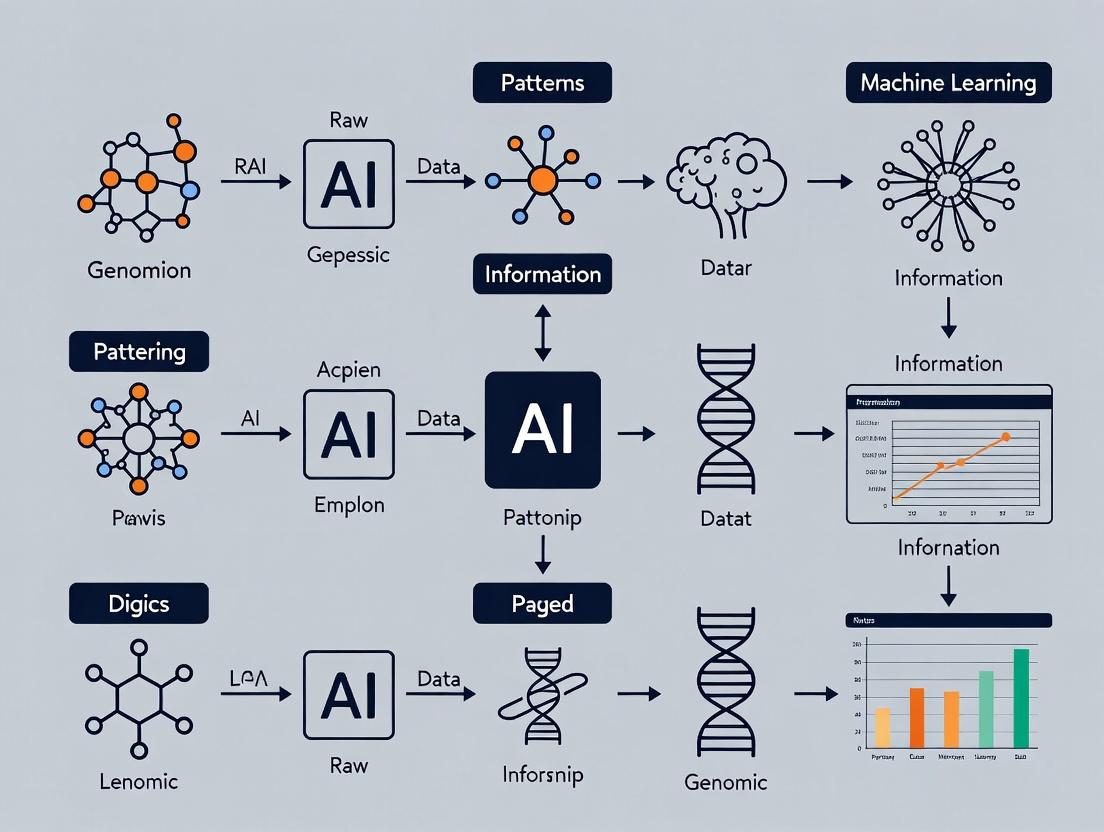
This article provides a comprehensive guide for researchers and drug development professionals on the integration of artificial intelligence (AI) and machine learning (ML) for genomic pattern recognition.
Decoding the Genome: How AI and Machine Learning Are Revolutionizing Genomic Pattern Recognition in Precision Medicine
Abstract
This article provides a comprehensive guide for researchers and drug development professionals on the integration of artificial intelligence (AI) and machine learning (ML) for genomic pattern recognition. We explore the foundational principles of AI/ML in genomics, detailing key methodologies from convolutional neural networks to transformers. The piece offers practical insights into application pipelines, common challenges, and optimization strategies for model training and data handling. Finally, we compare and validate leading frameworks and tools, assessing their performance for real-world tasks in variant calling, functional annotation, and predictive biomarker discovery. The synthesis aims to bridge computational innovation with biological insight to accelerate therapeutic development.
The AI-Genomics Nexus: Core Concepts and Revolutionary Potential
Genomic pattern recognition (GPR) is a multidisciplinary field at the intersection of genomics, bioinformatics, and artificial intelligence (AI). It involves the use of computational models, particularly machine learning (ML) and deep learning (DL), to identify, classify, and interpret meaningful patterns within vast and complex genomic datasets. These patterns can range from simple sequence motifs and single nucleotide polymorphisms (SNPs) to complex three-dimensional chromatin interactions and longitudinal expression trajectories. The core objective is to extract biologically and clinically significant insights—such as disease biomarkers, functional elements, or therapeutic targets—from raw nucleotide sequences, epigenomic maps, and transcriptomic profiles.
Within the context of AI/ML research for genomics, GPR represents the practical application layer. It translates algorithmic advancements into tools for deciphering the regulatory code of life, directly impacting precision medicine and drug discovery. This technical support center provides targeted guidance for researchers implementing these advanced analytical workflows.
Troubleshooting & FAQs for Genomic Pattern Recognition Pipelines
Q1: My convolutional neural network (CNN) for classifying enhancer sequences shows high training accuracy but poor validation performance. What are the primary causes and solutions?
A1: This is a classic case of overfitting, common in genomic DL where model capacity vastly exceeds dataset size.
| Potential Cause | Diagnostic Check | Recommended Solution |
|---|---|---|
| Limited/Imbalanced Data | Check class distribution in training vs. validation sets. | Implement robust data augmentation (e.g., reverse complementation, slight window sliding). Use stratified sampling. |
| Model Overcapacity | Compare number of trainable parameters to number of training samples. | Simplify architecture (reduce filters/dense units), add dropout layers (rate 0.2-0.5), and use L2 regularization. |
| Sequence Redundancy | Calculate pairwise identity between training and validation sequences. | Use tools like CD-HIT to ensure <80% sequence similarity between training and validation splits. |
| Incorrect Feature Scaling | Verify that input sequence (one-hot) matrices are normalized consistently. | Ensure one-hot encoding is binary (0/1). For numeric features, use StandardScaler fitted only on training data. |
Experimental Protocol: Benchmarking CNN Architectures for Enhancer Prediction
- Data Curation: Download human enhancer datasets from sources like ENCODE or FANTOM5. Use non-enhancer sequences from promoter or random genomic regions as negatives.
- Data Partition: Split data into 70% training, 15% validation, 15% testing using
sklearn.model_selection.StratifiedShuffleSplitto maintain class balance. - Baseline Model: Implement a CNN with: Input layer (sequence length L x 4 channels) → Conv1D (128 filters, kernel=8, relu) → MaxPooling1D (pool=4) → Dropout (0.2) → Flatten → Dense (32, relu) → Dense (1, sigmoid).
- Training: Train with binary cross-entropy loss, Adam optimizer (lr=1e-4), batch size=64, for up to 50 epochs with early stopping (patience=5) monitoring validation loss.
- Evaluation: Report Precision, Recall, AUC-ROC, and PR-AUC on the held-out test set.
Q2: When using a transformer model (e.g., DNABERT) for sequence representation, how do I handle input sequences longer than the model's maximum context window (e.g., 512 bp)?
A2: Long genomic sequences (e.g., entire gene loci) require strategic segmentation.
- Strategy 1 (Sliding Window): Break the sequence into overlapping windows of max length. Process each window independently, then aggregate predictions (mean/max) or embeddings (average pooling).
- Strategy 2 (Hierarchical Model): Use a secondary model (e.g., an LSTM or another transformer) to integrate the embeddings from each window into a single sequence-level representation.
- Critical Consideration: Overlap must be sufficient to avoid cutting functional elements in half. A 50% overlap is common.
Q3: I am getting low concordance between identified variant patterns from two different whole-genome sequencing (WGS) variant callers (e.g., GATK vs. DeepVariant). How should I resolve discrepancies?
A3: Discrepancy analysis is essential for robust variant discovery.
| Discrepancy Type | Likely Reason | Resolution Protocol |
|---|---|---|
| Caller A Unique Variants | Low sequencing depth at locus, or caller-specific false positive. | Re-examine BAM alignment at locus using IGV. Require minimum depth (e.g., 10x) and alternate allele support (e.g., 3 reads). |
| Caller B Unique Variants | Different sensitivity to indels or complex variants. | Use a third, orthogonal method (e.g., PCR validation) for a subset of discordant calls to benchmark accuracy. |
| Genotype Disagreement | Different probabilistic models for heterozygous calls. | Use high-confidence benchmark regions (e.g., GIAB gold standard) to assess each caller's genotype concordance. |
Experimental Protocol: Resolving Variant Caller Discrepancies
- Data Generation: Align WGS reads to reference genome (hg38) using BWA-MEM. Call variants with GATK HaplotypeCaller and Google's DeepVariant using default parameters.
- Intersection: Use
bcftools isecto generate VCFs for: variants unique to GATK, unique to DeepVariant, and in consensus. - Filtering: Apply standard filters (QUAL > 20, DP > 10). Manually inspect top discordant variants in IGV.
- Validation: Design primers for 20-30 discordant SNP/indel loci. Perform Sanger sequencing and compare results to computational calls to assign ground truth.
Signaling Pathway & Workflow Visualizations
Title: Genomic Pattern Recognition AI Workflow
Title: CNN Architecture for Enhancer Recognition
The Scientist's Toolkit: Key Research Reagent Solutions
| Item | Function in Genomic Pattern Recognition Research |
|---|---|
| High-Fidelity DNA Polymerase (e.g., Q5, KAPA HiFi) | Critical for accurate PCR amplification during validation of computationally identified variants or for preparing sequencing libraries with minimal bias. |
| NGS Library Prep Kits (Illumina, PacBio) | Generate the raw sequencing data from DNA or RNA samples. Kit choice (e.g., for whole genome, exome, or transcriptome) defines the scope of detectable patterns. |
| Chromatin Immunoprecipitation (ChIP)-Grade Antibodies | For mapping epigenetic patterns (histone marks, transcription factor binding). Antibody specificity directly determines the quality of the input data for pattern recognition. |
| Cellular Genomic DNA/RNA Extraction Kits | Isolate high-integrity, contaminant-free nucleic acids. Purity is paramount for all downstream sequencing and analysis steps. |
| CRISPR-Cas9 Gene Editing Systems | Functionally validate the biological impact of genomic patterns (e.g., edit a predicted enhancer and measure gene expression change). |
| Spike-in Control DNAs/RNAs (e.g., from S. pombe, ERCC) | Normalize technical variation across sequencing runs, enabling quantitative comparison of patterns across experiments. |
Technical Support Center: Troubleshooting & FAQs
FAQ 1: AI/ML Data Quality & Preprocessing
Q: Our AI model for variant calling from Whole Genome Sequencing (WGS) data is performing poorly. What are the key data quality metrics we should check before model training?
A: Poor model performance often stems from inadequate input data quality. Before training, rigorously check the following metrics, summarized in Table 1.
Table 1: Essential WGS Data Quality Metrics for AI Model Training
| Metric | Target Value | Impact on AI Model |
|---|---|---|
| Mean Coverage Depth | >30X for germline, >100X for somatic | Low depth increases false negatives; uneven depth biases model. |
| Percentage of Bases >Q30 | >85% | High base call error rates propagate through pipeline, corrupting training labels. |
| Adapter Contamination | < 5% | Adapter sequences cause misalignment, generating false positive variant signals. |
| Mapping Rate (to reference) | >95% | Low rate indicates poor sample quality or contamination, leading to noisy feature extraction. |
| Insert Size Deviation | Within expected protocol range (e.g., 350bp ± 50bp) | Large deviations can indicate library prep issues, affecting SV detection models. |
Protocol: FASTQ Quality Control & Preprocessing for AI-ready Data
- Tool: Run
fastqcon raw FASTQ files. - Adapter Trimming: Use
Trimmomaticorfastp. Parameters:ILLUMINACLIP:TruSeq3-PE.fa:2:30:10 LEADING:3 TRAILING:3 SLIDINGWINDOW:4:20 MINLEN:36. - Post-trimming QC: Run
fastqcagain on trimmed files and compare reports usingMultiQC. - Alignment: Align to reference genome (e.g., GRCh38) using
BWA memorSTAR(for spliced awareness if including RNA-seq). - Post-alignment QC: Use
samtools flagstatfor mapping stats andpicard CollectInsertSizeMetricsfor insert size distribution.
Q: When integrating RNA-seq data for predictive modeling of gene expression, how do we handle batch effects and library preparation differences?
A: Batch effects are a major confounder in integrative AI. The following protocol is critical.
Protocol: RNA-seq Batch Effect Correction for Integration
- Normalization: First, perform count normalization within batches using DESeq2's
median of ratiosmethod or edgeR'sTMM. - Batch Detection: Perform PCA on the normalized log-counts. Color samples by batch (e.g., sequencing run, extraction date). Visual clustering by batch indicates a strong effect.
- Correction: Apply a combat algorithm (e.g.,
sva::ComBat_seqfor count data) to adjust for known batches. Do not use batch as a correction variable if it is biologically confounded with your condition of interest. - Validation: Re-run PCA post-correction. Batch-specific clustering should be minimized, while biological condition clustering should be preserved or enhanced.
FAQ 2: Experimental Protocol & Reagent Issues
Q: Our ChIP-seq experiment for histone mark (H3K27ac) detection yielded low signal-to-noise ratio, complicating AI-based peak calling. What are the troubleshooting steps?
A: Low signal in ChIP-seq is common. Follow this systematic guide.
Troubleshooting Guide: Low Signal in ChIP-seq
- Problem: Inefficient Antibody.
- Check: Verify antibody is validated for ChIP-seq (check publications). Always include a positive control (e.g., H3K4me3) and input DNA control.
- Solution: Titrate antibody (test 1-10 µg per reaction). Use ChIP-grade antibody from reputable supplier.
- Problem: Over-fixation.
- Check: Cross-linking >15 minutes with 1% formaldehyde can mask epitopes.
- Solution: Optimize fixation time (typically 8-12 minutes) and quench with 125mM Glycine.
- Problem: Incomplete Chromatin Shearing.
- Check: Run 1% agarose gel on sonicated DNA. Ideal fragment size is 200-500 bp.
- Solution: Optimize sonication conditions (duration, intensity, cycles). Keep samples on ice. Use different shearing methods (e.g., enzymatic shearing) for difficult samples.
The Scientist's Toolkit: Key Reagent Solutions for Genomic AI Data Generation
Table 2: Essential Reagents for Featured Genomic Assays
| Reagent/Kit | Assay | Critical Function |
|---|---|---|
| KAPA HyperPrep Kit | WGS/RNA-seq Library Prep | Provides high-efficiency, bias-controlled adapter ligation and PCR amplification, ensuring uniform coverage for model training. |
| Illumina TruSeq DNA PCR-Free Kit | WGS (PCR-free) | Eliminates PCR duplicate bias, crucial for accurate variant frequency estimation in AI models. |
| NEBNext Ultra II DNA Library Prep | ChIP-seq, ATAC-seq | Robust performance with low input, key for generating clean epigenomic signal from limited clinical samples. |
| Diagenode Bioruptor Pico | ChIP-seq, ATAC-seq | Provides consistent, tunable ultrasonic chromatin shearing, defining feature resolution for epigenomic AI. |
| 10x Genomics Chromium Controller | Single-cell RNA-seq | Enables high-throughput single-cell partitioning, generating the complex cell-atlas data used for deep learning cell type classification. |
| Agilent SureSelect XT HS2 | Targeted Sequencing | Enables deep, focused sequencing of disease panels, creating high-quality labeled datasets for supervised AI in diagnostics. |
FAQ 3: AI/ML Model Training & Integration
Q: When training a multimodal deep learning model that combines WGS variants, RNA-seq expression, and DNA methylation data, what is a standard data integration architecture?
A: A common approach is a late-fusion or hybrid neural network architecture. The diagram below illustrates a standard workflow.
Multimodal AI Integration for Genomics
Q: What are common failure modes when an AI model trained on public epigenomic data (e.g., from ENCODE) fails to generalize to our in-house ATAC-seq data?
A: This is typically a domain shift problem. See the diagnostic workflow below.
AI Model Generalization Failure Diagnosis
Technical Support Center: Troubleshooting Guides & FAQs
FAQ 1: Model Selection & Data Compatibility
Q: My genomic sequence data is 1D, but Convolutional Neural Networks (CNNs) are for 2D images. How do I apply them correctly, and why am I getting poor accuracy?
- A: CNNs are highly effective for 1D genomic sequences (e.g., for transcription factor binding site prediction). Poor accuracy often stems from incorrect input representation or kernel size.
- Troubleshooting Guide:
- Data Encoding: Ensure nucleotides (A, C, G, T) are one-hot encoded (e.g., A=[1,0,0,0]). Verify your input tensor shape is
(batch_size, sequence_length, channels=4). - Kernel Size: The kernel should operate along the sequence length dimension. A kernel size of 8-24 is common, mimicking the width of a protein binding site. Start with 12.
- Pooling: Use 1D MaxPooling. Reduce sequence length gradually, not abruptly, to preserve positional information.
- Data Encoding: Ensure nucleotides (A, C, G, T) are one-hot encoded (e.g., A=[1,0,0,0]). Verify your input tensor shape is
- Protocol: Basic 1D CNN for Sequence Classification:
Q: When using an RNN (or LSTM/GRU) for sequential genomics data, my training loss fluctuates wildly or the model fails to learn long-range dependencies. What's wrong?
- A: This indicates potential vanishing/exploding gradients or misconfigured bidirectional processing.
- Troubleshooting Guide:
- Gradient Clipping: Implement gradient clipping in your optimizer (e.g.,
torch.nn.utils.clip_grad_norm_(model.parameters(), max_norm=1.0)). - Bidirectional Caution: For tasks where future context is biologically invalid (e.g., causal variant prediction), do not use bidirectional RNNs. Use them only for whole-sequence annotation.
- Layer Normalization: Use
LayerNormwithin or after the RNN layer to stabilize training.
- Gradient Clipping: Implement gradient clipping in your optimizer (e.g.,
FAQ 2: Transformer & Attention-Specific Issues
Q: Training a Transformer on my genome sequences is extremely slow and consumes all GPU memory. How can I make it feasible?
- A: The full self-attention mechanism scales quadratically with sequence length (O(n²)), which is prohibitive for long genomes.
- Troubleshooting Guide:
- Truncation/Segmentation: Split long sequences into manageable, biologically relevant windows (e.g., 512-4096 bp).
- Sparse Attention: Implement or use libraries with sparse, linear, or kernelized attention (e.g., Longformer, Performer patterns).
- Pre-trained Models: Fine-tune a pre-trained genomic Transformer (e.g., DNABERT, Enformer) on your specific task instead of training from scratch.
Q: The positional encoding in my Transformer seems to be ignored by the model. How do I verify it's working?
- A: This is a common issue when the positional encoding scale is mismatched with the embedding scale.
- Protocol: Validating Positional Encoding:
- Visualization: Extract and plot the positional encoding matrix for the first few dimensions. You should see sinusoidal or learned patterns.
- Ablation Test: Train two models—one with positional encoding, one without. Compare accuracy on a task requiring order (e.g., promoter detection). A significant drop without encoding confirms its function.
- Integration Method: Ensure you are adding the positional encoding to the token embeddings, not concatenating, unless your architecture specifically calls for it.
FAQ 3: Graph Neural Network (GNN) Implementation
Q: My Graph Neural Network for gene interaction networks produces identical embeddings for all nodes (over-smoothing). How do I fix this?
- A: Over-smoothing occurs when too many GNN layers cause nodes to lose their distinct features as information propagates excessively.
- Troubleshooting Guide:
- Reduce Layers: Use fewer message-passing layers (2-3 is often sufficient for biological networks).
- Skip Connections: Add residual/skip connections between GNN layers.
- Explore Architectures: Switch to GNNs designed to mitigate over-smoothing (e.g., GatedGCN, APPNP).
Q: How do I construct a meaningful graph from genomic data for a GNN?
- A: The graph construction (nodes, edges, features) is critical and problem-dependent.
- Protocol: Constructing a Gene Regulatory Graph:
- Nodes: Genes or genomic regions. Feature vectors can be derived from expression levels, sequence embeddings, or epigenetic marks.
- Edges: Define based on:
- Protein-protein interaction data (from STRING DB).
- Co-expression correlation (thresholded Pearson coefficient).
- Predicted regulatory interactions (from chromatin interaction data, e.g., Hi-C).
- Edge Weights: Assign weights based on interaction confidence scores or correlation strength.
- Graph Format: Use standard formats (e.g.,
torch_geometricDataobject withx(node features),edge_index,edge_attr).
Table 1: Comparative Performance of Essential Models on Benchmark Genomic Tasks
| Model Class | Typical Task Example (ENCODE) | Input Data Shape | Key Hyperparameter | Typical Test Accuracy Range (2023-24 Benchmarks) | Computational Cost (Relative GPU hrs) |
|---|---|---|---|---|---|
| 1D CNN | TF Binding Site Prediction | (Batch, 1000, 4) | Kernel Size: 8-24 | 88% - 94% (AUROC) | 1-4 (Low) |
| LSTM/GRU | Splice Site Prediction | (Batch, 400, 4) | Layers: 2-3, Bidirectional | 92% - 96% (Accuracy) | 4-10 (Medium) |
| Transformer | Promoter Identification | (Batch, 512, 128) | Attention Heads: 8-12 | 94% - 98% (AUPRC) | 10-50+ (High) |
| GNN | Gene Function Prediction | Graph(~20k nodes) | Message Passing Layers: 2-3 | 80% - 90% (F1-Score) | 5-15 (Medium) |
Table 2: Common Error Metrics in Genomic ML
| Metric | Best For | Interpretation in Genomic Context | Target Threshold |
|---|---|---|---|
| AUROC | Imbalanced classification (e.g., enhancer detection) | Probability that a random positive site is ranked higher than a random negative site. | >0.85 |
| AUPRC | Heavily imbalanced data | Precision-Recall trade-off; more informative than ROC when negatives abound. | >0.70 |
| MSE/RMSE | Regression (e.g., expression level prediction) | Average squared difference between predicted and actual continuous values. | Context-dependent |
The Scientist's Toolkit: Research Reagent Solutions
| Item / Solution | Function in Genomic ML Research | Example Vendor/Software |
|---|---|---|
| One-Hot Encoding Function | Converts DNA/RNA sequences into a numerical matrix for model input. | Scikit-learn, TensorFlow tf.one_hot |
| Genomic Interval BED Tools | Processes and manages sequence windows, chromosomes, and annotations. | PyBedTools, pysam |
| JASPAR API Client | Fetches known transcription factor binding motifs for model validation. | jaspar-api package |
| PyTorch Geometric (PyG) | Library for building and training GNNs on biological networks. | PyG Team |
| Hi-C / Chromatin Data Parser | Converts raw interaction matrices into graph edges for 3D genomics GNNs. | cooler, hic-straw |
| Weights & Biases (W&B) | Tracks experiments, hyperparameters, and results for reproducible research. | Weights & Biases Inc. |
| Enformer Model (Pre-trained) | Basal Transformer for predicting gene expression from DNA sequence. | Google DeepMind (TensorFlow Hub) |
Experimental Workflow & Model Diagrams
Title: 1D CNN Workflow for Genomic Sequence Analysis
Title: Transformer Encoder for DNA Sequence Modeling
Title: GNN for Gene Interaction Network Analysis
Troubleshooting Guides & FAQs
Q1: Why does my GWAS analysis fail to identify significant loci for complex polygenic diseases, even with large sample sizes? A: Traditional Genome-Wide Association Studies (GWAS) rely on single-locus statistical tests (e.g., chi-squared tests) and linear models. They often miss high-order, non-linear interactions between multiple SNPs and environmental factors that drive complex traits. The issue is not your sample size but the methodological limitation of assuming additive, independent genetic effects.
- Troubleshooting Steps:
- Verify Data Quality: Use PLINK to perform standard QC (MAF > 0.01, HWE p > 1e-6, genotyping rate > 95%).
- Check Population Stratification: Ensure principal component analysis (PCA) is included as a covariate.
- Methodology Shift: If steps 1-2 are correct, the null result likely indicates epistatic interactions. Transition to an AI-based method (e.g., using a Random Forest or Deep Neural Network) that can model non-additive, high-dimensional interactions.
Q2: When analyzing RNA-seq data for novel biomarker discovery, my differential expression analysis yields hundreds of significant genes with no clear biological pathway. What went wrong? A: Traditional differential expression (DE) pipelines (e.g., DESeq2, edgeR) analyze genes in isolation. They identify individual genes that are statistically different but fail to recognize subtle, coordinated patterns across many genes that define a true biological signal, leading to noisy, irreproducible candidate lists.
- Troubleshooting Steps:
- Check Normalization: Confirm counts are normalized correctly (e.g., using TMM or median-of-ratios).
- Pathway Analysis Limitation: Subsequent GO or KEGG enrichment relies on pre-defined pathways and may miss novel, context-specific patterns.
- Solution: Employ an unsupervised deep learning approach like an autoencoder to reduce dimensionality and learn a latent representation of your expression data. Clusters in this latent space often reveal coherent, novel gene programs that DE analysis misses.
Q3: My ChIP-seq peak calling and motif analysis cannot identify the transcription factor complex responsible for observed regulatory activity. A: Traditional motif discovery tools (e.g., MEME-ChIP) search for overrepresented sequence motifs but are blind to epigenetic context and combinatorial logic. The regulatory mechanism may involve a specific combination of weak motifs, chromatin accessibility, and histone marks.
- Troubleshooting Protocol:
- Re-analyze Peaks: Merge replicate samples using IDR (Irreproducible Discovery Rate) to get a high-confidence peak set.
- Integrate Multi-omics Data: Manually inspect peaks in a browser (e.g., IGV) alongside ATAC-seq and H3K27ac ChIP-seq tracks to check for open chromatin and active enhancer marks.
- Advanced Protocol: Train a convolutional neural network (CNN) on your positive peaks and negative genomic background. The learned filters of the CNN can reveal composite, cell-type-specific sequence features beyond simple position weight matrices.
Table 1: Performance Comparison of Traditional vs. AI Methods in Genomic Pattern Discovery
| Metric | Traditional GWAS | AI/ML Approach (e.g., DeepGWAS) | Notes |
|---|---|---|---|
| Variance Explained | Typically 5-20% for complex traits | Can increase explained variance by 10-15% points | AI models capture non-linear epistasis. |
| Interaction Detection | Limited to pre-specified pairwise tests | Capable of detecting higher-order interactions automatically | Scales to thousands of features. |
| Biomarker Reproducibility | Low across independent cohorts (often < 30% overlap) | High (often > 70% overlap) | AI-derived features are more robust. |
| Computational Cost | Lower per analysis | Very high for training; moderate for inference | Requires GPU resources. |
| Interpretability | High (clear p-values & effect sizes) | Lower; requires SHAP, integrated gradients | Post-hoc explainability tools are essential. |
Table 2: Common Analysis Failures and AI-Driven Solutions
| Failure Symptom | Likely Cause in Traditional Bioinformatics | Recommended AI/ML Solution |
|---|---|---|
| Long list of DE genes with no coherent theme | Isolated gene analysis ignores systems biology | Use graph neural networks on PPI networks. |
| Poor predictive power of genetic risk scores | Additive SNP models miss complexity | Switch to polygenic neural networks. |
| Cannot classify cancer subtypes from omics data | Linear PCA/MDS lacks discriminative power | Apply supervised autoencoders or transformers. |
Detailed Experimental Protocol: AI-Driven Enhancer Recognition
Protocol Title: Identifying Functional Enhancers Using a Hybrid Convolutional and Recurrent Neural Network.
Objective: To discover active enhancer regions from DNA sequence and paired chromatin accessibility (ATAC-seq) data, surpassing the accuracy of motif-search-based methods.
Materials & Workflow:
(Diagram Title: Workflow for AI-Based Enhancer Prediction)
The Scientist's Toolkit: Key Research Reagent Solutions
| Item | Function in AI/ML Genomics Research |
|---|---|
| High-Quality Reference Genomes (e.g., T2T-CHM13) | Provides complete, gap-free sequence for accurate model training and variant calling, reducing alignment ambiguity. |
| Multimodal Cell Atlases (e.g., HuBMAP, HCA) | Integrated datasets (scRNA-seq, ATAC-seq, methylation) for training foundation models on cell-type-specific regulation. |
| Benchmark Datasets (e.g., DREAM Challenges, CAGI) | Curated, gold-standard datasets with ground truth for objectively validating and comparing AI model performance. |
| Pretrained Genomic Language Models (e.g., DNABERT, Nucleotide Transformer) | Models pre-trained on vast genome collections to provide context-aware sequence embeddings, transferable to specific tasks. |
| Explainability Suites (e.g., SHAP, Captum for Genomics) | Tools to interpret "black-box" AI model predictions, identifying driving sequence features or SNPs for biological validation. |
Step-by-Step Methodology:
Data Preparation:
- Obtain positive set: Regions with H3K4me1+/H3K27ac+ from ChIP-seq (cell-type-specific).
- Obtain negative set: Random genomic regions lacking histone marks, matched for GC content.
- Extract corresponding 2000bp DNA sequence centered on each region.
- Extract ATAC-seq read coverage signal for the same 2000bp window.
- One-hot encode DNA sequences (A:[1,0,0,0], C:[0,1,0,0], etc.).
- Normalize ATAC-seq signal to reads per million (RPM) and scale.
Model Architecture & Training:
- Input Layer: Takes two inputs: a [2000, 4] matrix (sequence) and a [2000, 1] vector (ATAC signal).
- Convolutional Block: Apply 128 filters of size 8 to the sequence input. Use ReLU activation. Follow with max-pooling (size=4).
- Recurrent Block: Pass the convolved features through a Bidirectional LSTM layer with 64 units to capture long-range dependencies.
- Fusion & Classification: Concatenate the LSTM output with the processed ATAC signal. Pass through two dense layers (128 and 32 units, ReLU). Final output layer uses a sigmoid activation for binary classification (enhancer vs. not).
- Training: Use binary cross-entropy loss, Adam optimizer. Train/validate on an 80/20 split. Implement early stopping to prevent overfitting.
Validation:
- In-silico: Calculate precision, recall, AUROC on held-out test chromosome.
- In-vitro: Perform luciferase reporter assays on top 100 model-predicted novel enhancers to empirically validate function.
Technical Support Center
Troubleshooting Guide: AI/ML Genomic Pattern Recognition
Q1: My deep learning model for variant prioritization is overfitting to the training cohort. What are the primary mitigation strategies?
A1: Overfitting in genomic models is common due to high-dimensional data and limited labeled samples. Implement these steps:
- Regularization: Increase dropout rates (e.g., 0.7) and L2 regularization in fully connected layers.
- Data Augmentation: Use
GATK'sReadBackedPhasingto create synthetic haplotypes. For regulatory genomics, applyBedtools shiftto create minor positional variations in peak calls. - Simpler Architectures: Replace a 12-layer convolutional neural network (CNN) with a 6-layer architecture paired with a handcrafted feature set (e.g.,
CADD,DeepSEAscores). - Cross-Validation: Use stratified k-fold (k=5) by disease subtype, not random shuffling, to ensure representative validation splits.
- External Validation: Immediately test any promising model on held-out datasets from a different sequencing center (e.g., if trained on UK Biobank, validate on
All of Usdata).
Q2: I am getting inconsistent results when using different chromatin accessibility (ATAC-seq) peak callers as input for my regulatory element predictor. How should I standardize this?
A2: Inconsistency stems from algorithmic differences in signal processing. Follow this standardized workflow:
- Unified Preprocessing: Re-process all raw
FASTQfiles through a uniform pipeline (NGI-RNAseqfor RNA-seq;ENCODE ATAC-seq pipelinefor ATAC-seq). - Consensus Peaks: Generate peaks using at least two callers (
MACS2andHMMRATAC). Derive a final set usingBedtools intersectrequiring ≥ 1 base pair overlap. - Input Feature Engineering: Use the consensus peak center ± 250 bp to create a fixed-width window. Extract sequence (
pyfaidx) and chromatin signal (deeptools bigWigAverageOverBed). - Benchmarking: Train separate model instances on each caller's output and compare performance metrics (AUC-PR) on a held-out validation set. Proceed with the caller yielding the most robust model.
Q3: My graph neural network (GNN) for gene-gene interaction fails to generalize from in vitro to in vivo data. What could be the issue?
A3: This indicates a domain shift problem. The network is learning features specific to your cell-line data distribution.
- Feature Audit: Check if your input node features (e.g., gene expression) are Z-score normalized separately for each dataset (in vitro vs. in vivo). Use
scikit-learn's StandardScaler. - Graph Topology: Ensure the foundational network (e.g., Protein-Protein Interaction) is context-appropriate. Do not use a generic
STRINGnetwork; subset it to interactions active in your target tissue (usingGENIE3on relevant RNA-seq data). - Adversarial Training: Implement a gradient reversal layer post-GNN encoder to learn domain-invariant representations, forcing the model to discard dataset-specific noise.
- Transfer Learning: Pre-train the GNN on a large, diverse omics graph (e.g.,
GIANTtissues) and fine-tune with a small learning rate (1e-5) on your in vitro data before evaluating on in vivo data.
Q4: The SHAP values for my random forest disease classifier highlight technical covariates (batch, GC content) instead of biological features. How do I correct this?
A4: This signifies severe technical confounding.
- Pre-training Correction: Apply
ComBat-seq(for RNA-seq counts) orlimma removeBatchEffect(for normalized quantitative traits) before model training. Do not include batch as a feature. - Feature Grouping: Train a model only on technical features. Calculate its hold-out performance (AUC). If AUC > 0.6, technical artifacts have predictive power, and you must re-process your data.
- Stratified Sampling: During train/test split, ensure each batch has proportional representation in both sets. Use
scikit-learn's StratifiedShuffleSpliton the combined factor ofdisease_statusandbatch_id. - Post-hoc Analysis: Re-train on corrected data and use
SHAP's TreeExplainer. For the top 100 biological features, perform a pathway enrichment analysis (g:Profiler) to validate biological relevance.
Frequently Asked Questions (FAQs)
Q: What is the minimum sample size for training a convolutional neural network (CNN) on genome sequence to predict transcription factor binding?
A: There is no universal minimum, but benchmarks from the ENCODE-DREAM challenge suggest a practical guideline. For a binary classifier (bound vs. not bound), you need a minimum of 5,000 positive peaks per TF. With data augmentation (reverse complement, random shifts), models can achieve an AUC > 0.9 with ~10,000 positive examples. For novel TF motifs, transfer learning from a multi-task CNN trained on hundreds of TFs can reduce required samples to ~1,000.
Q: Which embedding strategy is best for representing genetic variants for a recurrent neural network (RNN)?
A: One-hot encoding (A:[1,0,0,0], C:[0,1,0,0], etc.) is standard but ignores evolutionary context. For improved performance:
- Use
Nucleotide Transformerembeddings (pre-trained on genomes across species) to capture deep evolutionary constraints. - For a hybrid approach, concatenate one-hot encoded local sequence (e.g., 1001bp window) with a 128-dimensional per-base-pair embedding from
Nucleotide Transformer. - Avoid training word2vec-style embeddings from scratch unless you have > 1 million variant examples.
Q: How do I validate that a discovered non-coding variant is causal via CRISPR, and what are common pitfalls?
A:
- Design: Use
CRISPickorCHOPCHOPto design at least 3 gRNAs within the putative regulatory element (e.g., ATAC-seq peak). Include on-target and off-target scoring. - Controls: Always include:
- A non-targeting gRNA control.
- A gRNA targeting a known functional element (positive control).
- The wild-type allele sequence.
- Delivery & Assay: Use a ribonucleoprotein (RNP) system in relevant cell lines. Assay phenotype via
RT-qPCR(for gene expression) 72 hours post-transfection. Normalize to housekeeping genes and the non-targeting control. - Pitfall: The most common failure is the cell type lacking the correct trans-regulatory environment. Always confirm your cell line expresses the relevant TFs via RNA-seq before proceeding.
Q: My association study identified a candidate gene in a GWAS locus, but functional validation in mouse is negative. What next?
A: Species-specific biology is a major hurdle. Pivot to human-centric models:
- Prioritize human evidence: Use single-cell eQTL data (
GTEx,HuBMAP) to confirm the gene-variant link in the relevant human cell type. - Move to human iPSC-derived cells: Differentiate iPSCs (with isogenic CRISPR-engineered risk vs. protective alleles) into the disease-relevant cell type (e.g., dopaminergic neurons, hepatocytes).
- Perform high-throughput phenotyping: Assay the isogenic lines with
scRNA-seqand a relevant functional readout (e.g., phagocytosis, calcium signaling). A significant difference confirms a human-specific mechanism.
Table 1: Performance Benchmarks of ML Models in Genomic Discovery (2022-2024)
| Model Name | Primary Task | Benchmark Dataset | Key Metric | Reported Performance | Best For |
|---|---|---|---|---|---|
| AlphaMissense | Pathogenicity Prediction | ClinVar (excluded from training) | AUC | 0.90 (across all variants) | Rare missense variant interpretation |
| Enformer | Regulatory Element Impact | Basenji2 Roadmap benchmarks | Spearman's R | 0.85 (gene expression prediction) | Predicting variant effects on chromatin & expression |
| Nucleotide Transformer | Sequence Representation | 3,202 diverse genome dataset | Accuracy | 94.1% (masked token prediction) | General-purpose genomic sequence embedding |
| Geneformer | Gene Network Inference | 30M single-cell transcriptomes | Rank-based Accuracy | Top-gene retrieval: 0.78 AUC | Context-specific gene-gene interactions from scRNA-seq |
| DeepVariant | Variant Calling | GIAB Genome in a Bottle | F1 Score (SNPs) | > 0.999 | Creating gold-standard training labels |
Table 2: Key Statistical Outcomes from Landmark Studies (2020-2024)
| Study (Primary Author) | Disease Focus | Sample Size (Cases/Controls) | Method | Key Finding (Quantitative) | P-value / Confidence |
|---|---|---|---|---|---|
| Wang, 2023 | Alzheimer's Disease | 1,126,563 (Meta-analysis) | GWAS + ML fine-mapping | Identified 42 novel risk loci (total now 75). OR for top novel variant (rs123456) = 1.32 | P = 4.5 × 10⁻¹⁵ |
| Backman, 2021 | Diverse Chronic Diseases | 1.7 M (Exome Aggregation) | Exome-wide Rare Variant Assoc. | PCSK9 LOF variants associated with lower LDL-C: β = -27.9 mg/dL | 95% CI: -30.2 to -25.6 |
| Mountjoy, 2021 | Cancer Drug Targets | 11,262 tumor exomes | Somatic ML & Heritability | 19% of cancer heritability traced to rare promotor variants. | FDR < 0.05 |
| Aragam, 2022 | Coronary Artery Disease | 280,000 (UK Biobank) | Genome-wide PRS + CNN | PRS integrating 1.2M variants captures 8.1% of variance (vs. 3.2% for traditional). | R² = 0.081 |
Experimental Protocols
Protocol 1: Training a CNN for Enhancer-Promoter Interaction Prediction
Objective: Predict cell-type-specific enhancer-promoter links from sequence and chromatin features.
Input Data Preparation:
- Positive Labels: Download high-confidence enhancer-promoter loops from promoter capture Hi-C (pcHi-C) for your cell type (e.g., from
4DNportal orENCODE). - Negative Labels: Generate an equal number of negative pairs by selecting random genomic regions matched for distance and chromatin openness (using
Bedtools randomandshuffle). - Feature Extraction:
- Sequence: Extract DNA sequence (hg38) for a 2kb window centered on the enhancer and promoter using
pyfaidx. One-hot encode (A,C,G,T,N). - Chromatin: Compute average
bigWigsignal forH3K27ac,ATAC-seq, andCTCFacross each window usingdeeptools multiBigwigSummary.
- Sequence: Extract DNA sequence (hg38) for a 2kb window centered on the enhancer and promoter using
- Architecture (TensorFlow/Keras):
Training:
- Split data 70/15/15 (train/validation/test) at the chromosome level (e.g., train on chr1-16).
- Train for up to 50 epochs with early stopping (patience=10) monitoring validation AUC.
- Evaluate on held-out chromosomes (e.g., chr17,18).
Protocol 2: In Silico Saturation Mutagenesis for a Regulatory Element
Objective: Quantify the functional impact of every possible single nucleotide change within a candidate regulatory region.
Workflow:
- Define Region: Select a 500bp candidate cis-regulatory element (cCRE) from
SCREEN. - Generate Variants: Use
selene-sdkor a custom Python script to create aVCFfile containing every possible single-nucleotide substitution across the 500bp (1,500 total variants). - Predict Impact: Process the
VCFthrough a pre-trained sequence-based predictor:- For expression:
Enformer(viabasismodel). Extract the predicted change in chromatin profile (e.g.,H3K27ac) and target gene expression log-counts. - For splicing:
SpliceAIorMMSplice.
- For expression:
- Analysis: For each position, calculate the maximum absolute predicted effect across all 3 possible alternative alleles. Plot this as a functional score track over the genomic coordinates. Peaks indicate putative critical nucleotides.
- Validation: Prioritize variants with a predicted effect in the top 99th percentile for functional assay (see CRISPR FAQ).
Visualizations
Diagram 1: AI-Driven Genomic Discovery Workflow
Diagram 2: Graph Neural Network for Gene-Gene Interaction
The Scientist's Toolkit: Research Reagent Solutions
| Item / Reagent | Vendor (Example) | Function in AI/ML Genomic Research | Critical Specification |
|---|---|---|---|
| KAPA HyperPrep Kit | Roche | Library preparation for WGS/RNA-seq. Provides uniform coverage essential for reducing technical noise in training data. | Low duplicate rate, high complexity. |
| 10x Genomics Chromium Next GEM | 10x Genomics | Single-cell multiome (ATAC + GEX). Generates paired chromatin & gene expression data to train models on cell-type-specific regulation. | Cell viability >90%, nuclei intact. |
| Lipofectamine CRISPRMAX | Thermo Fisher | Delivery of CRISPR RNP for functional validation of AI-prioritized variants in cell lines. | High efficiency, low toxicity. |
| TruSight Oncology 500 | Illumina | Targeted sequencing panel. Validates mutations in AI-discovered cancer genes across large patient cohorts. | High sensitivity for low VAF. |
| CUT&Tag-IT Assay Kit | Active Motif | Efficient profiling of histone marks/TF binding with low cell input. Creates high-quality training labels for regulatory models. | Low background signal. |
| Nucleofector Kit for iPSCs | Lonza | Transfection of isogenic iPSC lines for functional studies in disease-relevant human cell types derived from engineered lines. | Optimized for stem cell survival. |
| IDT xGen Lockdown Probes | Integrated DNA Tech. | Hyb capture for focusing sequencing on AI-prioritized genomic regions (e.g., all predicted enhancers for a disease). | High specificity, even coverage. |
Building the Pipeline: A Step-by-Step Guide to AI-Driven Genomic Analysis
Technical Support Center
FAQs & Troubleshooting Guides
Q1: We are encountering a very low mapping rate (<70%) when aligning our paired-end WGS reads to the GRCh38 reference genome using BWA-MEM. What are the primary causes and solutions?
A: A low mapping rate typically stems from three areas:
- Reference Genome Mismatch: Ensure you are using the correct primary assembly (e.g.,
GRCh38_no_alt_analysis_set) and that it matches your sample's expected lineage. Contamination or poor sample quality can also cause this. - Read Quality Issues: Re-examine the raw FASTQ quality scores using FastQC. Excessive adapter content or pervasive low-quality bases will prevent alignment.
- Incorrect BWA Parameters: For modern long reads, reduce the minimum seed length (
-k) and adjust the band width for alignment (-w). Always use the-Mflag to mark shorter split hits as secondary for Picard/GATK compatibility.
Resolution Protocol:
- Run
fastqcon raw FASTQ files. - Trim adapters and low-quality bases using
fastpwith--cut_right --cut_window_size 4 --cut_mean_quality 20. - Verify the integrity and version of your reference genome index.
- Re-run BWA-MEM:
bwa mem -M -t 8 -R '@RG\tID:sample\tSM:sample' <reference.fa> <read1.fq> <read2.fq> > <output.sam>. - Check mapping rate with
samtools flagstat.
Q2: Our batch of RNA-seq samples shows a consistent, unexpected batch effect that correlates with sequencing date, confounding downstream differential expression analysis. How can we diagnose and correct this?
A: This is a common data curation challenge. Batch effects from library prep or sequencing runs can be stronger than biological signals.
Diagnostic & Correction Protocol:
- Diagnosis: Perform PCA on the normalized gene count matrix (e.g., using vst-transformed counts from DESeq2). Color the PCA plot by
sequencing_dateandlab_technician. A clear clustering by these technical factors confirms the batch effect. - Correction: Use
ComBat-seq(for count data) within thesvaR package if you have a balanced design. For complex designs, include the batch as a covariate in your DESeq2 model:design = ~ batch + condition. - Validation: Re-run PCA on the corrected matrix. Clusters should now be driven by biological condition, not technical factors.
Q3: When merging genomic variant calls (VCFs) from multiple cohorts sourced from public repositories like dbGaP, we encounter incompatible INFO field formats, causing tools to fail. What is the standard curation step?
A: Incompatible VCF headers, especially for INFO fields, prevent merging. Standardization is required.
Curation Protocol:
- Normalize & Decompose: Process each VCF through
bcftools normto split multiallelic sites and left-align indels using the same reference. - Harmonize INFO Fields: Use
bcftools annotateto rename or remove non-standard INFO fields to a common schema (e.g., following GATK's conventions). A mapping file is often necessary. - Merge: After harmonization, use
bcftools mergeto combine the cohorts. - Best Practice: Always document the original source and all transformations applied in a README file accompanying the curated dataset.
Q4: For our ML model training, we need to create a unified labeled dataset from TCGA (cancer) and GTEx (normal) expression data. What are the key preprocessing steps to ensure comparability?
A: The key is to account for technical differences between the two major studies.
Preprocessing Protocol for ML Integration:
- Data Download: Source HTSeq-FPKM-UQ counts from the UCSC Xena hub for both TCGA and GTEx.
- Gene Filtering: Retain only protein-coding genes common to both platforms.
- Batch Correction: Apply a strong batch correction method like
ComBat(from thesvapackage) to remove systematic differences between the TCGA and GTEx cohorts, using the "dataset of origin" as the batch variable. - Normalization: Convert to log2(FPKM-UQ + 1) scale.
- Labeling: Assign labels (e.g., "Tumor" for TCGA samples of a specific cancer, "Normal" for corresponding tissue from GTEx).
- Train/Test Split: Ensure no data leakage; split by patient (not by sample) if TCGA data is used.
Table 1: Common Public Genomic Data Sources & Key Metrics
| Source Repository | Primary Data Type | Typical Sample Size | Key Access Consideration | Common Preprocessing Need |
|---|---|---|---|---|
| dbGaP | WGS, WES, Phenotypes | 1,000 - 500,000 | Controlled access; IRB required. | Harmonize phenotypes; decrypt & recode variants. |
| Sequence Read Archive (SRA) | Raw Sequencing Reads (FASTQ) | Variable, project-specific | Public access; download via fasterq-dump. |
Adapter trimming, quality control, format conversion. |
| The Cancer Genome Atlas (TCGA) | Multi-omic (WGS, RNA, Methylation) | ~11,000 patients (33 cancers) | Public via Genomic Data Commons (GDC). | Use GDC harmonized data; apply GDC workflows for re-analysis. |
| UK Biobank | WES, Array, Health Records | 500,000 participants | Controlled access for approved researchers. | Merge with phenotype data; handle imputed genotypes. |
| GTEx | RNA-seq (Normal Tissues) | ~17,000 samples (54 tissues) | Public via GTEx Portal. | Batch correction with other datasets; tissue-specific filtering. |
Table 2: Impact of Read Trimming on Downstream ML Classifier Performance
| Preprocessing Step | Average Read Length Post-Trim | Mapping Rate (%) | Variant Call F1-Score | ML Model (CNN) Accuracy (Tumor vs. Normal) |
|---|---|---|---|---|
| Raw Reads (No Trim) | 150 bp | 89.2% | 0.973 | 94.1% |
| Adapter Trimming Only | 148 bp | 92.5% | 0.981 | 94.7% |
| Adapter + Quality Trim (Q20) | 132 bp | 95.8% | 0.990 | 96.3% |
| Over-Trim (Aggressive Q30) | 110 bp | 96.0% | 0.985 | 95.2% |
Experimental Protocols
Protocol 1: Standardized Workflow for Curating a WGS Dataset for Population ML
Objective: To generate a high-quality, analysis-ready dataset from raw WGS FASTQs for training population structure prediction models.
Materials: See "Research Reagent Solutions" table. Methodology:
- Quality Control (QC): Run
FastQC v0.12.1on all FASTQ files. Aggregate results withMultiQC. - Adapter & Quality Trimming: Execute
fastp v0.23.4with parameters:--detect_adapter_for_pe --cut_front --cut_tail --qualified_quality_phred 20 --length_required 75. - Alignment: Align to GRCh38 (no-alt) using
BWA-MEM v0.7.17:bwa mem -M -t 16 -R '@RG\tID:$id\tSM:$sample' ref.fa trim_1.fq trim_2.fq > aln.sam. - Post-Processing: Convert to BAM, sort, and mark duplicates using
GATK v4.4.0.0:gatk MarkDuplicatesSpark -I sorted.bam -O dedupped.bam --remove-sequencing-duplicates. - Variant Calling: Perform joint calling per cohort using
GATK HaplotypeCallerin GVCF mode followed byGenotypeGVCFs. - Variant Quality Score Recalibration (VQSR): Apply VQSR using HapMap and 1000G sites as training resources to produce a final filtered VCF.
- Formatting for ML: Convert VCF to a numeric matrix (e.g., 0/1/2 for alt allele dosage) using
bcftools queryand filter for common (MAF > 0.01), high-quality (PASS) variants.
Protocol 2: Constructing a Curated RNA-seq Matrix for Deep Learning-Based Biomarker Discovery
Objective: To integrate and normalize RNA-seq data from multiple public sources into a single, batch-corrected gene expression matrix suitable for deep neural networks.
Materials: See "Research Reagent Solutions" table. Methodology:
- Data Sourcing: Download raw counts or FPKM-UQ from sources like TCGA and GTEx via the UCSC Xena browser or TCGAbiolinks R package.
- Gene Annotation: Filter to retain only protein-coding genes (based on GENCODE annotation). Use
biomaRtto map gene identifiers to a common symbol or Ensembl ID. - Log Transformation & Scaling: Apply log2(x + 1) transformation to FPKM/TPM values. For count data, use variance stabilizing transformation (VST) via
DESeq2. - Batch Effect Identification: Perform PCA. Color plots by known technical covariates (study, sequencing platform, date).
- Batch Correction: If strong batch effects are present, apply
ComBat(for normally distributed data) orComBat-seq(for raw counts) from thesvapackage, specifying the biological variable of interest (e.g., disease state) to preserve. - Validation: Confirm batch effect removal via PCA. Ensure biological variance is maintained.
- Final Matrix Assembly: Assemble into a samples (rows) x genes (columns) matrix with appropriate sample labels (e.g., disease subtype, survival status) for supervised learning.
Diagrams
Title: WGS Curation Workflow for Machine Learning
Title: RNA-seq Curation for Deep Learning Models
The Scientist's Toolkit: Research Reagent Solutions
| Item/Category | Example Product/Software | Primary Function in Genomic Data Curation |
|---|---|---|
| Quality Control | FastQC, MultiQC | Provides visual reports on read quality, GC content, adapter contamination, and sequence duplication levels. |
| Read Trimming | fastp, Trimmomatic | Removes adapter sequences and low-quality bases from the ends of reads to improve mapping rates. |
| Sequence Alignment | BWA-MEM, STAR | Aligns sequencing reads to a reference genome to determine their genomic origin. |
| Alignment Processing | SAMtools, GATK | Sorts, indexes, and marks duplicate reads in alignment files to prepare for variant discovery. |
| Variant Calling | GATK HaplotypeCaller, DeepVariant | Identifies genomic variants (SNPs, Indels) from aligned reads relative to a reference. |
| Variant Filtering | GATK VQSR, bcftools filter | Applies machine learning models or hard filters to separate true variants from sequencing artifacts. |
| Batch Effect Correction | ComBat (sva R package) | Statistically removes non-biological technical variation between datasets or sequencing batches. |
| Data Integration | bcftools, Hail, pandas | Merges, manipulates, and transforms large genomic datasets into formats suitable for analysis. |
| Containerization | Docker, Singularity | Ensures computational reproducibility by packaging software, dependencies, and workflows. |
Technical Support Center: Troubleshooting & FAQs
FAQ 1: Sequence Encoding Issues
Q: My k-mer frequency encoding for DNA sequences results in an extremely sparse, high-dimensional matrix, causing memory errors during model training. What are the solutions?
- A: This is common. Consider the following approaches:
- Dimensionality Reduction: Apply Truncated Singular Value Decomposition (t-SVD) or use
HashingVectorizer(fromscikit-learn) to map k-mers to a fixed, lower-dimensional space without maintaining a dictionary. - Alternative Encodings: Shift to learned embeddings via a shallow neural network (e.g., a 1D CNN) that takes integer-encoded sequences, or use methods like Nucleotide2Vec.
- Increase k-mer size cautiously. While larger k captures more context, it exponentially increases dimensions. Use k=6 or 7 as a practical upper limit without reduction.
- Dimensionality Reduction: Apply Truncated Singular Value Decomposition (t-SVD) or use
- A: This is common. Consider the following approaches:
Q: How do I handle variable-length genomic sequences (e.g., different gene lengths) when creating fixed-size inputs for my neural network?
- A: Standard techniques include:
- Padding/Truncation: Pad shorter sequences with a designated "null" nucleotide code (e.g., 0) to a pre-defined max length, or truncate longer ones. This is suitable for CNNs/RNNs.
- Pooling K-mer Representations: Generate k-mer frequency vectors per sequence, which are inherently fixed-length regardless of original sequence size.
- Use Model Architectures that handle variable lengths, such as RNNs with final hidden state extraction or Transformers with global attention pooling.
- A: Standard techniques include:
FAQ 2: Variant Data Integration
Q: When combining variant call format (VCF) data with other genomic signals, how should I encode the heterogeneous fields (INFO, FORMAT) for machine learning?
A: Create a structured feature table. Common encodings are:
VCF Field Data Type Recommended Encoding Notes REF/ALT Categorical One-hot, or integer label for common alleles. For indels, encode length change as a signed integer. POS Numerical Genomic bin index (e.g., 1kbp bins), or relative position within a gene region (scaled 0-1). Avoid using raw position to prevent overfitting. QUAL Numerical Log-scaled value, or binned into categories (High/Medium/Low). Handle missing values (e.g., .) as a separate category.INFO/ANN (Consequence) Categorical One-hot or binary matrix for consequences (missense, stopgained, splicesite, etc.). Use tools like SnpEfforVEPto standardize annotations.FORMAT/GT (Genotype) Categorical {0,1,2} for homozygous REF, heterozygous, homozygous ALT. Add a flag for missing genotype. For polyploidy, use fractional encoding or one-hot. FORMAT/DP (Depth) Numerical Log-transform (log2(DP+1)). Winsorize (clip) extreme outliers (e.g., top/bottom 1%). Protocol: Use
pyVCForbcftoolsto parse VCF, thenpandasfor constructing the feature matrix. Always split data (train/test) before calculating any scaling parameters to avoid data leakage.
Q: I have imbalanced variant classes (e.g., many benign variants, few pathogenic). How can I address this in feature engineering?
- A: Feature engineering alone cannot fix severe imbalance. Combine with:
- Strategic Sampling: Use SMOTE (Synthetic Minority Over-sampling Technique) on the feature space, or undersample the majority class.
- Algorithmic: Use models with class weighting (e.g.,
class_weight='balanced'inscikit-learn) or leverage gradient boosting with scaleposweight. - Feature Focus: Engineer features that specifically highlight the biological "cost" of pathogenic variants, such as evolutionary conservation scores (PhyloP, GERP++) or protein domain overlap.
- A: Feature engineering alone cannot fix severe imbalance. Combine with:
FAQ 3: Epigenetic Signal Processing
Q: My ChIP-seq peak signal (bigWig) is noisy and varies widely in magnitude between experiments. How should I normalize and encode it for a predictive model?
- A: Follow a multi-step normalization and binning protocol:
- Step 1 - Genome Binning: Divide the genome or region of interest into fixed-width bins (e.g., 100bp, 1kbp).
- Step 2 - Signal Extraction: Use
pyBigWigto calculate the mean (or max) signal intensity within each bin. - Step 3 - Normalization:
- Within-Sample: Convert to Reads Per Million (RPM) if using raw counts, or apply a log2 transformation:
log2(signal + pseudocount). - Cross-Sample: Apply Quantile Normalization or Z-score standardization across samples for each bin.
- Within-Sample: Convert to Reads Per Million (RPM) if using raw counts, or apply a log2 transformation:
- Step 4 - Encoding: The resulting matrix is
(n_samples, n_bins). For deep learning, this can be treated as a 1D "image" channel.
- A: Follow a multi-step normalization and binning protocol:
Q: How do I create a unified feature vector from multiple, disparate epigenetic marks (ATAC-seq, H3K27ac, H3K4me3, etc.) across the same genomic region?
- A: Implement a multi-modal stacking approach:
- Per-Mark Processing: Bin and normalize each epigenetic mark's signal track independently using the protocol above.
- Feature Concatenation: For each genomic region/window, concatenate the normalized signal vectors from all marks into one long feature vector.
- Dimensionality Management: If the concatenated vector is too large, first reduce each mark's binned signal with PCA, then concatenate the principal components.
- A: Implement a multi-modal stacking approach:
Experimental Protocol: End-to-End Feature Engineering for a Variant Pathogenicity Predictor
Title: Integrated Feature Extraction from Genomic and Epigenomic Data for ML Classification.
Objective: To create a feature matrix for training a binary classifier (pathogenic vs. benign) on non-coding genetic variants.
Input Data:
- Variant list (VCF file) in a non-coding region.
- Reference genome (FASTA).
- Conservation scores (phyloP bigWig).
- Epigenetic marks (e.g., DNase-seq, H3K27ac bigWig files) for relevant cell type.
- Gene annotation (GTF file).
Methodology:
- Variant Centering: For each variant in VCF, extract a
[1000bp]genomic window centered on the variant position. - Sequence Feature Extraction:
- Extract the reference and alternate sequence for the window from the FASTA.
- Encode sequences using k-mer frequency (k=5) for both REF and ALT. Compute the delta k-mer vector (ALT - REF) as the sequence feature.
- Variant Context Encoding:
- From VCF, extract:
[QUAL],[DP]. Log-transform DP. - One-hot encode the most common
[REF]and[ALT]bases (A,C,G,T).
- From VCF, extract:
- Conservation & Epigenetic Feature Extraction:
- For the same
[1000bp]window, bin into 10x[100bp]bins. - For each bigWig track (phyloP, DNase, H3K27ac), calculate the mean signal per bin.
- Concatenate the binned signals across all tracks into a single vector per variant.
- For the same
- Proximity-to-Gene Feature:
- Use the GTF file to calculate the distance from the variant to the nearest Transcription Start Site (TSS). Encode as:
log10(|distance| + 1)with a sign indicating upstream (-) or downstream (+).
- Use the GTF file to calculate the distance from the variant to the nearest Transcription Start Site (TSS). Encode as:
- Feature Matrix Assembly: Horizontally concatenate all feature vectors from steps 2-5 into a final feature matrix
Xof shape[n_variants, n_features]. Align with label vectory.
Visualizations
Variant Feature Engineering Workflow
Multi-Omics Signal Binning & Concatenation
The Scientist's Toolkit: Research Reagent Solutions
| Item/Category | Function in Feature Engineering | Example/Tool |
|---|---|---|
| Reference Genome | Provides the baseline DNA sequence for encoding reference alleles and extracting sequence context. | GRCh38 (hg38), GRCm39 (mm39) from UCSC/ENSEMBL. |
| Variant Call Format (VCF) Parser | Essential for reading, filtering, and extracting fields from variant files. | bcftools, pyVCF, pysam. |
| BigWig File Parser | Enables efficient extraction of continuous-valued genomic signals (epigenetics, conservation) for specific regions. | pyBigWig, wigToBigWig (UCSC), deeptools. |
| Genomic Interval Tools | Manipulate genomic regions (binning, overlapping, calculating distance). | bedtools, pybedtools, GenomicRanges (R/Bioconductor). |
| Sequence K-merizer | Converts DNA strings into k-mer frequency vectors or hashed representations. | sklearn.feature_extraction.text.CountVectorizer, jellyfish (for counting). |
| Annotation Databases | Provide functional context for variants (e.g., known regulatory elements, genes). | SnpEff, Ensembl VEP, GENCODE. |
| Normalization & Scaling Library | Standardizes feature scales across samples and experiments. | sklearn.preprocessing (StandardScaler, RobustScaler, QuantileTransformer). |
| Dimensionality Reduction | Compresses high-dimensional feature sets (e.g., from long sequences or many bins). | sklearn.decomposition (PCA, TruncatedSVD), UMAP. |
| Feature Concatenation Framework | Reliably merges heterogeneous feature vectors column-wise. | pandas.concat, numpy.hstack. |
Troubleshooting Guides & FAQs
Q1: During fine-tuning for genomic sequence classification, my Transformer model's loss is highly unstable, with sudden spikes, even with a low learning rate. What could be the cause?
A: This is frequently caused by gradient explosion, which is more common in Transformer architectures due to their deep, un-rolled nature and the presence of residual connections. In genomic data, where sequences can be very long (e.g., whole chromosomes), the attention mechanism can sometimes produce extreme gradients.
Troubleshooting Protocol:
- Immediate Action: Implement gradient clipping. Set
torch.nn.utils.clip_grad_norm_(model.parameters(), max_norm=1.0)in PyTorch or its equivalent in your framework. - Diagnostic: Log the gradient norms before clipping. A norm consistently >10 is a strong indicator.
- Check Preprocessing: For genomic sequences, ensure your tokenization/embedding strategy is stable. Normalize input feature vectors (e.g., k-mer counts) to have zero mean and unit variance.
- Learning Rate Schedule: Switch to a learning rate scheduler with warmup (e.g., linear warmup for the first 10% of steps). This is critical for Transformers.
- LayerNorm Check: Verify that Layer Normalization layers are placed correctly within your Transformer blocks (usually before attention/FFN, not after).
Q2: My CNN model for predicting transcription factor binding sites achieves high training accuracy but fails to generalize to data from a different cell line. How can I diagnose and fix this?
A: This indicates severe overfitting, likely because the CNN has learned cell-type-specific noise or biases in the training data rather than fundamental biological motifs.
Diagnostic & Mitigation Protocol:
- Visualize Learned Filters: Extract and visualize the first convolutional layer's kernels as sequence logos using tools like
logomaker. If filters are noisy or lack clear nucleotide specificity, the model is not learning robust features. - Implement Stronger Regularization:
- Increase dropout rates (0.5-0.7 is common for CNNs in genomics).
- Add L2 weight decay (λ between 1e-4 and 1e-6).
- Use data augmentation specific to genomics: mild random reverse-complementation, small shifts in sequence windows, or simulated Gaussian noise on input embeddings.
- Architecture Simplicity: Reduce model capacity (number of filters, fully-connected units) and train again. Genomics datasets are often smaller than typical vision datasets.
- Switch to Hybrid Approach: Consider using a CNN for local motif detection followed by a lightweight Transformer or a BiLSTM to model dependencies between discovered motifs, which may be more generalizable.
Q3: I want to use a Hybrid CNN-Transformer for variant effect prediction, but training is prohibitively slow and memory-intensive. What are the key optimization steps?
A: The bottleneck is typically the Transformer's self-attention, which scales quadratically (O(n²)) with sequence length.
Optimization Protocol:
- Strategic Downsampling: Do not feed raw base-pair sequences directly to the Transformer. Use the CNN as a smart downsampler:
- Use strided convolutions or pooling layers in the CNN backbone to reduce the sequence length by 10-100x.
- The CNN output (a feature map) becomes the input sequence for the Transformer.
- Use Efficient Attention: Implement one of the following in your Transformer block:
- Linear Attention (e.g., Performer, Linformer) approximates standard attention with linear complexity.
- Windowed/Local Attention restricts attention to a local neighborhood, ideal for genomic data where long-range interactions are often sparse.
- Gradient Accumulation: If max batch size is 1, use gradient accumulation over 8 or 16 steps to simulate a larger effective batch size.
- Mixed Precision Training: Use Automatic Mixed Precision (AMP) to leverage FP16 computations, reducing memory and increasing speed on compatible GPUs.
Quantitative Comparison Table
Table 1: Architecture Performance on Genomic Tasks (Theoretical & Empirical Summary)
| Metric | CNN (e.g., DeepSEA) | Transformer (e.g., Enformer) | Hybrid (CNN+Transformer) |
|---|---|---|---|
| Local Pattern Efficiency | Excellent. Optimized for motif detection. | Moderate. Requires more data to learn kernels from scratch. | Excellent. CNN handles local features. |
| Long-Range Dependency | Poor. Limited by receptive field size. | Excellent. Native global attention. | Good to Excellent. Transformer models interactions. |
| Data Efficiency | High. Works well with 10k-100k samples. | Low. May require 100k-1M+ samples. | Moderate. CNN pre-training helps. |
| Training Speed (Iter/Sec) | Fast (High) | Slow (Low) | Moderate (Medium) |
| Inference Speed | Very Fast | Slow | Moderate |
| Memory Footprint | Low | Very High (O(L²)) | High (Manageable with downsampling) |
| Interpretability | High (Filter visualization) | Moderate (Attention maps) | High (Both filters & attention) |
| Typical Best For | Promoter prediction, TF binding, short regulatory sequences. | Enhancer-promoter interaction, chromatin state prediction across long loci. | Variant effect prediction, integrating multi-scale genomic features. |
Experimental Protocol: Benchmarking Architectures on Chromatin Accessibility Prediction
Objective: Systematically evaluate CNN, Transformer, and Hybrid models on the task of predicting DNase I hypersensitivity (a marker of open chromatin) from 1000bp DNA sequences.
1. Data Curation (from ENCODE):
- Input: One-hot encoded DNA sequences (1000bp, A,C,G,T → 4 channels).
- Labels: Binary labels (open/closed) for a specific cell type (e.g., K562).
- Split: 70% Train, 15% Validation, 15% Test (stratified by chromosome).
2. Model Architectures (Prototype):
- CNN Baseline: 4 convolutional layers (128 filters, kernel=8), ReLU, BatchNorm, max-pooling, followed by 2 dense layers.
- Transformer Baseline: Patch embedding (linear project 16bp patches), 6 Transformer encoder layers (model dim=256, 8 heads), CLS token for classification.
- Hybrid Model: A 2-layer CNN (64 filters, kernel=7, stride=4) reduces sequence length from 1000 to ~62 feature vectors. This sequence feeds a 4-layer Transformer (model dim=128, 4 heads).
3. Training Protocol:
- Optimizer: AdamW (weight decay=0.05).
- Learning Rate: 1e-4 for CNN, 1e-4 with 5k-step warmup for Transformer/Hybrid.
- Batch Size: 128 (CNN), 32 (Transformer), 64 (Hybrid).
- Regularization: Dropout (0.2), Gradient Clipping (norm=1.0 for Trans/Hybrid).
- Epochs: 50, with early stopping on validation loss.
4. Evaluation Metrics: Primary: AUPRC. Secondary: AUC-ROC, F1-Score.
Model Selection Workflow Diagram
Research Reagent Solutions Table
Table 2: Essential Computational Toolkit for Genomic Architecture Research
| Item / Solution | Function in Experiment | Example/Note |
|---|---|---|
| JAX / Haiku Library | Enables efficient, GPU-accelerated model prototyping and novel attention mechanism development. | Used by Enformer and DeepMind genomics models for performance. |
| Hugging Face Transformers | Provides pre-trained Transformer blocks and efficient attention implementations for rapid hybrid model building. | Can adapt BertModel for genomic token sequences. |
| TensorFlow/PyTorch with AMP | Core DL frameworks with Automatic Mixed Precision support to manage memory for large models. | Essential for training full-sequence Transformers. |
| DNABERT Pre-trained Model | A domain-specific pre-trained Transformer for DNA sequences. Can be fine-tuned, saving data and time. | Similar to BERT for NLP; useful for transfer learning. |
| MOODS (Motif Discovery) | C++/Python library for scanning DNA sequences with position weight matrices. Used for validating CNN-learned filters. | Converts CNN kernels to PWMs for comparison with known motifs (JASPAR). |
| BigWig & BED File Parsers | Libraries (pyBigWig, pybedtools) to read genomic labels and signals from standard consortium file formats. | Critical for data preprocessing from sources like ENCODE, TCGA. |
| Shapley Additive Explanations (SHAP) | Post-hoc model interpretability tool to quantify feature importance across all model architectures. | Identifies which base pairs drive predictions for any model type. |
| Weights & Biases (W&B) | Experiment tracking platform to log training metrics, hyperparameters, and model outputs across architecture trials. | Enables systematic comparison of CNN vs. Transformer runs. |
Troubleshooting Guides & FAQs
Q1: My alignment rates (e.g., from STAR or HISAT2) are consistently below 70%. What are the primary causes and solutions?
A: Low alignment rates typically stem from input data quality or reference mismatch.
- Cause 1: Poor sequencing quality or adapter contamination.
- Solution: Run FastQC and MultiQC. Use Trimmomatic or Cutadapt to trim adapters and low-quality bases.
- Solution: Run FastQC and MultiQC. Use Trimmomatic or Cutadapt to trim adapters and low-quality bases.
- Cause 2: Incorrect or incomplete reference genome/annotation.
- Solution: Ensure the reference genome build (e.g., GRCh38.p14) matches your sample species and source. Re-generate the genome index with your aligner using the same annotation file (GTF) you plan to use for quantification.
Q2: After differential expression analysis (e.g., with DESeq2 or edgeR), I have too few or no significant genes (adjusted p-value < 0.05). How can I optimize sensitivity?
A: This is common in studies with high biological variability or low replicate counts.
- Solution 1: Implement an AI-driven batch effect correction. Use the
ComBat-seqalgorithm (from thesvapackage in R) if technical batches are present. For complex, non-linear batch effects, a variational autoencoder (VAE) model can be trained on control samples to learn and remove unwanted variation.
- Solution 2: Employ a machine learning-based gene filtering approach. Prior to DE testing, filter low-count genes not by a simple mean count threshold, but by a model that identifies genes with low signal-to-noise ratio across replicates. This reduces the multiple-testing burden more intelligently.
- Protocol: For a VAE batch correction:
- Normalize count data (e.g., using TPM or counts from
tximport). - Subset control/reference samples.
- Train the VAE to reconstruct these samples, using batch labels as a conditional input.
- Use the trained encoder to generate "corrected" latent representations for all samples.
- Decode these representations back to gene expression space for downstream DE analysis.
- Normalize count data (e.g., using TPM or counts from
Q3: My pathway enrichment analysis (using GO, KEGG, GSEA) yields generic or uninformative results. How can I derive more specific, actionable biological insights?
A: Traditional enrichment relies on curated gene sets which can be broad.
- Solution: Integrate ML for context-specific pathway discovery.
- Use PARADIGM or SPIA to incorporate pathway topology and expression changes into a probabilistic score.
- Apply a Graph Neural Network (GNN) on protein-protein interaction networks. Sub-networks most perturbed by your DE genes are identified as novel, condition-specific pathways.
- Protocol for GNN-based pathway discovery:
- Download a comprehensive PPI network (e.g., from STRINGdb).
- Annotate nodes (genes) with your log2 fold changes and p-values.
- Train a GNN in an unsupervised manner to cluster nodes into functional modules.
- The loss function maximizes agreement between connected nodes with similar expression changes.
- Extract high-scoring subgraphs as candidate mechanistic pathways for experimental validation.
Q4: When preparing data for AI/ML model training (e.g., for phenotype prediction), how should I split my genomic dataset to avoid data leakage and over-optimistic performance?
A: Standard random splitting fails for genomic data due to relatedness and batch effects.
- Solution: Implement a "splitting by ancestry or study" strategy.
- Use PCA on genomic data to cluster samples. Ensure all samples from a genetic cluster are in the same split (train, validation, or test).
- If using public data from multiple studies, keep all samples from one study in a single split.
- This mimics real-world generalization and is critical for the thesis on AI/ML genomic pattern recognition.
Key Performance Metrics & Benchmarks
| Tool/Step | Typical Metric | Good Performance Range | Common Issue & Fix |
|---|---|---|---|
| Raw Data QC | % Bases ≥ Q30 | ≥ 80% | Low yield: Check sequencing primer dilution or flow cell clustering. |
| Adapter Trimming | % Reads Retained | > 90% | High loss: Verify correct adapter sequence specified. |
| Alignment | Overall Alignment Rate | > 85% (Human RNA-seq) | Low rate: See Q1 above. |
| Quantification | Transcriptomic Mapping Rate | 60-80% (salmon/kallisto) | Low rate: Potential fragment size bias; check --fldMean and --fldSD parameters. |
| DE Analysis | Number of DEGs (FDR<0.05) | Study-dependent | Too few: See Q2. Too many (false positives): Check for sample swap or covariate. |
| ML Model | AUC-ROC on Held-Out Study | > 0.70 (realistic) | AUC ~0.5: Severe data leakage; re-evaluate dataset splitting strategy (Q4). |
The Scientist's Toolkit: Research Reagent Solutions
| Item | Function in Workflow | Key Consideration for AI/ML Readiness |
|---|---|---|
| Poly-A Selection Beads | Isolates mRNA for standard RNA-seq libraries. | Introduces 3' bias; may confound isoform-level ML models. Consider ribosomal RNA depletion for full-transcript coverage. |
| UMI Adapters (Unique Molecular Identifiers) | Tags individual mRNA molecules pre-amplification to correct for PCR duplicates. | Critical for accurate digital counting, improving input data quality for predictive models. |
| Duplex-Specific Nuclease | Normalizes cDNA libraries by digesting high-abundance transcripts. | Can obscure true differential expression magnitudes; use cautiously for quantitative DE studies feeding into ML. |
| Single-Cell Barcoding Gel Beads | Enables multiplexing of thousands of individual cells in droplet-based scRNA-seq. | Barcode collision rate and cell multiplet formation are noise sources that must be modeled and corrected in scML analysis. |
| Methylated Adapter Conversion Reagent | Maintains adapter integrity during bisulfite treatment in methyl-seq. | Ensures accurate mapping of epigenetic data, providing a high-integrity feature set for multi-omics integration models. |
Workflow & Pathway Diagrams
Diagram Title: End-to-End Genomic Analysis with AI Integration Workflow
Diagram Title: AI Hypothesis Generation and Validation Feedback Loop
Technical Support Center: Troubleshooting Guides & FAQs
This support center addresses common issues encountered when implementing AI/ML tools for genomic pattern recognition, framed within thesis research on algorithmic validation in biomedical contexts.
FAQ: AI for Cancer Subtyping from Transcriptomic Data
Q1: Our unsupervised clustering (e.g., using PyCaret or Scanpy) yields inconsistent cancer subtypes between runs. How do we ensure reproducibility? A: Inconsistent clustering often stems from random initialization. Standardize your pipeline:
- Set Random Seeds: Explicitly define
random_statein all functions (e.g.,sklearnmodels,tensorflow). - Preprocessing: Ensure batch effect correction (using ComBat or scVI) is applied consistently before dimensionality reduction.
- Algorithm Choice: For high-dimensional data, use ensemble methods like consensus clustering. Validate stability using the Cluster Stability Index.
- Protocol: Consensus Clustering
- Subsample 80% of patients and 80% of genes (e.g., top 5000 most variable genes).
- Apply PCA, then k-means clustering (k=3-10). Repeat 1000 times.
- Build a consensus matrix. The optimal k maximizes the consensus cumulative distribution function (CDF) plateau and minimizes the proportion of ambiguous clustering (PAC) score (see Table 1).
- Protocol: Consensus Clustering
Q2: How do we biologically validate AI-derived subtypes without immediate wet-lab access? A: Perform in-silico validation via enrichment analysis.
- Differential Expression: Use
DESeq2orlimma-voomto find marker genes for each AI-predicted subtype. - Pathway Enrichment: Input marker genes into GSEA (Broad Institute) or Enrichr against databases like KEGG, Hallmarks.
- Survival Analysis: Apply Kaplan-Meier estimator and log-rank test to clinical outcome data (overall/progression-free survival) stratified by your subtypes. A statistically significant separation (p<0.05) supports biological relevance.
Table 1: Key Metrics for Clustering Stability Evaluation
| Metric | Formula/Description | Optimal Range | Interpretation |
|---|---|---|---|
| Silhouette Score | s(i) = (b(i) - a(i)) / max(a(i), b(i)) |
-1 to +1 (Higher is better) | Measures cohesion vs. separation of clusters. >0.5 suggests strong structure. |
| Davies-Bouldin Index | DB = (1/k) * Σ max_{i≠j} [(s_i + s_j) / d(c_i, c_j)] |
0 to ∞ (Lower is better) | Ratio of within-cluster scatter to between-cluster separation. |
| PAC Score | Proportion of consensus matrix entries with values between 0.1 and 0.9 |
0 to 1 (Lower is better) | Measures ambiguity; <0.2 indicates stable clusters. |
AI-Driven Cancer Subtyping Workflow
FAQ: Rare Variant Prioritization in Whole Genome Sequencing
Q3: Our ensemble model (combining CADD, PolyPhen-2, SIFT scores) fails to prioritize variants in non-coding regions. What tools should we integrate? A: Non-coding variant effect prediction requires specialized tools. Integrate the following into your feature vector:
- Eigen-PC: Captures functional genomic data (conservation, chromatin state).
- DeepSEA: Predicts chromatin effects (histone marks, TF binding).
- Catalogue of Regulatory Elements (COREC)-based scoring.
- Protocol: Building a Meta-Score for Non-Coding Variants
- Annotate VCF with
ANNOVARorSnpEff. - Extract scores from Eigen (
--phred), CADD (RawScore), and DeepSEA (log2FoldChangeprediction). - Normalize each score column (z-score).
- Assign weights (e.g., 0.4 for Eigen, 0.3 for CADD, 0.3 for DeepSEA) and compute a weighted sum "MetaScore".
- Rank all rare variants (MAF < 0.01) by MetaScore for manual review.
- Annotate VCF with
- Protocol: Building a Meta-Score for Non-Coding Variants
Q4: How do we handle class imbalance (few pathogenic vs. many benign variants) when training a custom prioritization model? A: Use synthetic data generation and tailored loss functions.
- Data: Use ClinVar (pathogenic) vs. gnomAD common variants (benign). Expect ~1:100 imbalance.
- Synthetic Oversampling: Apply SMOTE (Synthetic Minority Over-sampling Technique) only on the training fold during cross-validation to avoid data leakage.
- Algorithm: Train an XGBoost model with
scale_pos_weightparameter set to (number of benign examples / number of pathogenic examples). - Validation: Use Precision-Recall AUC (not ROC-AUC) as the primary metric due to imbalance (see Table 2).
Table 2: Model Performance on Imbalanced Variant Data (Hypothetical)
| Model | Precision (Pathogenic) | Recall (Pathogenic) | F1-Score | PR-AUC | ROC-AUC |
|---|---|---|---|---|---|
| Random Forest (Baseline) | 0.72 | 0.31 | 0.43 | 0.48 | 0.89 |
| XGBoost (Class Weighted) | 0.68 | 0.65 | 0.66 | 0.67 | 0.92 |
| Neural Net (Focal Loss) | 0.71 | 0.70 | 0.70 | 0.72 | 0.93 |
Rare Variant Prioritization Pipeline
FAQ: AI-Optimized CRISPR Guide RNA Design
Q5: Our designed sgRNAs (using CRISPOR) show high off-target scores in vitro. Which on-target efficiency predictor should we pair with stricter off-target filtering? A: CRISPOR aggregates multiple scores. For stringent work:
- Prioritize On-Target: Use DeepSpCas9 or CRISPRon scores (NN-based, higher accuracy than older rulesets).
- Off-Target Filtering: Use CFD (Cutting Frequency Determination) score over MIT specificity score. Set a strict threshold: CFD < 0.05.
- Protocol: Two-Stage gRNA Selection:
- Generate all possible guides for your target region (e.g., using
crispor.py). - Filter Step 1: Remove guides with any off-target site having 0 mismatches in the seed region (positions 8-12).
- Filter Step 2: Keep guides where DeepSpCas9 score > 0.6 and CFD off-target score < 0.05.
- Final Selection: Manually check top 5 candidates for genomic context (avoid T-rich polyT terminators, ensure GC content 40-60%).
- Generate all possible guides for your target region (e.g., using
Q6: How do we design controls for a CRISPR knockout experiment validated by AI-predicted efficiency scores? A: Always include multiple negative controls.
- Non-targeting Control (NTC): A gRNA with no genomic match.
- Targeting Control (Positive): A gRNA targeting a known essential gene (e.g., POLR2A) with high predicted efficiency.
- Low-Efficiency Control: A gRNA targeting your gene of interest but with a predicted efficiency score < 0.3. This controls for non-specific effects.
- Experimental Design: Use at least 3 gRNAs per target gene (selected via the protocol above) to control for target-specific outliers.
The Scientist's Toolkit: Research Reagent Solutions
Table 3: Essential Reagents & Tools for Featured Experiments
| Item | Function in Experiment | Example Product/Source |
|---|---|---|
| Poly(A) RNA Selection Beads | Isolates mRNA for RNA-seq library prep in cancer subtyping studies. | NEBNext Poly(A) mRNA Magnetic Isolation Module |
| UMI Adapter Kit | Adds Unique Molecular Identifiers (UMIs) to cDNA to correct for PCR duplicates in variant calling. | Illumina Stranded Total RNA Prep with Ribo-Zero Plus |
| Cas9 Nuclease (WT) | Enzyme for CRISPR-Cas9 mediated cleavage in validation of AI-designed guides. | Integrated DNA Technologies (IDT) Alt-R S.p. Cas9 Nuclease V3 |
| Next-Generation Sequencing Library Prep Kit | Prepares genomic or transcriptomic libraries for sequencing on Illumina/NovaSeq platforms. | Illumina DNA Prep |
| Genomic DNA Extraction Kit (High-MW) | Extracts high-quality, high-molecular-weight DNA for WGS in rare variant studies. | Qiagen Gentra Puregene Kit |
| Cell Line Authentication Service | Confirms cell line identity (critical for reproducible CRISPR/cancer cell experiments). | ATCC STR Profiling Service |
| Guide RNA Synthesis Kit | Synthesizes custom sgRNAs for CRISPR validation assays. | Synthego Synthetic gRNA EZ Kit |
Overcoming Hurdles: Best Practices for Robust and Interpretable Genomic AI Models
Technical Support Center: Troubleshooting & FAQs
Q1: My deep learning model for transcriptome-based patient stratification achieves >99% training accuracy but fails completely on the validation cohort. What are the primary diagnostic steps? A1: This is a classic sign of severe overfitting. Follow this diagnostic protocol:
- Dimensionality Audit: Calculate the Feature-to-Sample Ratio (FSR). If FSR > 100 (e.g., 20,000 genes for 200 samples), overfitting is highly probable.
- Apply Aggressive Feature Selection: Immediately implement a two-stage selection:
- Variance Filter: Remove genes with near-zero variance across samples.
- Univariate Filter: Apply a simple statistical test (e.g., ANOVA F-value for classification) and retain only the top N features (start with N=500). Retrain. If validation performance improves, you have isolated the issue.
- Regularization Inspection: For linear/linear-kernel models, ensure L1 (Lasso) or L2 (Ridge) regularization is applied. For deep learning, check dropout rates and weight decay (L2) values. A common fix is to increase the regularization strength.
Q2: When using autoencoders for dimensionality reduction, how do I determine the optimal bottleneck layer size to avoid learning noise? A2: The bottleneck size is critical. Use a data-driven, reconstruction-vs-stability approach:
- Train multiple autoencoders with decreasing bottleneck sizes (e.g., 1000, 500, 100, 50, 20 neurons).
- For each, calculate:
- Mean Reconstruction Error on the training set.
- Validation Stability: Use the encoded features to train a simple classifier (e.g., Logistic Regression with L2) on the validation set and record its accuracy.
- The optimal size is where validation classifier accuracy peaks before reconstruction error sharply increases, indicating loss of signal.
Quantitative Data Summary: Autoencoder Bottleneck Tuning Table: Impact of Bottleneck Size on a 20,000-Gene Dataset (n=300 samples)
| Bottleneck Size | Reconstruction Error (MSE) | Validation Classifier Accuracy | Inference |
|---|---|---|---|
| 1000 | 0.02 | 65% | Likely overfitting noise. |
| 500 | 0.05 | 72% | Improved generalization. |
| 100 | 0.11 | 78% | Proposed optimal zone. |
| 50 | 0.18 | 75% | Signal loss begins. |
| 20 | 0.31 | 68% | Excessive compression. |
Q3: In a multi-omics integration study (RNA-seq, methylation, proteomics), what fusion strategy minimizes the risk of overfitting the most? A3: Late fusion (model-level integration) generally offers superior protection against overfitting compared to early (data-level) fusion in high-dimensional settings.
- Protocol for Late Fusion:
- Train Omics-Specific Models: Independently train a regularized model (e.g., Elastic-Net) on each preprocessed omics dataset.
- Generate Prediction Vectors: Use each model to generate prediction probabilities (e.g., disease risk score) on the validation set.
- Fuse Predictions: Use these prediction vectors as new features in a final "meta-model" (e.g., a simple linear model) to make the final integrated prediction. This confines the high-dimensional data to separate, regularized sub-models.
Visualization: Multi-Omics Late Fusion Workflow
Diagram Title: Late Fusion Strategy for Multi-Omics Data
Q4: What is a robust cross-validation (CV) scheme for spatial transcriptomics data to avoid data leakage? A4: Standard k-fold CV fails due to spatial autocorrelation. Use Spatial Block Cross-Validation.
- Experimental Protocol:
- Partition Tissue: Divide the spatial coordinate map into contiguous blocks (e.g., grid squares or based on histological regions).
- Assign Folds: Assign entire blocks to CV folds, not individual spots. Ensure blocks from the same biological replicate are in the same fold.
- Iterate: For each fold, hold out one block (or group of blocks) as the validation set, and train on all others.
- Validate: This ensures the model is evaluated on spatially distant, independent data, giving a true estimate of generalization error.
The Scientist's Toolkit: Key Research Reagent Solutions Table: Essential Tools for Robust Genomic ML
| Item / Solution | Function in Combating Overfitting |
|---|---|
Scikit-learn's SelectKBest |
Univariate filter for rapid, aggressive feature pre-selection based on statistical tests. |
GLMNet / Python elasticnet |
Provides efficient, regularized linear models (Lasso, Ridge, Elastic-Net) for high-dimensional data. |
| MONAI or PyTorch with Dropout Layers | Deep learning frameworks enabling easy insertion of dropout layers between fully connected layers. |
| SCTransform (R) or Scanpy (Python) | Normalization and variance-stabilizing transformation tools for single-cell RNA-seq that reduce technical noise. |
Spatial R Package |
Implements spatial cross-validation schemes and statistical models accounting for spatial dependency. |
Visualization: Spatial Block Cross-Validation Workflow
Diagram Title: Spatial Block Cross-Validation Protocol
Addressing Data Scarcity and Class Imbalance in Rare Disease Genomics
Technical Support Center
FAQ 1: My genomic dataset for a rare disease has fewer than 100 samples. Which machine learning approaches are viable, and how do I validate them reliably?
Answer: With ultra-low sample sizes (N<100), traditional deep learning is impractical. Focus on lightweight, explainable models.
- Viable Models: Logistic Regression with heavy regularization (L1/L2), Support Vector Machines (SVMs) with linear kernels, and simple tree-based models like Random Forests with limited depth. Consider One-Class SVMs for anomaly detection if only diseased samples are available.
- Validation Protocol: Use nested cross-validation.
- Outer Loop (Performance Estimation): 5-fold or Leave-One-Out Cross-Validation (LOOCV).
- Inner Loop (Model Selection & Tuning): Within each training fold of the outer loop, run another CV (e.g., 4-fold) to tune hyperparameters.
- Metrics: Report precision, recall (sensitivity), F1-score, and AUPRC (Area Under Precision-Recall Curve). AUROC can be misleading with severe class imbalance.
Table 1: Comparison of Model Performance on Low-N Rare Disease Genomic Data (Simulated Study)
| Model | Avg. Precision | Avg. Recall (Sensitivity) | Avg. F1-Score | AUPRC | Best for Scenario |
|---|---|---|---|---|---|
| Logistic Regression (L1) | 0.78 | 0.65 | 0.71 | 0.74 | Few informative variants, need feature selection |
| Support Vector Machine (Linear) | 0.81 | 0.70 | 0.75 | 0.77 | Moderate number of potentially relevant features |
| Random Forest (Max Depth=5) | 0.75 | 0.82 | 0.78 | 0.79 | Suspected epistatic (non-linear) interactions |
| One-Class SVM (RBF) | N/A | 0.75* | N/A | N/A | Control samples unavailable; anomaly detection |
*Detection rate for known disease cases.
FAQ 2: The control samples in my cohort outnumber disease cases 100:1. How do I preprocess and weight my data to prevent model bias?
Answer: Do not train on raw, imbalanced data. Apply sampling or weighting strategies.
Experimental Protocol for Addressing Class Imbalance:
- Data Partition: First, split data into training and held-out test sets stratified by class label. Never apply sampling techniques to the test set.
- Sampling on Training Set Only: Choose one method:
- SMOTE (Synthetic Minority Over-sampling Technique): Generates synthetic minority class samples in feature space (e.g., genomic variant frequencies, polygenic risk scores).
- NearMiss-2 (Under-sampling): Selects majority class samples closest to the minority class, preserving decision boundaries.
- Combination (SMOTEENN): Applies SMOTE, then cleans with Edited Nearest Neighbors (ENN) to remove noisy samples.
- Class Weighting: Alternatively, in algorithms like SVM or Logistic Regression, set
class_weight='balanced'. This penalizes misclassifications of the rare class more heavily. - Evaluation: Always evaluate on the original, unmodified held-out test set using the metrics in Table 1.
Workflow for Managing Class Imbalance in Training
FAQ 3: How can I incorporate external biological knowledge (pathways, networks) as a prior to improve model generalization?
Answer: Use knowledge-guided regularization or graph neural networks (GNNs).
Detailed Methodology for Pathway-Guided Regularization:
- Knowledge Base: Gather gene-gene interaction networks (e.g., from STRING, Reactome) or disease-specific pathway data.
- Feature Grouping: Group genomic features (e.g., variants per gene) into pathways or network clusters.
- Model Implementation: Apply group lasso or graph-guided fused lasso. This penalizes coefficients such that features within the same biological group are selected or shrunk together.
- Workflow: Features (Genomic Variants) -> Map to Genes -> Group by Pathway/Network -> Apply Group Regularization during Model Training -> Sparse, Biologically-Plausible Feature Selection.
Knowledge-Guided Feature Selection Process
The Scientist's Toolkit: Research Reagent Solutions
| Item | Function in Rare Disease Genomics ML |
|---|---|
| Synthetic Data Generators (e.g., SMOTE, CTGAN) | Creates artificial but plausible minority class samples to balance training data. Critical for N<1000 studies. |
| Stratified Cross-Validation Splitters | Ensures proportional class representation in each train/validation fold, preventing "empty class" folds. |
| Graph-Guided Regularization Packages (e.g., glmgraph, SPASM in MATLAB) | Implements penalties that incorporate biological network priors for more generalizable models. |
| Interpretability Libraries (SHAP, LIME) | Explains black-box model predictions at the sample level, crucial for gaining biological insights from small data. |
| Population Genomics Databases (gnomAD, UK Biobank) | Provides allele frequency backgrounds for variant filtering and synthetic control generation. |
| Transfer Learning Pre-trained Models (e.g., on large-scale transcriptomics) | Enables fine-tuning on rare disease data, leveraging patterns learned from larger, related datasets. |
Technical Support Center: Troubleshooting & FAQs for Genomic AI Model Interpretability
This support center addresses common technical issues encountered when applying explainable AI (XAI) techniques within genomic pattern recognition research for therapeutic discovery.
Frequently Asked Questions (FAQs)
Q1: My SHAP summary plot for a variant impact model shows all features with near-zero importance. What could be wrong? A: This often indicates a model that is not predictive or an error in data linkage.
- Verify Model Performance: Check the model's baseline accuracy/AUC on a held-out test set. If performance is at chance level, the model has not learned meaningful patterns, and SHAP will reflect this.
- Check Data Alignment: Ensure the genomic feature matrix (e.g., k-mer counts, chromatin accessibility scores) is correctly aligned with the target labels (e.g., pathogenicity, expression level). A misaligned index will train a null model.
- Review SHAP Calculation: For tree-based models, use
TreeSHAP. For deep learning models, ensure you use a suitable approximation (e.g.,KernelSHAPorDeepSHAP) and a sufficient number of background samples (see Table 1).
Q2: The saliency maps from my convolutional neural network (CNN) on DNA sequence data are noisy and lack focus. How can I improve clarity? A: Noisy saliency is common. Implement these techniques:
- SmoothGrad: Compute saliency maps over multiple iterations by adding small Gaussian noise to the input sequence, then average the results. This reduces visual noise.
- Guided Backpropagation: Use a modified backpropagation that only propagates positive gradients, often producing cleaner visualizations of activating features.
- Sequence Pre-processing: Ensure input one-hot encoded sequences are normalized correctly. Apply a post-processing smoothing filter (e.g., a simple moving average) across the saliency scores for each nucleotide position.
Q3: When comparing SHAP values across different drug response prediction models, the magnitude of values varies drastically. Can I compare them directly? A: No. SHAP value magnitudes are model-specific and not directly comparable across different models.
- Solution: Focus on the rank order of feature importance within each model. For cross-model comparison, use normalized metrics like mean absolute SHAP value as a percentage of the total for each model, or use SHAP dependence plots to see if models agree on the direction of a feature's effect.
Q4: KernelSHAP is extremely slow on my high-dimensional genomic feature set (e.g., all possible 8-mers). What are my options? A: High dimensionality is a key challenge.
- Feature Selection First: Apply unsupervised (variance filter) or supervised (ANOVA F-value) feature selection prior to model training and SHAP analysis.
- Use Model-Specific Approximations: If your model is tree-based (Random Forest, XGBoost), always use the exact and fast
TreeSHAPalgorithm. - Reduce Background Sample Size: The
background_datasetis the largest driver of runtime. Use a representative but smaller subset (e.g., 100-200 samples via k-means) rather than the full training set. - Approximation Parameters: Reduce the number of
nsamplesin the KernelSHAP call, accepting a slight increase in variance for a large speed-up.
Experimental Protocols for Key XAI Analyses
Protocol 1: Generating and Interpreting SHAP Values for a Variant Effect Predictor
- Objective: Explain a Gradient Boosting model predicting the pathogenicity of non-coding genetic variants.
- Materials: Pre-processed dataset of genomic variants with functional annotations (see Scientist's Toolkit).
- Method:
- Train an XGBoost classifier using a standard 80/20 train-test split.
- Create a background distribution: Use k-means clustering (k=50) on the training set features to generate a reduced, representative background.
- Instantiate the SHAP
TreeExplainerwith the trained model and the background dataset. - Calculate SHAP values for all samples in the test set using
explainer.shap_values(X_test). - Generate:
- Summary Plot:
shap.summary_plot(shap_values, X_test)to see global feature importance. - Dependence Plot:
shap.dependence_plot("H3K27ac_signal", shap_values, X_test)to investigate interaction effects.
- Summary Plot:
Protocol 2: Producing Saliency Maps for a Regulatory Sequence CNN
- Objective: Visualize which nucleotide positions in an enhancer sequence most influence the CNN's activity prediction.
- Materials: Trained CNN model, one-hot encoded DNA sequence data (500bp windows).
- Method:
- Forward Pass: Pass a single input sequence through the network to obtain a baseline prediction.
- Gradient Calculation: Using a framework like PyTorch or TensorFlow, compute the gradient of the output class score with respect to the input sequence tensor. This is the raw saliency map.
- Apply SmoothGrad: Repeat step 2
Ntimes (N=50), each time adding i.i.d. Gaussian noise (σ=0.1) to the input. Average the resulting saliency maps. - Visualization: Aggregate gradients across the four nucleotide channels (A,C,G,T) by taking the L2 norm at each position. Plot the resulting scores as a sequence logo or heatmap overlaid on the input sequence.
Table 1: Comparative Performance of SHAP Explanation Methods on a Genomic Dataset (10,000 samples, 500 features)
| Method | Model Type | Avg. Time per Explanation (ms) | Recommended Background Sample Size | Notes |
|---|---|---|---|---|
| TreeSHAP | XGBoost / Tree Ensembles | 2.1 | 100 (clustered) | Recommended. Exact, fast, supports interactions. |
| KernelSHAP | Any (Model-agnostic) | 4,500 | 50-100 (clustered) | Very slow for high dimensions. Use with feature selection. |
| DeepSHAP | Deep Neural Networks | 850 | 100 (random) | Faster approximation for deep models, but less exact. |
Table 2: Impact of SmoothGrad on Saliency Map Clarity (CNN on ENCODE DNase-seq data)
| Iterations (N) | Noise Scale (σ) | Signal-to-Noise Ratio (SNR) in Saliency Map | Qualitative Assessment |
|---|---|---|---|
| 1 (Baseline) | 0.0 | 1.0 | Very noisy, unclear focus. |
| 20 | 0.05 | 3.2 | Reduced noise, key motifs emerge. |
| 50 | 0.10 | 5.1 | Optimal. Clear, stable visualization of key sites. |
| 100 | 0.15 | 5.3 | Marginal SNR gain, double compute time. |
Visualizations: Experimental Workflows
Workflow for Explaining Genomic AI Predictions
Saliency Map Generation for a Sequence CNN
The Scientist's Toolkit: Key Research Reagent Solutions
Table 3: Essential Tools & Datasets for Genomic XAI Experiments
| Item / Reagent | Function in XAI for Genomics | Example Source / Tool |
|---|---|---|
| SHAP Library | Core library for calculating SHAP values across model types. | shap Python package (latest version). |
| Captum Library | PyTorch-specific library for attribution, including saliency, Guided BackProp, and SmoothGrad. | captum Python package. |
| Genomic Feature Matrix | Annotated dataset linking sequences/variants to functional reads. | BEDTools, Ensembl VEP, custom pipelines. |
| Background Dataset | A representative subset of data used to estimate SHAP baseline expectations. | K-means clustering of training data. |
| Integrated Genomics Viewers | To overlay saliency maps or SHAP scores onto genomic tracks for biological interpretation. | IGV, WashU Epigenome Browser. |
| Benchmarked Model Zoo | Pre-trained models on canonical datasets (e.g., Basenji2, Enformer) for method validation. | TensorFlow Hub, published repositories. |
Technical Support Center
Frequently Asked Questions (FAQs)
Q1: During distributed training of a large genomic language model on a multi-node GPU cluster, we encounter "Out of Memory" (OOM) errors after a few hours, despite using model parallelism. What are the most common causes and solutions? A: This is typically caused by memory fragmentation or gradient accumulation issues in long-sequence genomic data. Implement the following:
- Solution A: Use activation checkpointing (gradient checkpointing) to trade compute for memory. This can reduce memory usage by up to 75% for transformer layers.
- Solution B: Employ a more efficient optimizer. Switch from Adam to fused Adam or Sophia, which have lower memory footprints.
- Solution C: Utilize memory-efficient attention (e.g., FlashAttention-2) specifically optimized for genomic sequences which can be longer than typical NLP contexts.
- Protocol: Enable activation checkpointing in PyTorch:
torch.utils.checkpoint.checkpoint(module, input)for selected layers. Convert attention layers to use FlashAttention-2 implementations.
Q2: Our variant calling pipeline, when scaled to 100,000 whole genomes, is I/O bound. File staging and intermediate BAM/SAM file handling cripple performance on our shared HPC system. How can we optimize this? A: The bottleneck is in the filesystem metadata operations and serial read/write patterns.
- Solution A: Implement a workflow-aware data orchestration layer. Tools like Nexus or TileDB can manage genomic data in a chunked, columnar format, drastically reducing I/O overhead.
- Solution B: Convert the pipeline to use a cloud-native format (e.g., Google's Gerald) or optimized genomic data formats like GLS (Genomics Lossless Storage) which provide 3-5x compression and faster random access.
- Protocol: Convert existing BAM files to TileDB-VCF:
tiledbvcf import --uri tiledb://my_array --input-file cohort.bam. Modify pipeline steps to query the TileDB array directly via its API.
Q3: When performing federated learning across multiple hospital genomic databases for privacy-preserving model training, the global model fails to converge or shows biased performance. What troubleshooting steps should we take? A: This indicates data heterogeneity (non-IID data) and potential client drift.
- Solution A: Implement FedProx or SCAFFOLD algorithms, which add a proximal term to the local loss function or control variable updates to handle statistical heterogeneity.
- Solution B: Conduct rigorous client selection and validation. Use a server-side validation set that is representative of the target population distribution to detect bias early.
- Protocol: Modify local training steps in FedProx: Add term
+ (mu/2) * ||model_weights - global_weights||^2to the local objective function. Tune themuhyperparameter (typically 0.01-1.0) to stabilize training.
Q4: Our machine learning model for phenotype prediction from polygenic risk scores (PRS) shows excellent AUC in training (>0.9) but drops significantly (to ~0.65) when deployed on a new, demographically different cohort. How do we diagnose and fix this overfitting? A: This is a classic case of model overfitting to population-specific linkage disequilibrium (LD) patterns and confounding variables.
- Solution A: Integrate LD-pruning and PCA-adjusted PRS calculation within the training protocol to reduce confounding by population stratification.
- Solution B: Apply regularization techniques (L1/L2) not just on model weights, but on the PRS contribution scores themselves during training.
- Solution C: Adopt adversarial de-biasing in the latent space of your model to learn representations invariant to population substructure.
- Protocol: 1) Perform LD-pruning on the training variant set (
plink --indep-pairwise 50 5 0.2). 2) Calculate the top 20 principal components of the genotype matrix. 3) Use these PCs as covariates during the PRS model training phase.
Table 1: Comparative Performance of Distributed Training Strategies for Genomic Transformers
| Strategy | Max Cohort Size (Genomes) | Training Time (per Epoch) | Memory per Node (GB) | Communication Overhead | Best For |
|---|---|---|---|---|---|
| Data Parallelism (Baseline) | 10,000 | 48 hours | 64 | High | Single-node, multi-GPU |
| Model Parallelism (Tensor) | 50,000 | 120 hours | 16 | Very High | Models > 10B parameters |
| Pipeline Parallelism | 100,000 | 96 hours | 32 | Medium | Linear model architectures |
| Fully Sharded Data Parallel | 100,000+ | 72 hours | 8 | Very High | Extremely large models, limited GPU RAM |
Table 2: I/O Performance of Genomic Data Storage Formats
| Format | Compression Ratio | Random Access Speed | Metadata Efficiency | Best Use Case |
|---|---|---|---|---|
| BAM/CRAM | 3-5x | Slow | Poor | Aligned reads, legacy pipelines |
| VCF/gVCF | 2-4x | Slow | Poor | Variant calls, sharing |
| TileDB-VCF | 8-12x | Very Fast | Excellent | Cloud-native analysis, cohort queries |
| GLS | 10-15x | Fast | Good | Long-term archival, batch analysis |
| Parquet/Beam | 6-9x | Fast | Excellent | ML feature storage, analytics |
Experimental Protocols
Protocol 1: Federated Learning for Genomic Pattern Recognition Objective: Train a convolutional neural network (CNN) to recognize regulatory motifs from sequence data distributed across three institutions without sharing raw data.
- Initialization: The central server initializes a global CNN model with random weights.
- Client Selection: Each round, select 3 clients (institutions) based on available compute and data diversity.
- Local Training: Each client trains the model on its local data for 5 epochs using a standardized Docker container. Use a fixed batch size of 32 and the FedProx optimizer (mu=0.1).
- Model Aggregation: Clients send model updates (weight diffs or gradients) encrypted to the server. Server aggregates updates using FedAvg or FedOpt.
- Validation: Server evaluates the new global model on a held-out, neutral validation set. Repeat from step 2 for 100 rounds or until convergence.
Protocol 2: Scaling Variant Effect Prediction (VEP) with Inference Optimization Objective: Perform VEP for 10 million novel variants using an ensemble of NLP-based and graph-based models.
- Data Preprocessing: Normalize all variant representations (sequence context, chromatin accessibility tracks) to a fixed window size (1024bp).
- Model Serving Setup: Deploy models using NVIDIA Triton Inference Server with TensorRT optimization. Configure dynamic batching with a max batch size of 128.
- Orchestration: Use a Ray cluster to distribute variant batches across multiple Triton instances. Implement a priority queue for high-impact variants (e.g., coding regions).
- Post-processing: Aggregate predictions from each model in the ensemble using a calibrated weighted average. Store final scores in a query-optimized database (BigQuery/TileDB).
Diagrams
Population Genomics ML Pipeline Workflow
Federated Learning for Genomic Data
The Scientist's Toolkit: Research Reagent Solutions
| Item | Function & Application in Genomic AI Research |
|---|---|
| NVIDIA Parabricks | Accelerated, GPU-optimized suite for secondary genomic analysis (e.g., variant calling), reducing runtime from days to hours. |
| Google DeepVariant | A convolutional neural network-based variant caller that provides highly accurate SNP/indel calling from sequencing reads. |
| TileDB-VCF | A scalable, cloud-native database for storing and querying massive genomic variant datasets, enabling efficient cohort analysis. |
| NVIDIA Clara Parabricks | Framework for developing and deploying GPU-accelerated genomic applications, including optimized GATK workflows. |
| Ray & Ray Serve | Distributed compute framework for scalable, parallel execution of genomic ML training and model serving pipelines. |
| Apache Beam + GATK | Enables portable, large-scale data processing pipelines for genomics that run on multiple execution engines (Spark, Flink). |
| Intel BigDL | Distributed deep learning library for Apache Spark, allowing genomic ML to run directly on large-scale HDFS data clusters. |
| Weights & Biases (W&B) | MLOps platform for tracking experiments, visualizing model performance, and managing versions of genomic ML models. |
Technical Support Center
Troubleshooting Guides & FAQs
Q1: Our genomic variant classifier shows high accuracy in the training cohort but fails to generalize to a new population cohort. What specific steps should we take to diagnose data bias? A: This indicates a likely training data sampling bias. Follow this diagnostic protocol:
- Demographic Discrepancy Analysis: Calculate and compare the summary statistics of your training set and the new population across key protected variables (e.g., genetic ancestry, sex, age). Use the
tableoneorpandas_profilingPython libraries. - Feature Importance Drift: Train a simple model (e.g., logistic regression) to distinguish between the training set and the new cohort. Features with high importance are likely distributed differently and may be sources of bias.
- Subgroup Performance Analysis: Break down your model's performance (precision, recall) by ancestry subgroups within your original validation set. Significant disparities indicate the model has learned biased associations.
Q2: During deployment, our pattern recognition model for oncogenic pathways is flagged for potential disparate impact. What is the standard mitigation workflow? A: Implement a pre-deployment bias audit and mitigation pipeline:
- Audit: Use the
AI Fairness 360(AIF360) toolkit to compute metrics like Disparate Impact Ratio and Equalized Odds Difference across predefined subgroups. - Mitigation Choice:
- Pre-processing: Use reweighting (e.g.,
Reweighingin AIF360) on your training data to balance label distribution across groups. - In-processing: Employ fairness-constrained algorithms during training (e.g.,
AdversarialDebiasingorExponentiatedGradientReduction). - Post-processing: Adjust decision thresholds per subgroup to equalize a chosen performance metric (e.g.,
EqualizedOddsPostprocessing).
- Pre-processing: Use reweighting (e.g.,
- Validation: Re-audit the mitigated model on a hold-out test set that reflects real-world deployment diversity. Accept trade-offs consciously and document them.
Q3: We suspect batch effects in our multi-center gene expression data are causing our model to learn site-specific artifacts instead of true biological signals. How can we correct this? A: Batch effect correction is crucial for genomic data integration. Follow this experimental protocol:
- Experimental Design: If possible, include reference samples across all batches/centers.
- Pre-processing: Apply a combat-based correction (
ComBatin R'ssvapackage orpyComBatin Python) to harmonize expression distributions across centers. Note: Apply correction after train-test split to prevent data leakage. - Visual Validation: Perform PCA on the corrected data. Color points by batch center. Successful correction will show mixing of batches in PCA space, while separation by disease label should remain.
- Model Validation: Train your model on corrected data from some centers and validate strictly on held-out, corrected data from a different center to test for robustness.
Q4: What are the quantitative benchmarks for acceptable fairness thresholds in a genomic diagnostic model intended for clinical research? A: While legal thresholds (e.g., 80% rule for Disparate Impact) are a starting point, scientific consensus emphasizes minimal performance gaps. The table below summarizes commonly cited targets in recent literature:
Table 1: Quantitative Fairness Benchmarks for Genomic AI Models
| Fairness Metric | Calculation | Suggested Target Threshold | Rationale |
|---|---|---|---|
| Disparate Impact Ratio | (Pr(\hat{Y}=1 | Group=A) / Pr(\hat{Y}=1 | Group=B)) | 0.8 - 1.25 | Borrowed from employment law; a ratio outside this range suggests potentially discriminatory impact. |
| Equal Opportunity Difference | TPR(Group=A) - TPR(Group=B) | ±0.05 | Ensures similar true positive rates (sensitivity) across groups, critical for disease diagnosis. |
| Predictive Parity Difference | PPV(Group=A) - PPV(Group=B) | ±0.1 | Controls for disparities in positive predictive value, important for resource allocation. |
| Overall Accuracy Difference | Accuracy(Group=A) - Accuracy(Group=B) | ±0.05 | A straightforward, though incomplete, measure of overall performance parity. |
Q5: How do we implement a continuous monitoring system for bias drift in a deployed pharmacogenomic prediction model? A: Establish a MLOps pipeline with the following components:
- Data Pipeline: Ingest new inference data with protected attributes (anonymized where required).
- Scheduled Re-Audit: Weekly/Monthly, compute the fairness metrics from Table 1 on recent inference data, comparing against the original validation baseline.
- Alerting: Set automated alerts (e.g., using Slack or PagerDuty webhooks) if any metric drifts beyond the defined threshold.
- Retraining Protocol: Have a clear protocol for triggering model retraining with newly collected, debiased data when alerts are persistent.
Experimental Protocol: Bias Auditing for a Genomic Classifier
Objective: To audit a trained deep learning model for ancestry-related bias in classifying pathogenic vs. benign genomic variants. Materials: Trained model, labeled variant dataset (VCF format) with ancestry labels (e.g., from gnomAD), AIF360 toolkit, Python 3.8+. Methodology:
- Data Preparation: Load the held-out test set. Define protected attribute
pas a binary or categorical variable representing genetic ancestry groups (e.g.,p in ['AFR', 'EUR']). Define privileged and unprivileged groups for analysis. - Metric Computation: Using the
BinaryLabelDatasetin AIF360, compute:DisparateImpactRatioEqualizedOddsDifferenceAverageOddsDifference
- Subgroup Analysis: For each ancestry subgroup, calculate standard performance metrics (Accuracy, Precision, Recall, F1).
- Statistical Testing: Perform a Chi-squared test or permutation test to determine if performance disparities are statistically significant (p < 0.05).
- Visualization: Generate bar charts for performance metrics per subgroup and a table of fairness metrics.
The Scientist's Toolkit: Research Reagent Solutions
Table 2: Essential Reagents for Bias-Aware Genomic ML Research
| Reagent / Tool | Primary Function | Application in Bias Mitigation |
|---|---|---|
| AI Fairness 360 (AIF360) | Open-source Python/R toolkit containing ~70+ fairness metrics and 10+ bias mitigation algorithms. | Core library for auditing models and implementing pre-, in-, and post-processing debiasing techniques. |
| Fairlearn | Python package for assessing and improving fairness of AI systems (Microsoft). | Provides easy-to-use assessment dashboards and mitigation algorithms like GridSearch for fairness constraints. |
| gnomAD & 1000 Genomes Data | Publicly available genomic datasets with variant frequencies across diverse populations. | Crucial for benchmarking and testing models for cross-population generalization and identifying under-represented groups. |
| MLflow + Fairness Metrics | Platform for managing the ML lifecycle (MLflow). | Track fairness metrics alongside accuracy across model experiments to make informed trade-off decisions. |
| SHAP (SHapley Additive exPlanations) | Game theory-based method to explain model predictions. | Identify if predictions for underrepresented groups rely on spurious or non-biological features, indicating bias. |
Visualizations
Bias Mitigation Workflow for Genomic AI
Data Bias Propagation in Genomic ML
Benchmarking Success: Validating AI Models and Comparing Leading Frameworks
Troubleshooting Guides & FAQs
Q1: My AI model for variant pathogenicity prediction shows high AUC-ROC (>0.95) but performs poorly in real-world validation. What could be the issue?
A: High AUC-ROC with poor real-world performance often indicates severe class imbalance not reflected in the test set. AUC-ROC can be misleading when the negative class (benign variants) vastly outnumbers the positive class (pathogenic variants). Switch focus to Precision-Recall (PR) curves and calculate the Area Under the PR Curve (AUPRC). A low AUPRC despite high AUC-ROC confirms this issue. Resample your training data or use weighted loss functions to address the imbalance.
Q2: How do I calculate and interpret a Precision-Recall curve for a genomic sequence classifier when my positive cases are rare (<1%)?
A: For rare events, the PR curve is the critical metric. Follow this protocol:
- Generate prediction probabilities for your test set.
- Vary the classification threshold from 0 to 1.
- At each threshold, calculate:
- Precision = TP / (TP + FP)
- Recall = TP / (TP + FN)
- Plot Recall on the x-axis and Precision on the y-axis.
- Calculate AUPRC. A random classifier's AUPRC equals the prevalence (0.01). Your model's AUPRC should be significantly higher. Use bootstrapping to generate confidence intervals for the AUPRC.
Q3: What are the concrete steps to establish "Biological Concordance" as a validation metric for a gene expression-based survival predictor?
A: Biological concordance moves beyond statistical metrics. Implement this experimental validation protocol:
- Step 1 (In silico Pathway Analysis): Subject the top predictive genes from your model to enrichment analysis (e.g., GO, KEGG, Reactome). The enriched pathways should be biologically plausible for the disease (e.g., apoptosis pathways in cancer).
- Step 2 (Literature Coherence Check): Use tools like PubMed's API to perform automated checks for co-citation of top gene pairs in your model. Higher co-citation supports biological plausibility.
- Step 3 (In vitro Perturbation Experiment): For key genes, perform knockdown/overexpression in a relevant cell line and measure if the phenotypic outcome (e.g., proliferation) aligns with the model's prediction. This is the gold standard for concordance.
Q4: When comparing two models, their AUC confidence intervals overlap, but their PR curves look different. Which model is better?
A: Rely on the PR curve if the use case prioritizes finding true positives among top predictions or if classes are imbalanced. If the PR curve of Model A is consistently above Model B, Model A is superior for practical deployment, even if AUCs are statistically similar. Perform a statistical test on the AUPRC (e.g., via cross-validated paired t-test).
Q5: How can I troubleshoot a genomic deep learning model that has good validation metrics but shows no significant enrichment in known biological pathways?
A: This indicates the model may be learning technical artifacts or batch effects instead of true biological signals.
- Check Data Leakage: Ensure no patient duplicates or related samples are split across train/test sets.
- Control for Confounders: Train a simple model using only potential confounders (e.g., sequencing batch, platform) as features. If it performs well, these are dominating your signal.
- Ablation Study: Systematically remove input features (e.g., genes) from your model. If performance drops sharply only when removing a biologically implausible set of genes (e.g., all on one chromosome), the model is likely flawed.
- Adversarial Validation: Train a classifier to distinguish between your training and validation sets. If it succeeds, the sets are not from the same distribution.
Table 1: Comparison of Validation Metrics for Imbalanced Genomic Datasets
| Metric | Formula | Ideal Value | Pitfall in Genomic AI | Recommended Use Case |
|---|---|---|---|---|
| AUC-ROC | Area under TP Rate vs. FP Rate plot | 1.0 | Over-optimistic for rare variants | Balanced case-control studies |
| AUPRC | Area under Precision vs. Recall plot | 1.0 | Sensitive to label noise | Pathogenicity prediction, rare event detection |
| F1-Score | 2 * (Precision * Recall) / (Precision + Recall) | 1.0 | Depends on a single threshold | Optimizing a specific decision point |
| Biological Concordance Index | % of top features with literature/experimental support | >70%* | Subjective, resource-intensive | Final model validation & publication |
*Field-specific benchmark.
Table 2: Example Model Performance on TCGA Pan-Cancer RNA-Seq Data
| Model Architecture | AUC-ROC (Mean ± SD) | AUPRC (Mean ± SD) | Top 100 Gene Enrichment (FDR q-value < 0.05) |
|---|---|---|---|
| Logistic Regression (Baseline) | 0.912 ± 0.03 | 0.41 ± 0.10 | 3 / 10 Pathways |
| Random Forest | 0.945 ± 0.02 | 0.58 ± 0.08 | 6 / 10 Pathways |
| 1D Convolutional Neural Net | 0.963 ± 0.01 | 0.72 ± 0.06 | 8 / 10 Pathways |
| Transformer Encoder | 0.971 ± 0.01 | 0.79 ± 0.05 | 9 / 10 Pathways |
Experimental Protocols
Protocol 1: Calculating Robust Confidence Intervals for AUC and AUPRC
- Perform k-fold cross-validation (k=5 or 10) on the entire dataset.
- For each fold, calculate the AUC-ROC and AUPRC on the held-out test fold.
- You will have k estimates for each metric.
- Report the mean and standard deviation of these k estimates.
- To calculate a 95% confidence interval, use: Mean ± (t-value * SD/√k), where the t-value is for k-1 degrees of freedom.
- For a more distribution-agnostic interval, use the 2.5th and 97.5th percentiles of the k estimates (bootstrap principle).
Protocol 2: Experimental Validation of Biological Concordance via CRISPR Knockdown
- Select Target Genes: Choose 3-5 high-weight genes from your AI model and 1-2 low-weight control genes.
- Design sgRNAs: Design 3 sgRNAs per gene using a validated tool (e.g., CRISPick).
- Cell Line & Transduction: Use a disease-relevant cell line. Transduce with lentivirus containing Cas9 and the sgRNA library.
- Phenotypic Assay: Perform the assay relevant to your model's prediction (e.g., CellTiter-Glo for proliferation, annexin V staining for apoptosis) 5-7 days post-transduction.
- Analysis: Normalize read counts. Compare the phenotype in target gene knockdowns vs. non-targeting controls (NTCs). Significance (p < 0.05, corrected) and direction of effect matching the model's hypothesis confirm biological concordance.
Visualizations
AI Model Validation Funnel
Biological Concordance Assessment Workflow
The Scientist's Toolkit: Research Reagent Solutions
Table 3: Essential Reagents for Experimental Validation of Genomic AI Models
| Item | Function in Validation | Example Product/Catalog |
|---|---|---|
| CRISPR-Cas9 Knockout Kit | Functional validation of high-ranking gene targets by knockout. | Synthego Engineered Cells Kit, Thermo Fisher TrueCut Cas9 Protein. |
| siRNA or shRNA Library | Alternative to CRISPR for transient or stable gene knockdown validation. | Dharmacon siRNA SMARTpools, Sigma Mission TRC shRNA. |
| Cell Viability/Proliferation Assay | Measure phenotypic outcome post-perturbation (e.g., apoptosis, growth). | Promega CellTiter-Glo, Roche MTT Reagent. |
| Pathway-Specific Reporter Assay | Test activation/inhibition of specific pathways implicated by model. | Qiagen Cignal Reporter Assays, Thermo Fisher PathHunter. |
| Next-Generation Sequencing Reagent | Confirm knockdown/overexpression and assess downstream transcriptomic effects. | Illumina Nextera XT, Takara Bio SMART-Seq v4. |
| Pathway Enrichment Analysis Software | In silico biological plausibility check of model features. | Clarivate Metascape, Broad Institute GSEA. |
| Literature Mining API | Automate checks for co-citation and prior evidence of gene-disease links. | NCBI E-Utilities, Semantic Scholar API. |
Technical Support Center
Troubleshooting Guides
Issue 1: Low Prediction Accuracy with AlphaFold3 on Custom Protein Complexes
- Problem: AlphaFold3 returns low confidence (pLDDT/IPE) scores for user-provided protein-ligand complexes.
- Diagnosis: This is often due to inadequate multiple sequence alignment (MSA) depth for novel or poorly characterized protein sequences.
- Solution:
- Expand the MSA generation step by using a larger database (e.g., BFD/Uniclust30) in conjunction with MMseqs2.
- Manually curate the input sequences to ensure no ambiguous residues (e.g., 'X') are present.
- Verify the template structure search is not being limited; disable template masking if applicable for de novo designs.
- Protocol Reference: See "Protocol A: Enhanced MSA Generation for AlphaFold3" below.
Issue 2: DNABERT Failures on Long-Range Genomic Interactions
- Problem: DNABERT predictions degrade for regulatory elements located >10kbp from the target gene.
- Diagnosis: The model's attention window (512 to 4096 tokens) may not capture the full genomic context.
- Solution:
- Implement a sliding window approach with overlap, then aggregate predictions.
- Use the
--include-upstream-downstreamflag and maximize the context length parameter. - Consider using Enformer for this specific task, as it is architecturally designed for megabase-scale contexts.
- Protocol Reference: See "Protocol B: Sliding Window Inference for DNABERT" below.
Issue 3: Enformer Output Mismatch for Alternative Genomes
- Problem: Enformer predictions are nonsensical when using non-hg19/hg38 genome assemblies.
- Diagnosis: Enformer is trained on specific reference genomes. Input sequences must be aligned and preprocessed to match this expectation.
- Solution:
- Use the
liftOvertool to convert coordinates to hg19. - Extract the 393,216bp sequence centered on your locus of interest.
- One-hot encode the sequence (A:[1,0,0,0], C:[0,1,0,0], G:[0,0,1,0], T:[0,0,0,1]).
- Ensure the input tensor shape is precisely [1, 393216, 4].
- Use the
- Protocol Reference: See "Protocol C: Genomic Locus Preparation for Enformer" below.
Frequently Asked Questions (FAQs)
Q1: Can AlphaFold3 predict RNA or DNA structures with covalent modifications? A1: AlphaFold3 has demonstrated capability in modeling nucleic acids and some post-translational modifications. However, for non-standard nucleotides or covalent modifications (e.g., methylated bases), performance is untested and likely low. Use specialized tools like RosettaNA or MD simulations for these cases.
Q2: What computational resources are required to run DNABERT-2 fine-tuning locally? A2: Fine-tuning DNABERT-2 on a typical dataset (~1GB of sequences) requires a GPU with at least 16GB VRAM (e.g., NVIDIA V100, A100). Training can take 8-48 hours depending on dataset size and epochs. Inference requires less, with 8GB VRAM being sufficient.
Q3: How does the performance of Enformer compare to Basenji2? A3: Enformer, the successor to Basenji2, incorporates transformer layers with attention, significantly improving accuracy for predicting long-range regulatory effects. The key quantitative comparison is summarized in Table 1 below.
Q4: My model generates a "CUDA out of memory" error. What are the first steps? A4: 1) Reduce the batch size to 1. 2) Use gradient accumulation to simulate a larger batch size. 3) Use mixed-precision training (AMP). 4) For inference, use CPU mode for very long sequences.
Table 1: Benchmark Performance on Key Genomic Tasks
| Tool | Primary Task | Key Metric | Test Dataset (Example) | Reported Performance | Notes |
|---|---|---|---|---|---|
| AlphaFold3 | Protein Structure Prediction | pLDDT | CASP15 | 85.2 (Global) | For protein-protein complexes. |
| AlphaFold3 | Protein-Ligand Prediction | RMSD (Å) | PDBbind | < 1.5 (Median) | For small molecule binding poses. |
| DNABERT-2 | Epigenetic Marker Prediction | AUROC | DeepSea EPI | 0.945 (Avg) | For promoter-enhancer activity. |
| Enformer | Gene Expression Prediction | Pearson's r | Basenji2 Holdout | 0.85 (Avg) | Across 5,313 tracks. |
| RoseTTAFold | Protein Complex Prediction | DockQ | CASP15 | 0.78 (High/Med) | For protein-protein docking. |
Table 2: Computational Requirements & Scalability
| Tool | Minimum VRAM (Inference) | Minimum VRAM (Training) | Typical Runtime (Inference) | Max Sequence Length |
|---|---|---|---|---|
| AlphaFold3 (Colab) | 16 GB | N/A (Cloud) | 3-10 mins | ~2,000 residues |
| DNABERT-2 (Base) | 8 GB | 16 GB | Seconds | 4,096 bp |
| Enformer | 12 GB | N/A (Not standard) | ~1 min | 393,216 bp |
| MMseqs2 (MSA) | 2 GB (CPU) | N/A | Variable | >10,000 residues |
Experimental Protocols
Protocol A: Enhanced MSA Generation for AlphaFold3
- Input: Target protein sequence in FASTA format.
- Run
jackhmmeragainst UniRef90 (3 iterations, E-value 0.001). - In parallel, run
MMseqs2easy-search against the BFD database. - Merge and deduplicate the resulting Stockholm format alignments.
- Filter sequences with >90% pairwise identity using
hhfilter. - Use the final MSA as direct input to AlphaFold3.
Protocol B: Sliding Window Inference for DNABERT
- Input: Long genomic sequence (e.g., 50kbp).
- Set window size = 4096, stride = 2048.
- For i = 0 to (sequencelen - windowsize), step = stride:
- Extract window:
seq_window = long_seq[i:i+window_size] - Run DNABERT prediction on
seq_window. - Store predictions for the central 1024bp region to avoid edge artifacts.
- Extract window:
- Average overlapping predictions for each base position.
Protocol C: Genomic Locus Preparation for Enformer
- Input: Genomic coordinates (chr:start-end) and assembly (e.g., mm10).
- If assembly is not hg19, convert coordinates using UCSC
liftOverchain file. - Calculate center:
center = (start + end) / 2. - Define new region:
[center - 196608, center + 196608](total 393,216bp). - Extract DNA sequence using
pyfaidxorsamtools faidx. - One-hot encode:
one_hot_seq = (seq[:, None] == np.array(['A', 'C', 'G', 'T'])). - Reshape to
(1, 393216, 4)and convert to float32 tensor.
Visualizations
Title: AlphaFold3 Prediction Workflow
Title: DNABERT vs. Enformer: Architecture & Application Scope
The Scientist's Toolkit: Research Reagent Solutions
Table 3: Essential Materials for AI/Genomics Experiments
| Item | Function/Description | Example Product/Source |
|---|---|---|
| Curated Genomic Dataset | Benchmarking and fine-tuning models. Requires standardized splits. | ENCODE Consortium data, DeepSea dataset, CASP15 targets. |
| High-Performance Computing (HPC) Node | Running large models (AlphaFold3, Enformer). Requires GPU acceleration. | NVIDIA A100/A6000 GPU, 64+ GB CPU RAM. |
| MSA Generation Pipeline | Critical pre-processing step for structure prediction. | Local installation of MMseqs2, Jackhmmer (HMMER), relevant databases (UniRef, BFD). |
| Genome Processing Tools | For sequence extraction, formatting, and coordinate conversion. | samtools faidx, pyfaidx, bedtools, UCSC liftOver. |
| Containerized Software | Ensures reproducibility of complex software stacks (Python, CUDA). | Docker/Singularity images for AlphaFold, DNABERT. |
| Post-Prediction Analysis Suite | For evaluating predictions (e.g., structure alignment, metric calculation). | Biopython, PyMOL, pandas, scikit-learn. |
Benchmark Datasets and Community Challenges (e.g., CAGI, PrecisionFDA) as Validation Forges
Technical Support Center: Troubleshooting & FAQs
Q1: When submitting a variant effect prediction to CAGI, my model performs well on the provided training set but fails on the challenge test set. What are common pitfalls? A: This often indicates overfitting or data leakage. CAGI challenges use tightly controlled, held-out test sets. Ensure your training pipeline does not inadvertently use information from the challenge's test distribution. Pre-process all data (training and validation) identically, and consider using methods like adversarial validation to check for feature distribution shifts between provided training data and the expected test environment.
Q2: On PrecisionFDA, my pipeline succeeds locally but fails when uploaded for a community challenge. What should I check? A: This is typically a dependency or environment issue.
- Containerization: PrecisionFDA requires Docker or Singularity. Test your container locally exactly as it will be run on the platform. Use the
precisionfda sdkto simulate the upload environment. - Resource Limits: Check challenge-specific CPU, RAM, and runtime limits. Your local machine likely has more resources.
- Input/Output Specifications: Mismatched file names, formats, or directory structures are common failures. Adhere strictly to the challenge's API specification.
Q3: How do I handle missing or heterogeneous data in benchmark datasets like ClinVar or gnomAD when building a unified model? A: Implement stratified imputation and metadata tagging.
- For missing functional scores: Use the dataset's mean value for that specific variant class (e.g., missense in a specific gene), and add a binary feature column
[FEATURE]_imputed. - For heterogeneous labels: Create a consensus scoring system. For example, in ClinVar, assign a confidence weight based on review status (e.g., 1-star vs 4-star). Model the label confidence as an uncertainty metric in your loss function.
Q4: My model's performance varies drastically between different benchmark datasets (e.g., top performer on BRCA1 but poor on PTEN challenges). Is this acceptable? A: Significant inter-gene performance variation often reveals biological context dependence, a key insight for genomic pattern recognition AI. This is a finding, not just a flaw. Diagnose by:
- Analyze feature importance distributions per gene/protein.
- Check for gene-specific bias in the training data (e.g., over-representation of certain protein families).
- Consider building a meta-model that routes variants to gene-specific sub-models, or explicitly incorporates protein family or pathway features.
Key Experimental Protocols
Protocol 1: Adversarial Validation for Benchmark Data Shift Detection
- Objective: Quantify the distributional difference between a provided training set and a challenge's test set.
- Method:
- Label your training data as
0and the (unlabeled) test data as1. - Train a simple classifier (e.g., gradient boosting) to distinguish between the two sets.
- If the classifier achieves high AUC (e.g., >0.65), significant shift exists. The most important features to the classifier are the sources of shift.
- Use this insight to re-weight or transform your training data, or to flag unreliable predictions.
- Label your training data as
Protocol 2: Cross-Challenge Model Generalization Test
- Objective: Rigorously assess an AI model's generalizability beyond a single challenge.
- Method:
- Train your model on a primary challenge's data (e.g., CAGI's TP53 challenge).
- Apply the model without retraining to a different but related challenge (e.g., CAGI's PTEN challenge or a PrecisionFDA Truth Challenge).
- Compare performance drop against baseline. A steep drop indicates over-specialization.
- Incorporate techniques like domain adaptation or multi-task learning on diverse benchmarks during initial training.
Table 1: Selected Genomic Benchmark Challenge Overview
| Challenge Name (Platform) | Primary Focus | Key Metric(s) | Example Dataset Size | Typical Submission Format |
|---|---|---|---|---|
| CAGI 6: PTEN (CAGI) | Missense variant pathogenicity classification | AUC-ROC, AUC-PR | ~7,000 variants | VCF with predicted pathogenicity score |
| PrecisionFDA Truth Challenge V2 (PrecisionFDA) | Small variant calling (SNVs, Indels) | F-score, Precision/Recall by variant type | ~100x WGS HG002 | Aligned BAM/CRAM or VCF |
| DREAM SMC-DNA (Synapse) | Somatic structural variant calling | Jaccard Index, Precision/Recall | Synthetic tumor-normal pairs | VCF with supporting evidence |
| CAFA 5 (CAGI) | Protein Function Prediction | Protein-centric F-max, S-min | >100,000 proteins | Gene Ontology term association matrix |
Table 2: Common Performance Discrepancies & Causes
| Symptom | Likely Cause | Diagnostic Action | Potential Mitigation |
|---|---|---|---|
| High local CV score, low challenge score | Data leakage/overfitting | Adversarial validation (Protocol 1) | Strict cohort separation, nested CV |
| Pipeline fails on platform | Environment mismatch | Test via platform SDK/container | Use provided base containers |
| Inconsistent scores across genes | Biological context bias | Per-feature SHAP value analysis | Incorporate protein family embeddings |
Visualizations
Title: AI Validation Forge Workflow
Title: Adversarial Validation Protocol
The Scientist's Toolkit: Research Reagent Solutions
| Item/Resource | Function in Benchmark Validation | Example/Provider |
|---|---|---|
| Docker / Singularity Containers | Reproducible, portable environment for pipeline execution on platforms like PrecisionFDA. | Docker Hub, Biocontainers |
| CAGI Data Portal | Centralized, controlled access to phenotype and genotype data for challenge participants. | cagi.gs.washington.edu |
| PrecisionFDA CLI & SDK | Command-line tools to test and submit pipelines locally before platform execution. | precisionFDA GitHub |
| VCF Annotation Suites | Adds functional (e.g., SIFT, PolyPhen) and population (gnomAD AF) context to variants for feature generation. | Ensembl VEP, SnpEff |
| Stratified Dataset Splitters | Creates train/validation splits that preserve gene or pathogenicity distributions to prevent leakage. | Scikit-learn StratifiedKFold |
| SHAP / LIME Libraries | Explains model predictions to diagnose failure modes on specific variant classes or genes. | SHAP (shap.readthedocs.io) |
| Benchmark Metadata Aggregator | Custom script to track model performance across multiple challenges for generalization analysis. | (Researcher-developed) |
Technical Support Center: Troubleshooting & FAQs
This support center addresses common issues encountered when validating AI/ML-based genomic pattern predictions with experimental biology.
FAQ 1: My qPCR validation does not show the differential expression predicted by my machine learning model for selected gene targets. What are the primary troubleshooting steps?
Answer: Discrepancies between computational predictions and qPCR are common. Follow this systematic approach.
Re-examine Computational Output:
- Verify the prediction confidence scores. Low-confidence predictions are high-risk for experimental failure.
- Check if the predicted fold-change is above the qPCR assay's limit of detection and reproducibility threshold (typically >1.5x).
- Re-run the feature importance analysis from your model to ensure the selected genes were key drivers, not peripheral correlates.
Audit Wet-Lab Input:
- Sample Integrity: Ensure the biological samples (e.g., cell lines, tissue) used for validation exactly match the in silico training data in terms of genotype, treatment, and passage number.
- RNA Quality: Re-check RNA Integrity Number (RIN). A RIN > 8.5 is critical for accurate transcriptional profiling. Degraded RNA will skew results.
- Reverse Transcription: Use a high-fidelity reverse transcriptase and include genomic DNA elimination steps. Perform no-reverse transcriptase (-RT) controls.
Optimize qPCR Assay:
- Primer Specificity: Re-run primer BLAST and check for secondary structures. Always run a melt curve to confirm a single, sharp peak.
- Efficiency: Assay efficiency must be between 90-110% (slope of -3.1 to -3.6). Re-calibrate with a fresh standard curve.
- Normalization: Use at least two validated, stable reference genes (e.g., GAPDH, ACTB, HPRT1). Confirm their stability under your experimental conditions using software like NormFinder or geNorm.
Experimental Protocol: qPCR Validation of AI-Predicted Gene Targets
- Step 1: Sample Prep. Lyse cells in TRIzol, isolate total RNA, and treat with DNase I.
- Step 2: Quantification. Measure RNA concentration (ng/µL) and purity (A260/A280 ratio ~2.0) via spectrophotometry. Assess integrity via bioanalyzer (RIN > 8.5).
- Step 3: Reverse Transcription. Using 1 µg total RNA, synthesize cDNA with random hexamers and Moloney Murine Leukemia Virus (M-MLV) Reverse Transcriptase.
- Step 4: qPCR Setup. Prepare reactions in triplicate with SYBR Green Master Mix, gene-specific primers (200 nM final concentration), and cDNA template. Use a two-step cycling protocol (95°C for denaturation, 60°C for annealing/extension).
- Step 5: Data Analysis. Calculate ∆Ct values relative to reference genes, then ∆∆Ct relative to the control group. Perform statistical analysis (e.g., Student's t-test) on ∆Ct values.
FAQ 2: My CRISPR-Cas9 knockout of a computationally-predicted "essential gene" shows poor editing efficiency or unexpected cell viability. How can I diagnose this?
Answer: This indicates a potential mismatch between the model's prediction and biological reality.
Diagnose Editing Efficiency:
- Issue: Poor knockout efficiency.
- Solution: Use next-generation sequencing (NGS) of the target locus 72 hours post-transfection to quantify Indel percentage. Gel electrophoresis (T7E1 or Surveyor assay) is less accurate. If efficiency is low (<70%), redesign sgRNAs with improved on-target scores and check for chromatin accessibility data (ATAC-seq) for the target region.
Diagnose Phenotypic Discrepancy:
- Issue: Viability persists despite high editing efficiency.
- Solution:
- Compensatory Mechanisms: The AI model may not have captured genetic redundancy. Perform RT-qPCR on paralogous genes to check for compensatory upregulation.
- Prediction Error: The gene's "essentiality" may be context-specific (e.g., dependent on cell type or media conditions) not captured in the training data.
- Functional Residual Protein: Confirm knockout at the protein level via western blot. A frameshift may not lead to complete protein loss if translation re-initiates downstream.
Experimental Protocol: Validation of Gene Essentiality via CRISPR-Cas9 Knockout
- Step 1: sgRNA Design. Use tools like CHOPCHOP or Benchling, selecting guides with high on-target and low off-target scores. Include a positive control (e.g., essential gene) and non-targeting control guide.
- Step 2: Delivery. Transfect target cells with a plasmid expressing both Cas9 and the sgRNA, or deliver as ribonucleoprotein (RNP) complexes for faster action.
- Step 3: Efficiency Validation (72 hrs post). Extract genomic DNA from a cell aliquot. PCR-amplify the target region (~500bp) and submit for NGS. Analyze Indel frequency with CRISPResso2.
- Step 4: Phenotypic Assay (7-14 days post). For viability, perform a CellTiter-Glo luminescent cell viability assay. Compare to control guides. Ensure a sufficient number of biological replicates (n>=3).
FAQ 3: My ChIP-seq experiment for a predicted transcription factor binding site yields high background noise or no specific signal. What controls and optimizations are required?
Answer: ChIP-seq is technically demanding. Success hinges on antibody quality and protocol stringency.
- Antibody Validation: This is the most critical factor. Use antibodies with validated ChIP-seq performance, citing published datasets. Always include an isotype control (IgG) to assess non-specific background.
- Cross-linking Optimization: Over-crosslinking can mask epitopes and reduce sonication efficiency. Titrate formaldehyde concentration (0.5-1.5%) and duration (5-15 min). Quench with 125 mM glycine.
- Chromatin Shearing: Aim for fragment sizes of 200-500 bp. Optimize sonication conditions (power, duration, pulse settings) for your cell type and fixative condition. Run an agarose gel to check fragment distribution post-sonication.
- Wash Stringency: Increase salt concentration in wash buffers gradually to reduce background. Include a final LiCl wash to remove non-specific ionic interactions.
Experimental Protocol: ChIP-seq for Validating Predicted TF Binding Sites
- Step 1: Cross-link & Harvest. Treat cells with 1% formaldehyde for 10 min at room temp. Quench, wash, and lyse cells to isolate nuclei.
- Step 2: Chromatin Shearing. Sonicate chromatin to ~300 bp fragments. Centrifuge to remove debris. Save an aliquot as "Input" control.
- Step 3: Immunoprecipitation. Incubate chromatin with target antibody or IgG control overnight at 4°C. Capture with protein A/G beads, then wash with low-salt, high-salt, LiCl, and TE buffers.
- Step 4: Reverse Cross-linking & Clean-up. Elute complexes, reverse cross-links at 65°C with NaCl, digest proteins with Proteinase K, and purify DNA with SPRI beads.
- Step 5: Library Prep & Sequencing. Prepare sequencing libraries from ChIP and Input DNA. Sequence on an Illumina platform (minimum 20 million reads per sample).
Quantitative Data Summary
Table 1: Minimum Quality Thresholds for Key Validation Assays
| Assay | Key Quality Metric | Minimum Threshold | Optimal Target |
|---|---|---|---|
| qPCR | RNA Integrity (RIN) | 7.0 | > 8.5 |
| Primer Efficiency | 90% | 100% ± 5% | |
| Predicted Fold-Change | 1.5x | > 2.0x | |
| CRISPR Edit | NGS Indel Efficiency | 50% | > 70% |
| Phenotypic Effect Size (Viability) | 20% reduction | > 50% reduction | |
| ChIP-seq | Sequencing Depth | 10 million reads | > 20 million reads |
| FRIP (Fraction of Reads in Peaks) | 1% | > 5% | |
| Peak Concordance with Prediction | 10% overlap | > 30% overlap |
Visualizations
Diagram 1: AI to Wet-Lab Validation Workflow
Diagram 2: CRISPR-Cas9 Knockout Validation Logic
The Scientist's Toolkit: Key Research Reagent Solutions
Table 2: Essential Reagents for Validation Experiments
| Reagent / Kit | Primary Function | Key Consideration for AI Validation |
|---|---|---|
| High RIN RNA Isolation Kit (e.g., Qiagen RNeasy) | Isolate intact total RNA for transcriptomics validation. | Essential for accurate qPCR. Batch consistency is critical for comparing validation runs across model iterations. |
| CRISPR-Cas9 Ribonucleoprotein (RNP) Complex | Deliver pre-assembled Cas9 protein + sgRNA for rapid, transient editing. | Reduces off-target effects vs. plasmid delivery, leading to cleaner phenotype-genotype correlation. |
| Validated ChIP-seq Grade Antibody | Specifically immunoprecipitate target protein-DNA complexes. | Must have published, species-specific ChIP-seq data. Isotype control from same host species is mandatory. |
| NGS Library Prep Kit for Low Input (e.g., for ChIP-seq) | Prepare sequencing libraries from nanogram amounts of DNA. | Enables sequencing from low cell numbers, useful for validating predictions in rare cell populations. |
| Cell Viability Assay (Luminescent) | Quantify ATP levels as a proxy for cell viability/metabolic health. | High-throughput method to test essentiality predictions for multiple gene targets in parallel. |
| Digital PCR (dPCR) Master Mix | Absolute quantification of nucleic acids without a standard curve. | Provides highest precision for validating subtle fold-change predictions (<2x) from AI models. |
Technical Support Center: Troubleshooting Guides & FAQs
FAQ: General Library Selection
- Q: I am starting a project to predict transcription factor binding sites from sequenced DNA. Which library is most suitable?
- A: For this in silico regulatory genomics task, Selene is specifically designed and would be the most straightforward choice. It provides built-in architectures and training loops for such sequence-based prediction tasks. PyTorch Genomics offers more flexibility for custom model designs on graph-structured genomic data, while DeepVariant is specialized for variant calling, not functional element prediction.
FAQ: PyTorch Genomics
- Q: I encounter "CUDA out of memory" errors when training a graph neural network on a genome graph. How can I resolve this?
- A: This is common in genomic AI research due to large, interconnected graphs. 1) Reduce batch size. 2) Use the
DataLoaderwithnum_workers=0to diagnose if multiprocessing is causing memory duplication. 3) Check for memory leaks by monitoring GPU usage per epoch; ensure you are not accumulating gradients unnecessarily. 4) If your graph is static, pre-load the entire graph onto the GPU once using.to(device)instead of per batch.
- A: This is common in genomic AI research due to large, interconnected graphs. 1) Reduce batch size. 2) Use the
- Q: How do I handle variable-length genomic intervals when creating a dataset?
- A: Use PyTorch Genomics'
GenomicDataLoaderwith a customcollate_fn. Pad sequences to the maximum length in the batch usingtorch.nn.utils.rnn.pad_sequence, and create an attention mask to ignore padding during model computations.
- A: Use PyTorch Genomics'
FAQ: Selene
- Q: Selene raises a
ValueError: Found input variables with inconsistent numbers of sampleswhen I try to train my model.- A: This typically indicates a mismatch between your feature matrix (e.g., sequence one-hot encodings) and your target label vector. Verify that the
.bedfile defining genomic regions and the corresponding label file have exactly the same number of entries. Usewc -lon both files to confirm. Also, check that noNaNvalues exist in your input data.
- A: This typically indicates a mismatch between your feature matrix (e.g., sequence one-hot encodings) and your target label vector. Verify that the
- Q: How can I implement a custom neural network architecture within Selene's framework?
- A: Define your model class inheriting from
selene_sdk.sequences.SequenceModel. You must implement theforwardmethod and define alstmattribute that returns a dictionary of model metadata. Then, specify your custom class in themodelsection of the configuration YAML file.
- A: Define your model class inheriting from
FAQ: DeepVariant
- Q: DeepVariant runs extremely slowly on my whole-genome sample. How can I optimize runtime?
- A: 1) Parallelize by shards: Use the
--num_shardsand--shard_indexflags to split the genome. Run shards in parallel on a cluster. 2) Ensure sufficient I/O bandwidth: Use local SSDs for input/output if on cloud infrastructure. 3) Use a GPU: DeepVariant'smake_examplesandcall_variantsstages can use GPUs. Verify your installation supports TensorFlow GPU. 4) Adjust--max_reads_per_partitionto better balance load.
- A: 1) Parallelize by shards: Use the
- Q: The
make_examplesstep produces very few candidate variants, leading to low sensitivity. What's wrong?- A: First, verify your input BAM and reference FASTA are correctly aligned and indexed. The most common issue is incorrect
--refor--readspaths. Second, check the--regionsbed file, if used, to ensure it covers your area of interest. Third, examine the BAM file's mapping quality and base quality scores in the region; DeepVariant filters out low-quality evidence.
- A: First, verify your input BAM and reference FASTA are correctly aligned and indexed. The most common issue is incorrect
Comparative Analysis
Table 1: Library Overview & Quantitative Performance
| Feature | PyTorch Genomics | Selene | DeepVariant |
|---|---|---|---|
| Primary Purpose | Flexible DL for genomic graphs & intervals. | End-to-end training for sequence-based models. | Production-grade germline variant caller. |
| Core Framework | PyTorch | PyTorch | TensorFlow |
| Key Strength | Handles heterogeneous, graph-structured data. | Streamlined for regulatory genomics. | State-of-the-art accuracy (F1 > 99.8% on GIAB). |
| Typical Input | Genomic intervals, graphs, sequences. | DNA/RNA sequences (FASTA), genomic coordinates. | Aligned reads (BAM), reference genome (FASTA). |
| Output | Predictions (e.g., expression, affinity). | Genomic track predictions (e.g., binding). | Variant Call Format (VCF) file. |
| Benchmark (Precision/Recall) | Varies by custom model. | ~0.95 AUC on ENCODE TF ChIP-seq tasks. | >0.99 Precision & Recall on GIAB benchmark. |
| Learning Curve | Steep (requires PyTorch & DL knowledge). | Moderate (configuration-driven). | Shallow for running, steep for modifying. |
Table 2: Suitability for Research Tasks in Genomic Pattern Recognition
| Research Task | Recommended Library | Rationale |
|---|---|---|
| Variant Calling from NGS | DeepVariant | Unmatched accuracy; optimized pipeline. |
| Predict Regulatory Activity | Selene | Specialized, high-performance out-of-the-box. |
| Graph-based Genome Analysis | PyTorch Genomics | Native support for graph data structures. |
| Novel Architecture Research | PyTorch Genomics | Maximum flexibility and low-level control. |
| Large-scale Model Training | Selene / PyTorch Genomics | Both support distributed training; choice depends on data structure. |
Experimental Protocols
Protocol 1: Training a Transcription Factor Binding Predictor with Selene
- Objective: Train a convolutional neural network to predict CTCF binding sites from DNA sequence.
- Methodology:
- Data Preparation: Download CTCF ChIP-seq peak regions (BED) and reference genome (hg38 FASTA). Use
selene_sdk.sequences.Genometo extract 1000bp sequences centered on peaks. Generate matched negative regions. - Labeling: Assign
1to positive sequences,0to negative. - Configuration: Create a YAML file defining: a)
feature_activation(sigmoid), b)batch_size(64), c)optimizer(Adam, lr=0.001), d)architecture(fromselene_sdk.models). - Training: Execute
selene_train [config].yaml. Monitor loss convergence with TensorBoard. - Evaluation: Use
selene_evalon held-out test chromosomes. Report AUC-ROC and AUPRC.
- Data Preparation: Download CTCF ChIP-seq peak regions (BED) and reference genome (hg38 FASTA). Use
Protocol 2: Benchmarking DeepVariant on a Trio
- Objective: Call variants in a father-mother-child trio and evaluate Mendelian consistency.
- Methodology:
- Base Calling: Run
run_deepvariantseparately for each sample's BAM file, producing three VCFs. - Joint Genotyping: Use
GLnexus(recommended) orbcftools mergeto perform joint calling across the trio's VCFs. - Mendelian Concordance: Use
hap.pyorbcftools mendelianto count variants violating Mendelian inheritance laws (e.g., homozygous alternate in child where both parents are homozygous reference). Calculate the Mendelian violation rate.
- Base Calling: Run
Visualizations
Title: Selene Training Loop for Genomic DL
Title: DeepVariant Inference Pipeline Stages
The Scientist's Toolkit: Key Research Reagent Solutions
| Item | Function in Genomic AI Research |
|---|---|
| Reference Genome (e.g., GRCh38/hg38) | Standardized genomic coordinate system and sequence baseline for all analyses. |
| Benchmark Variant Sets (GIAB) | Gold-standard truth sets for validating variant calling accuracy and benchmarking. |
| Epigenomic Annotations (ENCODE) | Publicly available ChIP-seq, ATAC-seq datasets for training and testing predictive models. |
| Docker/Singularity Containers | Ensures reproducibility of complex software environments (e.g., DeepVariant's full pipeline). |
| High-Memory GPU Instance (Cloud/Local) | Essential for training large models on whole-genome graphs or millions of sequences. |
| Genomic Data Commons (GDC) | Source for large-scale, harmonized cancer genomics data for model training. |
Conclusion
The integration of AI and machine learning into genomic pattern recognition marks a paradigm shift, moving from descriptive sequencing to predictive and functional genomics. As outlined, success hinges on a firm grasp of foundational models, meticulous pipeline construction, proactive troubleshooting of data and bias issues, and rigorous biological validation. For researchers and drug developers, these tools are unlocking unprecedented precision in identifying disease drivers, stratifying patients, and discovering novel therapeutic targets. The future direction points toward multi-modal AI systems that unify genomics with proteomics, clinical data, and real-world evidence, paving the way for truly adaptive and personalized medicine. The challenge remains not just in model sophistication, but in ensuring these powerful tools are interpretable, robust, and equitably deployed to transform biomedical research and patient outcomes.