Beyond Assembly: How DNA Methylation Profiling Links Plasmids to Hosts in Metagenomic Data
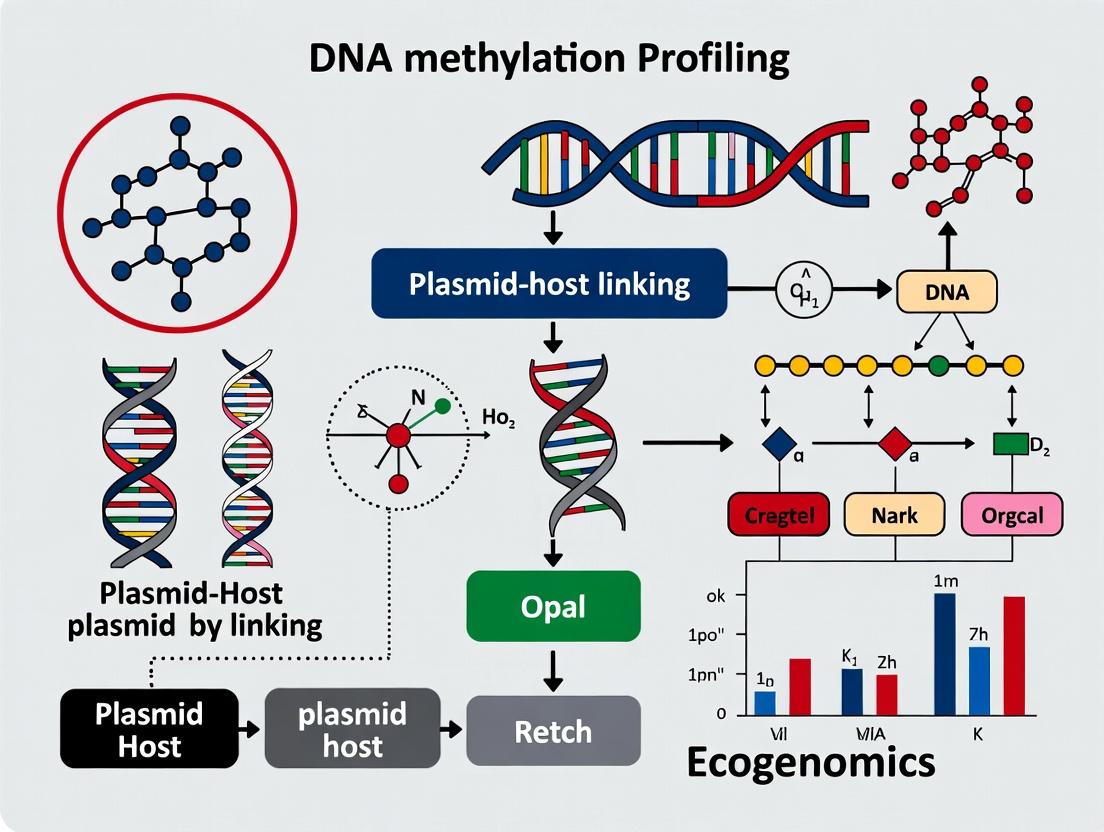
Metagenomic sequencing often fails to link mobile genetic elements like plasmids to their bacterial hosts, a critical gap for understanding antibiotic resistance and microbial ecology.
Beyond Assembly: How DNA Methylation Profiling Links Plasmids to Hosts in Metagenomic Data
Abstract
Metagenomic sequencing often fails to link mobile genetic elements like plasmids to their bacterial hosts, a critical gap for understanding antibiotic resistance and microbial ecology. This article details the methodology of DNA methylation profiling—exploiting the host-specific nature of restriction-modification systems—as a powerful tool for plasmid-host linking. We cover foundational principles, current laboratory and bioinformatic workflows (including PacBio and Oxford Nanopore platforms), optimization strategies, and comparative analysis against alternative methods. Aimed at researchers and bioinformaticians, this guide provides a comprehensive framework for implementing this cutting-edge technique to resolve plasmid-host dynamics in complex microbial communities.
Decoding the Epigenetic Signature: Why DNA Methylation is the Key to Plasmid-Host Linkage
Application Notes: Methylation Profiling for Plasmid-Host Linking
The identification of plasmid-host pairs in complex microbial communities remains a significant bottleneck in metagenomics. Standard assembly and binning techniques often fail to link mobile genetic elements (MGEs) to their bacterial or archaeal hosts. DNA methylation, an epigenetic marker mediated by host-encoded restriction-modification (RM) systems, provides a native, biological link. Plasmid DNA acquired by a host cell is methylated by the host's RM systems, imprinting a host-specific signature. Profiling these methylation motifs (methylomes) from sequenced DNA allows for the computational pairing of plasmids and hosts based on shared methylation patterns.
Table 1: Comparison of Metagenomic Linking Methods
| Method | Principle | Key Advantage | Primary Limitation | Linking Accuracy* |
|---|---|---|---|---|
| Co-abundance | Correlation of coverage profiles | No special sequencing required | Fails for low-abundance/dynamic communities | ~60-75% |
| Chromosome Conformation (Hi-C) | Physical DNA proximity ligation | Direct physical evidence | Requires specific library prep, signal decay | ~85-95% |
| Methylation Profiling (PacBio/ONT) | Shared RM methylation motifs | Uses native epigenetic signal; functional link | Requires long-read sequencing | ~90-98% |
| Single-cell Genomics | Physical co-localization in a cell | Gold standard for validation | Low throughput, high cost | ~99% |
*Reported accuracy for high-quality datasets under optimal conditions.
Table 2: Quantitative Metrics for Methylation-Based Linking (Simulated Metagenome)
| Parameter | Value | Description |
|---|---|---|
| Methylation Motif Detection Rate | 92.3% | Proportion of hosts with ≥1 detected RM motif |
| Plasmid-Host Linkage Rate | 67.8% | Proportion of plasmids linked to a host bin |
| False Positive Rate | 3.1% | Incorrect links/total links (via ground truth simulation) |
| Minimum Host Coverage | 20x | Recommended PacBio HiFi coverage for motif calling |
| Minimum Plasmid Coverage | 25x | Recommended coverage for robust plasmid methylome |
Detailed Experimental Protocol
Protocol: Plasmid-Host Linking via PacBio SMRT Sequencing Methylation Profiling
I. Sample Preparation & Sequencing
- DNA Extraction: Perform high-molecular-weight (HMW) DNA extraction from metagenomic sample (e.g., using the ZymoBIOMICS HMW DNA Miniprep Kit). Assess integrity via pulse-field gel electrophoresis or FEMTO Pulse system. Requirement: DNA fragments >40 kb.
- SMRTbell Library Construction: Prepare library using the SMRTbell Express Template Prep Kit 3.0 (Pacific Biosciences). Avoid shearing. Size-select using the BluePippin system (≥15 kb cutoff).
- Sequencing: Sequence on a PacBio Sequel IIe or Revio system using HiFi sequencing mode. Target a minimum of 20x coverage for the estimated community genome size. Use Sequel II Binding Kit 3.2 and SMRT Cell 8M.
II. Bioinformatics & Methylome Analysis
- Base Calling & Modification Detection: Process raw subreads (
*.bam) using theccstool (Circular Consensus Sequencing) to generate HiFi reads. Usepbmm2to align HiFi reads to the reference (orflyefor de novo assembly). Detect base modifications (6mA, 4mC) using theipdSummarytool from the SMRT Link v12.0+ suite with default parameters. - Motif Discovery & Binning: Run
MotifFinderon the modification output to identify consensus methylation motifs (e.g., GANTC, GRCGY). Simultaneously, perform metagenome-assembled genome (MAG) binning from the assembly usingmetaWRAP(Bin_refinement module) orDASTool. Assign contigs to MAGs. - Plasmid Identification & Linking:
- Identify plasmid contigs using
platonormobilome-identifier. - Linking Algorithm: For each plasmid contig, extract its observed methylation motifs. For each host MAG, compile its set of active RM system motifs (from MotifFinder). A plasmid is confidently linked to a host MAG if:
- Condition A: ≥2 unique methylation motifs are shared between the plasmid and the MAG.
- OR Condition B: 1 unique motif is shared AND that motif is not found in any other MAG in the community (unique signature).
- Optional Stringency Filter: Discard links where plasmid coverage is >10x divergent from host MAG coverage.
- Identify plasmid contigs using
Protocol Validation & Controls
- Positive Control: Spike a known host-plasmid pair (e.g., E. coli with pUC19) into the community prior to extraction.
- Negative Control: Analyze purified plasmid DNA (without host passage) to confirm absence of host-derived methylation.
- Validation: Confirm high-confidence links via single-cell sequencing or targeted Hi-C on a subset of samples.
Visualization Diagrams
Diagram Title: Workflow for Methylation-Based Plasmid-Host Linking
Diagram Title: Conceptual Basis of Methylation Linking
The Scientist's Toolkit: Research Reagent Solutions
Table 3: Essential Materials for Methylation-Based Linking
| Item | Function in Protocol | Example Product/Catalog | Critical Notes |
|---|---|---|---|
| HMW DNA Isolation Kit | Preserves long DNA fragments crucial for plasmid assembly & methylation phasing. | ZymoBIOMICS HMW Miniprep Kit; Qiagen MagAttract HMW DNA Kit | Avoid vortexing; use wide-bore tips. Check fragment size >40 kb. |
| PacBio SMRTbell Prep Kit | Constructs hairpin-ligated libraries for SMRT sequencing. | SMRTbell Express Template Prep Kit 3.0 | Size selection is critical for long plasmid recovery. |
| Size Selection System | Isolates ultra-long DNA fragments for sequencing. | Sage Science BluePippin (≥15 kb cutoff) | Alternatively, use Circulomics Nanobind disks. |
| PacBio Binding Kit | Attaches polymerase to SMRTbell templates for sequencing. | Sequel II Binding Kit 3.2 | Ensure compatibility with your instrument (Sequel IIe/Revio). |
| SMRT Cell | The consumable flow cell for sequencing. | SMRT Cell 8M | For maximum yield on Sequel IIe systems. |
| Bioinformatics Suite | Software for modification detection & motif finding. | SMRT Link (v12.0+) with ipdSummary & MotifFinder |
Requires associated base call files (*.bam). |
| Metagenomic Binning Pipeline | Recovers host genomes from assembly. | metaWRAP (Bin_refinement); DASTool |
Use multiple binning algorithms and refine. |
| Plasmid Identification Tool | Distinguishes plasmid from chromosomal contigs. | platon; MOB-suite |
platon uses curated databases of plasmid genes. |
| Positive Control DNA | Validates the entire workflow's linking capability. | Known host-plasmid pair (e.g., E. coli DH10B + defined plasmid) | Spike into a complex sample at ~1% abundance. |
Application Notes
Within metagenomics, linking mobile genetic elements (MGEs), like plasmids, to their bacterial hosts remains a significant challenge. Plasmid-host linking is critical for tracking antibiotic resistance gene (ARG) dissemination and understanding microbial community dynamics. This protocol details the application of host-specific DNA methylation patterns, imprinted by chromosomally encoded Restriction-Modification (RM) systems, as a "natural barcode" for this purpose.
Core Principle: A bacterial cell's unique complement of RM systems methylates specific DNA sequences (e.g., GATC, CCWGG). Plasmids residing within that host are methylated by the same machinery, acquiring a host-specific methylation signature. Through third-generation sequencing (PacBio SMRT or Oxford Nanopore) that detects base modifications, this signature can be read in silico and used to link the plasmid to its host without the need for physical separation or cultivation.
Key Advantages:
- Culture-Independent: Functions directly on mixed microbial communities.
- High-Resolution: Can distinguish between closely related bacterial strains based on their unique RM system repertoire.
- Retrospective Analysis: Can be applied to existing long-read metagenomic datasets.
Quantitative Data Summary:
Table 1: Comparison of Methylation Detection Platforms
| Platform | Technology | Read Length | Basecall + Modification Detection | Typical Accuracy for 5mC/6mA |
|---|---|---|---|---|
| PacBio (Sequel IIe) | SMRT Sequencing | HiFi reads: 10-25 kb | Kinetics analysis (IPD ratio) from circular consensus sequencing | >99% (Q20+) for base; >90% for modification |
| Oxford Nanopore (MinION Mk1C) | Nanopore Sensing | Ultra-long: >100 kb possible | Direct electrical signal analysis (basecall + modcall) | ~99% (Q20) for base; ~85-95% for modification |
Table 2: Common RM System Motifs and Methylation Types
| Recognition Sequence (Example) | Methyltransferase Type | Methylated Base & Position | Common Bacterial Genera |
|---|---|---|---|
| GATC | Type II (Dam) | N6-methyladenine (6mA) | Escherichia, Salmonella |
| CCWGG | Type II (Dcm) | 5-methylcytosine (5mC) | Escherichia |
| GCGC | Type II (HhaI) | 5-methylcytosine (5mC) | Haemophilus |
| CACNNNNGTG | Type I (EcoKI) | N6-methyladenine (6mA) | Escherichia, Klebsiella |
Experimental Protocols
Protocol 1: Metagenomic DNA Preparation for Host-Methylation Profiling
Objective: To extract high-molecular-weight (HMW), minimally sheared DNA from a complex microbial community.
Materials:
- Sample: Environmental or clinical sample (e.g., stool, soil, biofilm).
- Reagent Kit: ZymoBIOMICS HMW DNA Miniprep Kit or MagAttract HMW DNA Kit (QIAGEN).
- Equipment: Bead beater, thermomixer, pulsed-field gel electrophoresis system, Qubit fluorometer.
Procedure:
- Cell Lysis: Suspend sample in lysis buffer with proteinase K. Perform mechanical lysis via bead beating (2x 45 sec pulses, ice cooling between pulses).
- Inhibit Nucleases: Immediately add EDTA to 20 mM final concentration.
- HMW DNA Isolation: Follow kit protocol for HMW DNA, using wide-bore tips for all transfers. Elute in 10 mM Tris-HCl (pH 8.0).
- Quality Control: (A) Quantify using Qubit dsDNA BR Assay. (B) Assess integrity via pulsed-field gel electrophoresis (5-15 sec switch time). Aim for a dominant fragment size >40 kb.
Protocol 2: Long-Read Sequencing with Methylation Detection
Objective: Generate sequence data with inherent modification (modification) information.
Method A: PacBio SMRT Sequencing (HiFi Mode)
- Library Prep: Use the SMRTbell Express Template Prep Kit 3.0. Avoid DNA shearing. Perform size selection using the BluePippin system (cut-off >10 kb).
- Sequencing: Load library on a Sequel IIe system with Binding Kit 3.2 and Sequencing Primer v5. Set movie time to 30 hours.
- Data Generation: The instrument software (SMRT Link) performs Circular Consensus Sequencing (CCS), generating HiFi reads with kinetic information (Interpulse Duration, IPD) used for modification calling.
Method B: Oxford Nanopore Sequencing
- Library Prep: Use the Ligation Sequencing Kit V14 (SQK-LSK114) with the Native Barcoding Expansion. Do not perform PCR amplification.
- Sequencing: Prime and load the library onto a MinION Mk1C flow cell (R10.4.1 pore version preferred). Run for up to 72 hours.
- Basecalling & Modcalling: Use the super-accurate (sup) basecalling model in Dorado (
dorado basecaller) with the--modifications 5mC 6mAflag enabled to call sequences and modifications simultaneously.
Protocol 3:In SilicoMethylation Profiling and Plasmid-Host Linking
Objective: Identify methylation motifs and correlate plasmid-host signatures.
Software Requirements: bismark (PacBio), dorado/tombo/megalodon (Nanopore), Methylartist, MoDmap, metaplasmidSPAdes, MetaBAT2.
Workflow:
- Read Processing & Modification Calling:
- PacBio: Use
pbmm2to align HiFi reads to a reference genome or metagenome-assembled genomes (MAGs). UseipdSummary(SMRT Link) orbismarkto detect modifications. - Nanopore: Align reads with
minimap2. Use modified basecalls fromdoradoor re-call withmegalodonin modified-base mode.
- PacBio: Use
- Motif Discovery: Use
MoDmaporMethylartist discoverto identify overrepresented modified sequence motifs de novo from aligned data. - Host Genome Binning & RM Annotation: Assemble reads into contigs using
flye. Bin contigs into MAGs usingMetaBAT2. Annotate RM systems in MAGs usingREBASEorDefenseFinder. - Plasmid Assembly & Methylation Profiling: Co-assemble reads using a plasmid-aware assembler like
metaplasmidSPAdes. Extract plasmid contigs. - Linking: Compare the methylation motifs and patterns (frequency, context) found on plasmid contigs to those identified in the MAGs. A statistical match (e.g., using Pearson correlation of per-motif modification frequencies) links the plasmid to its host MAG.
Visualizations
Title: Plasmid-Host Linking via Methylation Workflow
Title: RM System Creates a Host-Specific Plasmid Barcode
The Scientist's Toolkit: Research Reagent Solutions
Table 3: Essential Materials for RM-Based Plasmid-Host Linking
| Item | Function & Rationale |
|---|---|
| ZymoBIOMICS HMW DNA Miniprep Kit | Optimized for shearing-minimized DNA extraction from mixed microbial communities; crucial for long-read sequencing. |
| PacBio SMRTbell Express Template Prep Kit 3.0 | Library preparation for PacBio HiFi sequencing, preserving modification signals without amplification. |
| Oxford Nanopore Ligation Sequencing Kit (SQK-LSK114) | Standard kit for native DNA sequencing on Nanopore, allowing direct modification detection. |
| REBASE Database | Curated database of RM systems, essential for annotating methyltransferase motifs in host MAGs. |
| BluePippin or SageELF System | Automated size selection to enrich for >10-20 kb fragments, improving assembly continuity. |
| R10.4.1 Nanopore Flow Cell | Latest pore version offering improved basecalling accuracy, particularly for modification detection. |
| Methylartist Software Package | Specialized toolkit for visualization and de novo discovery of methylation motifs from PacBio/Nanopore data. |
| metaplasmidSPAdes Assembler | Metagenomic assembler specifically designed to improve the recovery of plasmid sequences from complex samples. |
This application note is framed within a broader thesis on DNA methylation profiling for plasmid-host linking in metagenomics. The field recognizes that epigenetic modifications, particularly DNA methylation, within the microbiome are not merely host-centric phenomena but are intrinsic to bacterial and archaeal genomes. These epigenetic marks serve critical biological functions for microbes and provide a novel, stable biomarker for linking mobile genetic elements (M.g., plasmids) to their host of origin in complex microbial communities, a significant challenge in metagenomic assembly.
Key Quantitative Findings
Recent studies quantify the prevalence and utility of bacterial epigenomic signatures.
Table 1: Prevalence of Key Methylation Motifs in Common Gut Bacteria
| Bacterial Phylum/Genus | Primary Methylation Motif | Typical Modification | Average % of Genomes Containing Motif | Role in Host Linking |
|---|---|---|---|---|
| Bacteroides spp. | GANTC | m6A (Dam) | >95% | Strong, strain-specific linking signal |
| Firmicutes (e.g., Clostridioides) | CCA/TGG | m4C (CcrM-like) | 60-80% | Useful for genus-level association |
| Gammaproteobacteria | GATC | m6A (Dam) | ~99% | Robust plasmid-host assignment |
| Escherichia coli (model) | GATC, CTGCAG | m6A, m5C | 100% | Validated for single-molecule linking |
Table 2: Performance Metrics for Plasmid-Host Linking via Methylation Profiling
| Method | Accuracy (%) | Resolution | Required Sequencing Depth (Gb per sample) | Key Limitation |
|---|---|---|---|---|
| Sequence Composition (k-mer) | 45-60 | Plasmid to species/Genus | 5-10 | Confounded by horizontal gene transfer |
| Chromosomal Integration Sites | >95 (when present) | Strain | 20+ | Rare in metagenomes |
| Methylation Motif Correlation | 85-92 | Strain to Species | 10-15 (PacBio HiFi) | Requires SMRT/ONT sequencing |
| CRISPR Spacer Matching | 70-80 | Strain | Varies | Limited to CRISPR-containing hosts |
Experimental Protocols
Protocol 1: Sample Preparation for Metagenomic Methylation Profiling
Objective: To extract high-molecular-weight (HMW) DNA from a fecal/ environmental sample while preserving methylation states.
- Lysis: Use a gentle, enzymatic lysis buffer (e.g., lysozyme, mutanolysin for Gram-positives) at 37°C for 60 min to avoid shearing DNA.
- HMW DNA Extraction: Purify DNA using a magnetic bead-based HMW kit (e.g., MagAttract HMW DNA Kit). Avoid spin columns.
- DNA QC: Assess integrity via pulsed-field gel electrophoresis or Femto Pulse system. Aim for average fragment size >20 kb. Quantify using Qubit dsDNA BR Assay.
- Preservation: Aliquot DNA and store at -80°C. Avoid repeated freeze-thaw cycles.
Protocol 2: Single-Molecule, Real-Time (SMRT) Sequencing for Methylome Analysis
Objective: To generate long reads with inherent detection of base modifications (m6A, m4C).
- Library Construction: Use the SMRTbell Express Template Prep Kit 3.0.
- End-repair and A-tail 1-2 µg of HMW DNA.
- Ligate universal SMRTbell hairpin adapters.
- Purify with 0.45x AMPure PB beads to remove small fragments.
- Binding & Sequencing: Use the Sequel IIe/Revio system with Binding Kit 3.2.
- Bind library to polymerase using a 10:1 polymerase-to-template ratio.
- Load onto a SMRT Cell 8M or Revio SMRT Cell.
- Sequence with a 30-hour movie time using CCS (HiFi) mode for circular consensus sequencing.
- Data Processing: Run the primary analysis in SMRT Link (v11.0+) with
Modification and Motif AnalysisandKinetics Analysisenabled.
Protocol 3: Bioinformatic Pipeline for Methylation-Based Plasmid-Host Linking
Objective: To correlate plasmid and chromosomal methylation motifs to infer host.
- Read Processing & Assembly:
- Input: HiFi reads in BAM format (with base modification tags).
- Assemble reads using Flye (
--pacbio-hifi --meta) or hifiasm-meta.
- Methylation Motif Calling:
- Use
pbmm2to align reads to the assembly. - Run
ipdSummaryon the aligned BAM to detect modified bases and identify consensus motifs (e.g., GATC, GANTC).
- Use
- Motif Correlation & Linking:
- Extract per-contig motif frequency and average kinetic score (IPD ratio) for each motif.
- Calculate pairwise correlation (e.g., Pearson) of motif IPD ratio profiles between all plasmid and chromosome contigs.
- Assign a plasmid to the host chromosome with the highest correlation coefficient (r > 0.8 considered strong evidence).
Diagram Title: Workflow for Methylation-Based Plasmid-Host Linking
Diagram Title: Mechanism Creating a Shared Plasmid-Host Methylome
The Scientist's Toolkit: Research Reagent Solutions
Table 3: Essential Reagents and Kits for Metagenomic Methylation Profiling
| Item Name (Example) | Function & Role in Protocol | Critical Specification |
|---|---|---|
| MagAttract HMW DNA Kit (Qiagen) | Gentle magnetic bead-based purification of intact DNA from complex samples. | Maximizes DNA fragment length (>20 kb) for long-read sequencing. |
| SMRTbell Express Template Prep Kit 3.0 (PacBio) | Constructs SMRTbell libraries from HMW DNA for sequencing. | Preserves base modification signals during adapter ligation. |
| Sequel II Binding Kit 3.2 / Revio Binding Kit (PacBio) | Binds polymerase to SMRTbell library for sequencing. | Optimal kit for HiFi sequencing with modification detection. |
| AMPure PB Beads (PacBio) | Size-selective purification of SMRTbell libraries. | 0.45x ratio retains HMW fragments; critical for metagenomes. |
| DNeasy PowerLyzer PowerSoil Kit (Qiagen) | Alternative for robust lysis of difficult environmental samples. | Effective for soil/sputum; may yield shorter fragments. |
Base Modification Caller (ipdSummary) |
Software that identifies m6A, m4C, m5C from kinetic data. | Must be run with --identify m6A,m4C and --motif flags. |
| Flye / hifiasm-meta assembler | Assembles HiFi reads into contigs in metagenomic mode. | Essential for generating chromosomal and plasmid scaffolds. |
Application Notes
In metagenomics research, linking mobile genetic elements (M.g., plasmids) to their microbial hosts is critical for understanding horizontal gene transfer, antibiotic resistance dissemination, and functional ecology. Traditional methods, primarily based on sequence composition or proximity-ligation (Hi-C), face significant limitations in complex samples with low biomass or high strain diversity. DNA methylation profiling, leveraging the cell's innate restriction-modification systems as a unique "host fingerprint," provides a powerful orthogonal approach. This application note details how methylation-based plasmid-host linking circumvents assembly gaps and offers superior resolution in metagenomic analyses.
- Limitation of Assembly-Dependent Methods: Traditional co-assembly and binning require high-coverage, contiguous sequences, failing when plasmids or hosts do not assemble completely, which is common for low-abundance or repetitive elements.
- Methylation as a Direct Linkage Signal: A host cell's unique pattern of DNA methylation (e.g., 6mA, 5mC, 4mC) is imparted on both its chromosomal and extrachromosomal DNA. By profiling these epigenetic marks, one can link a plasmid to its host without needing a contiguous assembled genome for either entity.
- Single-Read Resolution: PacBio SMRT or Oxford Nanopore sequencing enables the direct detection of base modifications on single, long DNA molecules. This allows for host linkage from individual reads, effectively "spanning" the genomic gaps that break assembly-based methods.
Quantitative Comparison of Plasmid-Host Linking Methods
Table 1: Performance metrics of plasmid-host linking techniques in complex metagenomic samples.
| Method | Principle | Requirement | Host Resolution | Success in Low Coverage | Assembly Dependency | Throughput |
|---|---|---|---|---|---|---|
| Co-assembly & Binning | Sequence co-occurrence in contigs | High coverage, complete assembly | Species/Strain | Low | Absolute | High |
| Chromosome Conformation Capture (Hi-C) | Physical DNA proximity | Cross-linking efficiency, intact nuclei | Species | Moderate | High (for binning) | Medium |
| Methylation Pattern Linking | Shared epigenetic signature | Modified base detection (PacBio/Nanopore) | Strain-level | High | None | Medium |
Protocol: Methylation-Based Plasmid-Host Linking from Metagenomic Samples
I. Sample Preparation and Sequencing
- DNA Extraction: Perform a gentle lysis protocol (e.g., using lysozyme and proteinase K) to minimize DNA shearing and preserve high molecular weight DNA. Quantity using Qubit Fluorometry.
- Size Selection: Use pulsed-field gel electrophoresis or magnetic bead-based size selection (e.g., Circulomics SRE kit) to enrich DNA fragments >20 kb, ensuring sufficient length for methylation motif coverage.
- Library Preparation & Sequencing:
- For PacBio SMRT Sequencing: Prepare library using the SMRTbell Express Template Prep Kit 3.0. Sequence on a Revio or Sequel IIe system to generate HiFi reads with kinetic information for base modification detection.
- For Oxford Nanopore Sequencing: Prepare library using the Ligation Sequencing Kit (SQK-LSK114). Sequence on a PromethION or MinION device using the "super accurate" (SUP) basecalling mode.
II. Bioinformatic Analysis Workflow
- Read Processing & Modification Calling:
- PacBio: Use the ccs tool to generate HiFi reads. Call modified bases (6mA, 4mC) using ipdSummary or the pb-CpG-tools pipeline for 5mC.
- Nanopore: Basecall with Guppy or Dorado in "sup" mode with the
--movesand modified base calling enabled (e.g.,--modified-bases 5mC,6mA). Use Megalodon for high-accuracy modification profiles.
- Motif Discovery & Methylation Haplotype Creation:
- Cluster reads based on their coordinated methylation patterns across detected motif sites using tools like methplotlib or epi.
- Each distinct, consistent methylation profile cluster represents a "methylation haplotype," corresponding to a unique host strain.
- Plasmid Identification & Linking:
- Identify plasmid-derived reads using a database like PLSDB via minimap2.
- For each plasmid read, extract its methylation pattern. Assign the plasmid to the host whose methylation haplotype has the highest correlation (e.g., Pearson correlation) to the plasmid's pattern. Statistical confidence is assessed via permutation testing.
Visualization of Workflow
Title: Methylation-Based Plasmid-Host Linking Workflow
The Scientist's Toolkit
Table 2: Key Research Reagent Solutions for Methylation-Based Host Linking.
| Item | Function | Example Product/Catalog |
|---|---|---|
| HMW DNA Preservation Buffer | Stabilizes high molecular weight DNA immediately after cell lysis to prevent degradation. | Zymo Research DNA/RNA Shield; Qiagen DNAstable. |
| Gentle Lysis Enzymes | Efficiently lyses microbial cells while minimizing DNA shearing. | Lysozyme (Sigma L4919); Proteinase K (Thermo Fisher E00491). |
| Magnetic Bead HMW Cleanup | Size selection and purification of DNA fragments >20 kb. | Circulomics SRE Kit; Beckman Coulter SPRIselect. |
| SMRTbell Prep Kit | Library preparation for PacBio sequencing, compatible with modification detection. | PacBio SMRTbell Express Template Prep Kit 3.0. |
| Ligation Sequencing Kit | Library preparation for Oxford Nanopore modified base detection. | Oxford Nanopore SQK-LSK114. |
| Methylation-Aware Aligner | Maps long reads while preserving modification information in tags. | minimap2 (with -x map-ont/-x hifi and --MD). |
| Methylation Analysis Suite | Tool for calling and visualizing base modifications from sequencing data. | Megalodon (Nanopore); PacBio SMRT Link (PacBio). |
Detailed Experimental Protocol: Validation via Mock Community
Objective: Validate plasmid-host linkages determined by methylation profiling using a defined mock microbial community.
Materials:
- Defined Mock Community (e.g., ZymoBIOMICS Microbial Community Standard)
- Known plasmid-bearing strain (e.g., E. coli with pUC19) spiked into the mock community.
- Reagents from Table 2.
Procedure:
- Spike-in Preparation: Cultivate the plasmid-bearing strain separately. Quantify genomic and plasmid DNA copy number via qPCR. Spike the strain into the mock community at ~1% relative abundance.
- DNA Extraction & Sequencing: Follow Protocol I (Steps 1-3) for the spiked community.
- Bioinformatic Analysis: Follow Protocol II.
- Perform host methylation haplotype clustering. Confirm that a haplotype corresponding to the spiked-in strain is identified.
- Identify reads mapping to the known plasmid sequence.
- Validation: Calculate the percentage of plasmid reads whose methylation pattern correlates strongly (p-value < 0.01) with the spiked-in host haplotype. Expect >95% specificity in this controlled experiment. Use this to set correlation thresholds for unknown samples.
Title: Validation Protocol for Methylation-Based Linking
Within a broader thesis on DNA methylation profiling for plasmid-host linking in metagenomics research, direct detection of DNA modifications during sequencing represents a paradigm shift. Unlike bisulfite sequencing, Third-Generation (long-read) platforms from PacBio (SMRT) and Oxford Nanopore Technologies (ONT) enable the simultaneous determination of nucleotide sequence and base modifications in native DNA. This application note details their use for methylation detection, a critical tool for linking plasmids to their bacterial hosts in complex microbial communities by matching methylation motifs (methylomes) between mobile genetic elements and host chromosomes.
Platform Principles and Comparison
PacBio Single-Molecule Real-Time (SMRT) Sequencing
This method detects methylation by analyzing the kinetics of DNA synthesis. When a polymerase incorporates a nucleotide complementary to a template, the interval between incorporations (interpulse duration, IPD) is measured. Modified bases (e.g., 6mA, 4mC, 5mC) alter the local polymerase kinetics, producing a detectable deviation in the IPD ratio compared to an unmodified reference.
Oxford Nanopore Sequencing
This method detects modifications as DNA passes through a protein nanopore. Methylated bases cause characteristic disruptions in the electrical current (squiggle) as they transit the pore. Basecalling algorithms (e.g., Dorado with Remora) deconvolve these signals to call both the base and its modification status simultaneously.
Table 1: Platform Comparison for Direct Methylation Detection
| Feature | PacBio (Revio/Sequel IIe System) | Oxford Nanopore (PromethION/P2 Solo) |
|---|---|---|
| Primary Modification Detection | 6mA, 4mC, 5mC, 5hmC | 5mC, 6mA, 5hmC, others via training |
| Read Basis | Continuous Long Read (CLR) or HiFi | 1D (single-strand) or duplex |
| Key Metric | Interpulse Duration (IPD) Ratio | Raw current signal deviation ("squiggle") |
| Typical Accuracy for 5mC* | >95% (in E. coli motifs) | ~90-98% (dependent on motif/model) |
| Avg. Read Length* | 15-25 kb (CLR); 10-20 kb (HiFi) | 10-50 kb (ultra-long >100 kb possible) |
| Throughput per Run* | 1200-3600 Gb | 100-300 Gb (P2 Solo) |
| Direct Detection Workflow | Kinetics-based in silico analysis | Real-time signal analysis |
| Native DNA Input Requirement | 5 µg (for standard size-selected library) | 1-3 µg (for ultra-long DNA protocols) |
*Data from latest platform specifications (2024) and recent publications.
Detailed Experimental Protocols
Protocol A: Plasmid & Metagenomic DNA Preparation for Direct Methylation Sequencing
Goal: Extract high molecular weight (HMW), native DNA from bacterial isolates or complex microbial communities.
- Cell Lysis: Use gentle, enzymatic lysis (e.g., lysozyme/mutanolysin for Gram-positives) to preserve DNA integrity. Avoid harsh mechanical shearing.
- HMW DNA Extraction: Utilize magnetic bead-based kits designed for ultra-long DNA (e.g., Nanobind CBB Big DNA Kit, Circulomics Nanobind HMW Kit). Elute in low-EDTA or EDTA-free elution buffer.
- DNA QC: Assess quantity by Qubit Fluorometry. Assess quality and size by pulsed-field gel electrophoresis (CHEF) or Genomic DNA ScreenTape. Target average size >50 kbp for optimal library prep.
- Optional Enrichment: For plasmid-host linking, selectively enrich plasmid DNA using an alkaline lysis midi-prep followed by size-selection (BluePippin, Sage Science) to remove short fragments.
Protocol B: PacBio SMRTbell Library Prep and Methylation Detection
Principle: Construct a SMRTbell library and sequence. Detect modifications via kinetic analysis using SMRT Link software.
- DNA Repair & End-Prep: Treat 5 µg HMW DNA with the SMRTbell Enzyme Cleanup Kit (PacBio) to repair nicks and prepare blunt, ligation-ready ends.
- Adapter Ligation: Ligate universal hairpin adapters to the DNA using T4 DNA Ligase, creating a circular SMRTbell template.
- Size Selection & Purification: Remove failed ligation products and small fragments using AMPure PB beads with a 0.45x / 0.8x dual-size selection.
- Primer Annealing & Polymerase Binding: Anneal sequencing primer to the SMRTbell template. Bind the polymerase enzyme to the primer-template complex.
- Sequencing: Load the bound complex onto a Sequel IIe or Revio system and run using a Continuous Long Read (CLR) mode sequencing kit. CLR is preferred over HiFi for kinetic detection as it provides the continuous kinetic trace.
- Methylation Detection Analysis:
- Run primary analysis (SMRT Link).
- For motif-specific detection (e.g., GATC for Dam methylase): Use the "Modification and Motif Analysis" application. It identifies IPD outliers and calls consensus modifications at reference positions with associated p-values.
- For de novo methylation motif discovery: Use the "RS Modification Detection" algorithm. It scans for kinetic deviations across the genome and performs motif finding on significantly modified positions.
Protocol C: Oxford Nanopore Library Prep and Real-Time Methylation Calling
Principle: Prepare a ligation sequencing library and sequence on a PromethION or P2 Solo. Use modified basecallers (e.g., Dorado with Remora) for simultaneous basecalling and 5mC/6mA detection.
- DNA Repair & End-Prep: Treat 1-3 µg HMW DNA with the NEBNext Ultra II End Repair/dA-tailing Module (NEB).
- Native Adapter Ligation: Use the Ligation Sequencing Kit (SQK-LSK114). Ligate Native Adapters (which contain motor proteins) directly to the dA-tailed DNA using NEB Blunt/TA Ligase. Do not perform bisulfite or enzymatic conversion.
- Purification & Elution: Purify the ligated library using AMPure XP beads. Elute in Long Fragment Buffer (LFB) to preserve large fragments.
- Loading & Sequencing: Load the library onto a primed R10.4.1 or R10.5 flow cell. Sequence on a PromethION 2 Solo or P2 Solo for 72-120 hours.
- Real-Time Methylation Calling:
- Perform basecalling and modification calling simultaneously using the
doradobasecaller with the appropriate modified model. - Command example:
dorado basecaller --modified-bases 5mC_5hmC dna_r10.4.1_e8.2_400bps_sup@v4.3.0 pod5_directory/ > calls.bam - This outputs a BAM file with modified base probabilities in the
MMandMLtags (per-read, per-site). - For methylation summary and motif analysis, use tools like
Methylartistormodkitto aggregate calls, compute frequencies per genomic position/motif, and generate bedMethyl files.
- Perform basecalling and modification calling simultaneously using the
Visualization of Workflows and Concepts
Title: PacBio SMRT Methylation Detection Workflow
Title: Oxford Nanopore Methylation Detection Workflow
Title: Methylome-Based Plasmid-Host Linking Concept
The Scientist's Toolkit: Essential Research Reagents & Materials
Table 2: Key Reagents and Solutions for Direct Methylation Sequencing
| Item | Function & Relevance | Example Product (Vendor) |
|---|---|---|
| HMW DNA Extraction Kit | Gentle isolation of ultra-long, native DNA critical for long-read libraries and preserving modifications. | Nanobind CBB Big DNA Kit (Circulomics/PacBio) |
| Magnetic Beads (SPRI) | Size selection and purification during library prep to remove short fragments and enzymes. | AMPure PB Beads (PacBio), AMPure XP Beads (Beckman) |
| PacBio SMRTbell Prep Kit | All necessary enzymes and buffers for constructing SMRTbell libraries from HMW DNA. | SMRTbell Prep Kit 3.0 (PacBio) |
| ONT Ligation Sequencing Kit | Contains adapters, tether proteins, and buffers for preparing nanopore sequencing libraries. | Ligation Sequencing Kit v14 (SQK-LSK114, ONT) |
| DNA Repair Mix | Repairs nicks, gaps, and damaged bases in input DNA to improve library yield and read length. | NEBNext Ultra II End Repair/dA-Tailing Module (NEB) |
| Low-EDTA Elution Buffer | Preserves DNA integrity and is compatible with downstream enzymatic steps (avoids EDTA inhibition). | EB (10mM Tris-HCl, pH 8.0) or Elution Buffer T (Circulomics) |
| R10.4.1 Flow Cell | Latest nanopore chemistry providing high single-read accuracy, beneficial for modification calling. | R10.4.1 Flow Cell (FLO-PRO114M, ONT) |
| Methylated Control DNA | Positive control for benchmarking and validating methylation detection performance. | E. coli genomic DNA (dam+/dcm+) (e.g., NEB #N4013S) |
| Analysis Software | Specialized tools for calling, visualizing, and analyzing base modifications. | SMRT Link (PacBio), Dorado+Remora (ONT), Methylartist |
A Step-by-Step Protocol: From Sample to Linked Host-Plasmid Pairs
Application Notes
Within the broader thesis context of DNA methylation profiling for plasmid-host linking in metagenomics, this workflow is foundational. It enables the deconvolution of complex microbial communities by exploiting plasmid-specific epigenetic signatures. The key application is establishing ecological linkages between mobile genetic elements (plasmids, often harboring antimicrobial resistance genes) and their bacterial hosts, circumventing the need for cultivation. This is critical for tracking resistance dissemination in environmental or clinical microbiomes and informing drug development targeting specific resistant pathogens.
Experimental Protocols
Protocol 1: Metagenomic DNA Extraction and Size Selection for Plasmid Enrichment
Objective: To isolate high-molecular-weight (HMW) DNA from a microbial community, with optional enrichment for plasmid DNA.
- Sample Lysis: Subject environmental sample (e.g., 0.5g soil, 1mL filtered water) to bead-beating (0.1mm zirconia/silica beads) in a lysis buffer (e.g., Tris-EDTA-SDS, with proteinase K) for 2 minutes at 30 Hz.
- Inhibitor Removal: Add a precipitating agent (e.g., ammonium acetate) to the lysate, incubate on ice for 10 minutes, and centrifuge at 12,000 x g for 10 min. Transfer supernatant.
- DNA Binding & Wash: Bind DNA from the supernatant to a silica membrane column. Wash twice with an ethanol-based wash buffer.
- Elution: Elute DNA in 50-100 µL of low-EDTA TE buffer or nuclease-free water. Quantify using Qubit dsDNA BR Assay.
- (Optional) Plasmid Enrichment: Treat 1 µg of total metagenomic DNA with 5 U of ATP-dependent plasmid-safe DNase at 37°C for 8 hours to degrade linear chromosomal DNA. Purify the reaction using a 1X SPRI bead cleanup.
Protocol 2: PacBio HiFi Library Preparation and SMRT Sequencing
Objective: To generate sequencing libraries suitable for long-read, base-modification-aware sequencing.
- DNA Repair and End-Prep: Treat 1-5 µg of HMW DNA with a combination of DNA Damage Repair and End Repair/ATailing enzymes (e.g., SMRTbell Express Template Prep Kit 3.0) at 37°C for 30 minutes, followed by 72°C for 10 minutes.
- SMRTbell Ligation: Ligate unique barcoded SMRTbell adapters to the A-tailed inserts using DNA Ligase at 25°C for 60 minutes. The adapter design enables closed-circular consensus sequencing.
- Purification & Size Selection: Purify the ligation reaction using 0.45X and a subsequent 0.8X SPRI bead ratio to remove adapter dimers and select for inserts >5 kb.
- Primer Annealing & Polymerase Binding: Anneal sequencing primers to the SMRTbell template. Bind the polymerase enzyme to the primer-annealed complex using a proprietary binding kit.
- Sequencing: Load the bound complex onto a PacBio Revio or Sequel IIe SMRT Cell. Sequence using Continuous Long Read (CLR) or Circular Consensus Sequencing (CCS) mode to generate HiFi reads with an average accuracy >99.9% and read lengths >10 kb.
Protocol 3: Bioinformatics Pipeline for Methylation-Aware Host-Plasmid Linking
Objective: To process raw sequencing data into contigs, call methylation motifs, and link plasmids to hosts.
- Read Processing: Convert raw subreads (
.bam) to HiFi reads using theccstool (minimum passes ≥3, minimum predicted accuracy ≥0.99). Demultiplex usinglima. - Metagenomic Assembly: Assemble HiFi reads into contigs using a long-read assembler (e.g.,
hifiasm-metawith parameters-k 55 -w 78). Assess assembly quality withmetaQUAST. - Methylation Motif Detection: Re-map raw subreads to assembled contigs using
pbmm2. Detect base modifications (6mA, 4mC, 5mC) and their sequence contexts usingipdSummarywith the--methylFractionand--identify m6A,m4Cflags. - Contig Binning & Host Assignment: Bin contigs >2.5 kb into Metagenome-Assembled Genomes (MAGs) using composition and abundance features with
metaWRAP BINNING. Refine bins withmetaWRAP REFINE. Assign taxonomy usingGTDB-Tk. - Plasmid Identification & Linking: Identify plasmid contigs using
PlasmidVerifyandMOB-suite. Correlate the presence of specific, conserved methylation motifs (e.g., GANTC for 6mA) between plasmid contigs and chromosomal MAG contigs. Assign a plasmid to a host MAG if they share a statistically significant (p<0.01, Fisher's exact test) overlap in their methylation motif profile (type, sequence context, and modification frequency).
Data Tables
Table 1: Typical Yield and Quality Metrics Across the Workflow
| Step | Input Material | Key Metric | Target Output | Typical Yield/Rate |
|---|---|---|---|---|
| DNA Extraction | 0.5g soil / 1mL water | Concentration (Qubit), Fragment Size (TapeStation) | HMW DNA (>20 kb) | 5-30 µg total DNA |
| Size Selection | 5 µg total DNA | Fragment Size Distribution | Enriched Plasmid/High MW DNA | Recovery: 40-70% |
| HiFi Library Prep | 1 µg HMW DNA | Library Size (Fragment Analyzer) | SMRTbell Library | >90% adapter ligation efficiency |
| PacBio Revio Seq | 1 SMRT Cell 8M | HiFi Read Metrics | HiFi Reads | 3-4 million reads/cell, N50 >15 kb, >99.9% accuracy |
| Assembly (hifiasm-meta) | 10 Gb HiFi Data | Assembly Statistics | Contigs | N50: 100-500 kb, 50-90% reads aligned |
Table 2: Key Methylation Motifs and Linking Confidence
| Methylation Type | Common Prokaryotic Motif | Detection Enzyme (PacBio) | Role in Host Identification | Linking Confidence Threshold* |
|---|---|---|---|---|
| N6-methyladenine (6mA) | GANTC, CTCCAG, etc. | Dam, CcrM homologs | Strain-specific epigenetic signature | High (p < 0.01) |
| N4-methylcytosine (4mC) | CCAGG, CCTGG, etc. | McrB, etc. | Restriction-Modification system signature | Moderate to High |
| 5-methylcytosine (5mC) | GCGC, GCNNGC, etc. | Dcm, M.HpaII, etc. | Less common in bacteria, virus defense | Context-dependent |
*Based on statistical overlap of motif profiles between plasmid and MAG.
Visualizations
Title: Overall Workflow from Sample to Analysis
Title: Bioinformatics Pipeline for Methylation-Based Linking
The Scientist's Toolkit
Table 3: Essential Research Reagents and Materials
| Item / Solution | Function in Workflow | Key Consideration for Methylation Profiling |
|---|---|---|
| PacBio SMRTbell Express Prep Kit | All-in-one reagent set for HMW DNA repair, end-prep, A-tailing, and adapter ligation. | Maintains DNA integrity and size, crucial for preserving epigenetic signals during library construction. |
| ATP-dependent Plasmid-Safe DNase | Degrades linear dsDNA to enrich for circular plasmid DNA in metagenomic samples. | Critical pre-step to increase plasmid sequencing depth without amplifying host bias. |
| SPRIselect Beads | Solid-phase reversible immobilization beads for size-selective DNA purification and cleanup. | Used for precise size selection to retain HMW DNA and remove adapter dimers post-ligation. |
| PacBio Polymerase Binding Kit | Binds engineered polymerase to the SMRTbell template for sequencing. | The bound polymerase directly detects nucleotide incorporation kinetics (IPDs), enabling base modification calling. |
| SMRT Cell 8M (Revio) | The flow cell containing millions of Zero-Mode Waveguides (ZMWs) for simultaneous single-molecule sequencing. | Provides the throughput required for deep metagenomic coverage and statistically robust methylation detection. |
DNA Methylation Detection Software (ipdSummary) |
Algorithm that analyzes inter-pulse duration (IPD) shifts to identify base modifications. | Core tool for converting raw kinetic data into a table of modified motifs and their genomic positions. |
DNA Extraction Considerations for Preserving Methylation Signatures
Within the framework of a thesis investigating DNA methylation profiling for plasmid-host linking in metagenomics research, the integrity of native methylation patterns is paramount. Methylation signatures serve as epigenetic barcodes, potentially enabling the accurate linkage of mobile genetic elements to their bacterial hosts in complex communities. This application note details the critical considerations and protocols for DNA extraction that preserve these fragile epigenetic marks for downstream analysis, such as whole-genome bisulfite sequencing (WGBS) or third-generation sequencing.
Key Considerations for Methylation-Preserving Extraction
The primary threats to endogenous DNA methylation during extraction are: 1) the introduction of contaminating nucleases, 2) chemical degradation (e.g., acid/base hydrolysis), and 3) excessive physical shearing that may bias representational analysis. Enzymatic lysis is generally preferred over harsh mechanical or chemical methods. Ethylenediaminetetraacetic acid (EDTA) is essential to chelate divalent cations and inhibit Mg2+-dependent nucleases. Furthermore, rapid processing and immediate freezing at -80°C are critical to halt native enzymatic activity.
Quantitative Comparison of Extraction Method Impacts
Table 1: Impact of Common Lysis Methods on DNA Methylation Integrity
| Lysis Method | Relative Shearing | Risk of Methylation Loss | Suitability for Metagenomic Samples | Typical Yield |
|---|---|---|---|---|
| Bead Beating | High | Moderate (via heat/denaturation) | High (for tough cell walls) | High |
| Enzymatic Lysis | Low | Low | Moderate (species-specific efficiency) | Variable |
| Chemical Lysis (SDS) | Low | Low-Moderate (pH-dependent) | High | High |
| Thermal Lysis | Low | High (denaturation risk) | Low | Low |
Table 2: Key Reagent Effects on Methylation Stability
| Reagent / Step | Purpose | Methylation-Preserving Recommendation |
|---|---|---|
| Phenol-Chloroform | Organic extraction | Avoid; can cause de-purination and base hydrolysis. Use spin-column or salt-precipitation based cleanups. |
| Ethanol Precipitation | DNA concentration | Use high-purity ethanol; ensure final wash with 70-80% ethanol to remove salts. |
| Elution/Dialysis Buffer | Final resuspension | Use low-EDTA TE buffer (e.g., 0.1 mM EDTA) or nuclease-free water; neutral pH (7.0-8.5). |
| Storage Conditions | Long-term preservation | Store in neutral buffer at -80°C; avoid repeated freeze-thaw cycles. |
Detailed Protocol: Enzymatic Lysis and Gentle Extraction for Methylation Analysis
Materials:
- Lysis Buffer: 20 mM Tris-Cl (pH 8.0), 2 mM EDTA, 1.2% Triton X-100, 20 mg/mL Lysozyme.
- RNase A (DNase-free), Proteinase K.
- Magnetic Bead-based Cleanup Kit (e.g., SPRI beads) or High-Salt Precipitation reagents.
- Nuclease-free water or low-EDTA TE buffer.
Procedure:
- Cell Harvesting: Pellet microbial cells gently (4,000 x g, 10 min, 4°C). For filters, excise and place in lysis tube.
- Enzymatic Lysis: Resuspend pellet in 500 µL Lysis Buffer. Incubate at 37°C for 60 min with gentle inversion.
- Protein Digestion: Add 5 µL Proteinase K (20 mg/mL) and SDS to a final concentration of 0.5%. Incubate at 55°C for 120 min.
- RNase Treatment: Add 5 µL RNase A (10 mg/mL). Incubate at 37°C for 30 min.
- Cleanup: Perform a magnetic bead-based cleanup per manufacturer's instructions, using a 1:0.8 sample-to-bead ratio to remove impurities and short fragments. Elute in 50 µL of low-EDTA TE buffer (pH 8.0).
- QC: Quantify via fluorometry (e.g., Qubit). Assess integrity via pulsed-field or long-fragment agarose gel electrophoresis. Store at -80°C.
The Scientist's Toolkit: Research Reagent Solutions
Table 3: Essential Materials for Methylation-Preserving DNA Extraction
| Item | Function & Importance |
|---|---|
| Lysozyme (Gram-positive specific) | Enzymatically degrades peptidoglycan cell wall; gentle, specific lysis. |
| Proteinase K | Broad-spectrum serine protease; digests nucleases and other proteins post-lysis. |
| Magnetic SPRI Beads | Enable size-selective purification of DNA without organic solvents or column membranes that can cause loss. |
| Inhibitor Removal Technology Buffers | Specifically designed to remove humic acids, polyphenols, and other metagenomic inhibitors that interfere with downstream enzymatic steps. |
| Fluorometric DNA Quantification Kit | Accurate quantification of double-stranded DNA without interference from RNA or contaminants, unlike UV spectrophotometry. |
| Pulsed-Field Gel Electrophoresis System | Critical for assessing high-molecular-weight DNA integrity without excessive shearing from standard gel systems. |
Visualization of Workflow and Conceptual Framework
Title: Workflow for Methylation-Preserving DNA Extraction and Analysis
Title: Logical Framework Linking Extraction to Plasmid-Host Linking
Within a thesis on plasmid-host linking in metagenomics research, comprehensive methylome profiling is critical. DNA methylation patterns serve as epigenetic signatures that can link mobile genetic elements like plasmids to their bacterial hosts. This application note compares two leading long-read, single-molecule sequencing technologies for this purpose: Pacific Biosciences (PacBio) Single Molecule, Real-Time (SMRT) Sequencing and Oxford Nanopore Technologies (ONT) sequencing.
Table 1: Core Technology Comparison
| Feature | PacBio SMRT Sequencing (Sequel IIe/Revio) | Oxford Nanopore (PromethION/P2 Solo) |
|---|---|---|
| Underlying Principle | Real-time observation of fluorescently-tagged nucleotides during synthesis. | Real-time measurement of ionic current changes as DNA passes through a protein nanopore. |
| Primary Methylation Detection | Kinetic Variation (KV) analysis of polymerase speed. | Direct detection of modified bases via current signal disruption. |
| Native Detection | Yes (Requires no chemical conversion or enrichment). | Yes (Direct sequencing of native DNA). |
| Basecall Resolution | Requires comparison to an unmodified reference for kinetic analysis. | Basecalling models (e.g., Dorado, Guppy) can call modified bases directly (5mC, 6mA, etc.). |
| Typical Read Length (N50) | 10-30 kb (HiFi reads). | 10-100+ kb, with ultra-long reads possible. |
| Throughput per run | High (Up to ~360 Gb on Revio). | Very high and scalable (Up to Tb-scale on PromethION 48). |
| Required DNA Input | 1-5 µg for a standard library. | 100 ng - 1 µg for a standard library. |
| Sequencing Speed (Time to data) | ~0.5-30 hours for a run. | Real-time; data available within minutes of start. |
| Typical Consensus Accuracy | >99.9% (HiFi reads). | ~99%+ (duplex) to ~99.9% (with iterative polishing). |
| Portability | Benchtop instruments (Sequel IIe/Revio). | Range from pocket-sized (MinION) to high-throughput (PromethION). |
Table 2: Methylation Profiling Performance
| Parameter | PacBio SMRT Sequencing | Oxford Nanopore |
|---|---|---|
| Detectable Modifications | 6mA, 4mC, 5mC, others via kinetic deviation. | 5mC, 5hmC, 6mA, 5hmU, BrdU, others; expanding via model training. |
| Detection Method | Inter-pulse duration (IPD) ratio analysis. | Raw current signal analysis with specialized basecallers. |
| Typical Detection Accuracy | High for 6mA and 4mC in prokaryotes. | Varies by model; high for common motifs (e.g., Dam/Dcm). |
| Bioinformatics Tools | SMRT Link (Kinetic Analysis module), ipa, pbmm2, ccsmeth. |
Dorado (with remora), Guppy, Megalodon, tombo, f5c. |
| Key Advantage for Plasmid-Host Linking | Highly quantitative kinetic signals for known motifs. | Direct, simultaneous sequence and multi-modification detection. |
Experimental Protocols
Protocol 1: Native DNA Library Preparation for PacBio SMRT Sequencing
Objective: Generate SMRTbell libraries from metagenomic DNA for simultaneous sequencing and methylation detection.
- DNA Quality Assessment: Verify high molecular weight DNA (≥20 kb) using pulsed-field gel electrophoresis or Femto Pulse system. Concentration: ≥ 50 ng/µL in low TE buffer.
- DNA Repair and End-Preparation: Use the SMRTbell Prep Kit 3.0. Incubate 1-5 µg DNA with:
- PrepA Enzyme Mix: Repairs nicks and gaps, prepares ends for ligation.
- Incubation: 30 minutes at 37°C, then 15 minutes at 65°C.
- Adapter Ligation: Add SMRTbell Adapter (1:25 molar ratio adapter:insert) and DNA Ligase. Incubate for 1 hour at 20°C.
- Purification: Treat with ExoIII/ExoVII to remove failed ligation products. Purify using AMPure PB beads.
- Size Selection (Optional): For plasmid-enriched samples, use the BluePippin or SageELF system to select a target size range (e.g., >5 kb).
- Primer Annealing & Binding: Anneal sequencing primer to the SMRTbell template. Bind polymerase (Sequel II/Revio Binding Kit 3.0) to the primer-template complex.
- Sequencing: Load the bound complex onto a SMRT Cell 8M and sequence on a Sequel IIe or Revio system using a 30-hour movie, 2-hour pre-extension time.
Protocol 2: Native DNA Library Preparation for Oxford Nanopore Sequencing
Objective: Prepare a ligation sequencing library from native metagenomic DNA for direct methylation detection.
- DNA Input: 100 ng - 1 µg of high molecular weight DNA in low TE or nuclease-free water.
- DNA Repair and End-Preparation (Optional but recommended): Use the NEBNext Companion Module or ONT's Native DNA Repair Mix. Incubate up to 1 µg DNA with repair mix for 15 minutes at 20°C. Purify with AMPure XP beads.
- Adapter Ligation: Use the Ligation Sequencing Kit (SQK-LSK114).
- Add Native Adapter (AMX) and Ligation Buffer (LNB) to the DNA.
- Add T4 DNA Ligase and incubate for 15-20 minutes at room temperature.
- Purification: Add Quick Tether (QT) to stop the reaction. Purify the ligated DNA using AMPure XP beads. Elute in Elution Buffer (ELB).
- Priming and Loading: Add Sequencing Buffer (SQB) and Library Beads (LB) to the library. Load the mixture onto a primed R10.4.1 (or newer) flow cell (PromethION P2 Solo or MinION).
- Sequencing & Basecalling: Start the sequencing run via MinKNOW software. Use Dorado basecaller in super-accuracy (
sup) mode with the appropriate modified base model (e.g.,dna_r10.4.1_e8.2_400bps_sup@v4.3.0) for real-time or post-run methylation-aware basecalling.
Visualization
Diagram 1: Methylome Profiling for Plasmid-Host Linking
Diagram 2: Key Bioinformatics Workflow Comparison
The Scientist's Toolkit
Table 3: Essential Research Reagent Solutions
| Item | Function in Methylome Profiling | Example Product/Kit |
|---|---|---|
| High Molecular Weight DNA Isolation Kit | To extract long, native DNA preserving methylation marks from microbial communities. | Qiagen MagAttract HMW DNA Kit, NEB Monarch HMW DNA Extraction Kit. |
| Methylation-Free Host for Cloning | For generating unmethylated control DNA for kinetic variation calibration in PacBio. | E. coli strains like DH10B (dam-/dcm-). |
| SMRTbell Prep Kit | Creates the circular, hairpin-adapted library format required for PacBio SMRT sequencing. | PacBio SMRTbell Prep Kit 3.0. |
| Native DNA Repair Mix | Repairs nicks, gaps, and damaged ends in input DNA to improve library length and yield for both platforms. | NEB Next Companion Module, ONT Native DNA Repair Mix. |
| Ligation Sequencing Kit | Attaches sequencing adapters to dsDNA for Oxford Nanopore sequencing. | ONT Ligation Sequencing Kit (SQK-LSK114). |
| Methylated Control DNA | Known-methylation standard (e.g., lambda phage, pUC19) to validate detection performance. | NEB CpG Methylated Lambda DNA, Zymo Research SEQUEL-methylated Control. |
| Size-Selective Beads/System | To enrich for plasmid-sized or specific long fragments, improving plasmid-host linking resolution. | AMPure PB/XP Beads, BluePippin (Sage Science). |
| High-Fidelity Polymerase | For amplifying specific regions without introducing bias, if PCR is necessary. | NEB Q5, Takara PrimeSTAR GXL. |
Within the context of a thesis on DNA methylation profiling for plasmid-host linking in metagenomics research, the accurate detection of base modifications is paramount. Long-read sequencing technologies, particularly from PacBio and Oxford Nanopore, enable simultaneous detection of nucleotide sequence and its epigenetic modifications. This document provides detailed application notes and protocols for three critical bioinformatic tools—PacBio's Motif Finder, Nanopolish, and METEORE—that are essential for converting raw modification signals into biologically interpretable methylation profiles for linking plasmids to their bacterial hosts in complex microbial communities.
Application Notes
PacBio's Motif Finder
PacBio's SMRT (Single Molecule, Real-Time) sequencing detects base modifications, like N6-methyladenine (6mA) and 4-methylcytosine (4mC), by analyzing inter-pulse duration (IPD) kinetics. The Motif Finder tool is part of the SMRT Link/Portal suite and is designed to de novo identify sequence motifs associated with observed kinetic variations, pointing to potential methyltransferase recognition sites.
Key Application in Plasmid-Host Linking: Methylation motifs are often strain-specific and can serve as epigenetic "barcodes." Identifying a shared, unique methylation motif between a plasmid and a chromosomal contig in a metagenomic assembly provides strong evidence for their physical linkage within the same host cell.
Table 1: PacBio Motif Finder Performance Metrics
| Metric | Typical Value/Output | Significance for Methylation Profiling |
|---|---|---|
| Input Data | CCS (HiFi) reads or aligned subreads | Requires high-quality sequence context. |
| Core Algorithm | Kinetic deviation (IPD ratio) clustering | Identifies positions with consistent modification signals. |
| Primary Output | Methylated motif sequences (e.g., GANTC) | Provides the target sequence for restriction-modification systems. |
| Sensitivity | >90% for high-coverage motifs | Dependent on modification rate and sequencing depth. |
| Common QV Threshold | ≥ 30 | Quality value for modification calls; higher is more confident. |
Nanopolish
Nanopolish is a software package that analyzes raw nanopore sequencing signal data (squiggle) to call variants and detect DNA modifications, primarily 5-methylcytosine (5mC) and 6mA, using event-based hidden Markov models.
Key Application in Plasmid-Host Linking: It provides per-read, single-nucleotide resolution modification calls. By examining the methylation status of all occurrences of a motif across reads, one can perform methylation binning—clustering contigs (plasmids and chromosomes) based on correlated methylation patterns, thereby linking them to a common host.
Table 2: Nanopolish Modification Calling Parameters
| Parameter | Recommended Setting | Function |
|---|---|---|
| Model Type | dna_r9.4.1_450bps |
Matches pore chemistry and speed. |
| Caller | call-methylation |
Activates modification detection workflow. |
| Minimum Read Quality | Q7 | Filters out low-quality alignments. |
| Minimum Mapping Quality | Q20 | Ensures reads are uniquely placed. |
| Comparison Group | --paired |
For differential analysis (e.g., vs. native DNA). |
METEORE
METEORE (Methylation Estimation for Third-generation Reads) is a consensus tool that integrates the outputs of multiple nanopore methylation callers (like Nanopolish, Megalodon, DeepSignal). It uses a machine learning (random forest) approach to produce a unified, more accurate methylation call, reducing tool-specific biases.
Key Application in Plasmid-Host Linking: In metagenomics, signal noise is high. Using a consensus tool like METEORE increases the reliability of methylation calls from diverse, often incomplete microbial genomes, which is critical for generating robust methylation profiles used in clustering and plasmid-host association.
Table 3: METEORE Inputs and Consensus Performance
| Feature | Description | Impact on Consensus |
|---|---|---|
| Supported Callers | Nanopolish, Megalodon, DeepSignal | Leverages strengths of multiple methods. |
| Base Model | Random Forest classifier | Weights inputs based on learned accuracy. |
| Input Data | Per-read probability scores | Utilizes raw confidence from each tool. |
| Reported Accuracy Gain | ~2-5% over best single tool | Increases confidence in host-linking conclusions. |
| Key Output | Unified methylation probability | Standardized profile for downstream binning. |
Experimental Protocols
Protocol 1: Detecting Methylation Motifs from PacBio HiFi Data for Host Linking
Objective: To identify strain-specific methylation motifs from metagenomic HiFi reads for correlating plasmids and chromosomes.
Materials: See "The Scientist's Toolkit" below. Procedure:
- Data Generation: Sequence native (not bisulfite-treated) metagenomic DNA on a PacBio Revio or Sequel IIe system to generate HiFi reads.
- Primary Analysis: Use SMRT Link (
ccs) to generate circular consensus sequences (CCS) from subreads. Map CCS reads to a metagenome-assembled genome (MAG) catalog usingpbmm2 align. - Modification Detection: Run
ipdSummaryon the aligned data to calculate IPD ratios at every genomic position. - Motif Finding: Execute the Motif Finder module within SMRT Link or use
motif-maker findon theipdSummaryoutput. Set the modification QV threshold to 30. - Host-Linking Analysis: For each identified methylated motif (e.g.,
CCWGG), extract all instances in the MAG catalog. Generate a methylation frequency table (methylated instances/total instances) per contig. - Correlation & Linking: Perform hierarchical clustering on the methylation frequency matrix. Contigs (plasmids and chromosomes) that cluster together share a methylation profile and are inferred to originate from the same host.
Protocol 2: Nanopore-Based Methylation Binning with Nanopolish and METEORE
Objective: To cluster contigs from a metagenomic assembly using single-nucleotide methylation patterns to link plasmids to hosts.
Materials: See "The Scientist's Toolkit" below. Procedure:
- Data Generation: Sequence the same native metagenomic DNA on an Oxford Nanopore PromethION or MinION flow cell (R9.4.1 or R10.4.1). Base-call with
guppyin high-accuracy (hac) mode, retaining raw signal files (.fast5or.pod5). - Read Mapping: Assemble basecalled reads into contigs using
flye(with--metaflag). Map all reads back to the assembly usingminimap2(-ax map-ont). - Single-Tool Methylation Calling:
- Run
nanopolish call-methylationusing the indexed raw signals, assembly, and alignments. Output a per-read log-likelihood ratio (LLR) file. - In parallel, run other callers like
megalodon.
- Run
- Consensus Calling: Provide the output from step 3 (e.g., Nanopolish and Megalodon LLR files) to METEORE (
meteore -i [tool_outputs] -r assembly.fasta). This generates a consensus methylation call bedGraph file. - Profile Generation: For each contig > 10 kb, calculate the average methylation fraction per 5kb non-overlapping window for all motifs (e.g., CpG, GATC). This creates a multi-dimensional methylation profile.
- Methylation Binning: Use unsupervised clustering (e.g., UMAP + HDBSCAN) on the windowed profile matrix. Windows (and thus contigs) from the same microbial genome will co-cluster, revealing plasmid-host associations.
Visualizations
PacBio Motif-Based Host Linking Workflow
Nanopore Consensus Methylation Binning Workflow
The Scientist's Toolkit
Table 4: Essential Research Reagent Solutions for Methylation Profiling
| Item | Function in Context |
|---|---|
| PacBio SMRTbell Prep Kit 3.0 | Prepares metagenomic DNA into SMRTbell libraries for HiFi sequencing without bias against modified bases. |
| Oxford Nanopore Ligation Sequencing Kit (SQK-LSK114) | Prepares DNA for nanopore sequencing, preserving base modifications for downstream signal analysis. |
| Magnetic Bead-based Size Selectors (SPRI) | Critical for removing short fragments and optimizing library size for both platforms, improving assembly. |
| High Molecular Weight (HMW) DNA Extraction Kit (e.g., NEB Monarch) | Extracts intact, long DNA from microbial communities, essential for long-read sequencing and assembly. |
| DDA or DIA Methylated Control DNA (e.g., pUC19, lambda phage) | Serves as a positive control for benchmarking modification detection tools and pipeline calibration. |
| Qubit dsDNA HS Assay Kit | Accurately quantifies low-concentration metagenomic DNA libraries prior to sequencing. |
This application note details a protocol for tracking plasmid dynamics within complex gut microbiomes, a critical challenge in antimicrobial resistance (AMR) surveillance. This work is framed within a broader thesis positing that DNA methylation profiling serves as a high-fidelity method for plasmid-host linking in metagenomic assemblies. While nucleotide sequence alone is often insufficient to reliably associate plasmids with their bacterial hosts in mixed communities, unique methylation motifs—part of a bacterial host's restriction-modification system and imprinted on its plasmids—provide a stable, heritable "host fingerprint." This case study applies this principle to track the mobilization of a beta-lactam resistance plasmid in a synthetic human gut microbiome under antibiotic perturbation.
Application Notes: Experimental Design & Quantitative Outcomes
A synthetic human gut microbiome (10 bacterial species) was spiked with a donor Escherichia coli strain harboring a conjugative IncF plasmid (blaCTX-M-15, AmpR). The community was introduced into a chemostat system simulating the colon environment. After equilibration, a sub-therapeutic dose of ampicillin was introduced. Metagenomic samples were collected at six time points over 96 hours.
Key Quantitative Findings
Table 1: Plasmid Abundance and Resistance Gene Dynamics
| Time Point (hr) | Relative Abundance of IncF Plasmid (RPKM) | blaCTX-M-15 Reads (TPM) | Estimated Transfer Frequency (Transconjugants/Donor) |
|---|---|---|---|
| 0 (Pre-Antibiotic) | 125.4 ± 12.3 | 150.2 ± 18.5 | N/A |
| 24 | 415.7 ± 45.6 | 580.9 ± 62.1 | 1.5 x 10⁻³ |
| 48 | 1250.8 ± 110.2 | 1420.5 ± 135.8 | 3.8 x 10⁻³ |
| 72 | 980.5 ± 98.7 | 1105.3 ± 101.4 | 2.1 x 10⁻³ |
| 96 | 850.2 ± 76.5 | 920.8 ± 87.9 | 1.7 x 10⁻³ |
Table 2: Methylation-Based Host Assignment of IncF Plasmid
| Host Species (Putative) | Time 0hr (%) | Time 48hr (%) | Time 96hr (%) | Methylation Motif (Detected) |
|---|---|---|---|---|
| Escherichia coli (Donor) | 98.7 | 45.2 | 32.1 | GATC (Dam) |
| Klebsiella pneumoniae | 0.5 | 38.5 | 41.2 | GATC, CGCG |
| Citrobacter freundii | 0.8 | 12.1 | 18.4 | GATC, CCWGG |
| Unassigned | 0.0 | 4.2 | 8.3 | N/A |
Experimental Protocols
Protocol A: Metagenomic DNA Extraction and Long-Read Sequencing with Methylation Detection
Objective: Obtain high-molecular-weight DNA suitable for plasmid assembly and simultaneous detection of base modifications.
- Sample Lysis: Suspend 200 mg of gut microbiome pellet in 1 mL PBS. Use a bead-beating lysis kit with gentle mechanical disruption (45 sec) to avoid shearing chromosomal DNA while ensuring cell wall breakage.
- DNA Purification: Perform purification using magnetic bead-based clean-up (e.g., AMPure XP) with a 0.4x:1x dual-size selection to enrich for >10 kb fragments.
- Library Preparation & Sequencing: Prepare library using the SQK-LSK114 kit (Oxford Nanopore Technologies). Load onto a MinION R10.4.1 flow cell. For PacBio, use the Sequel II system with SMRTbell prep kit 3.0. Sequence to a target depth of 5 Gb per sample.
- Basecalling & Modification Detection: For Nanopore, use
doradobasecaller with the--modified-bases 5mC 6mAmodel. For PacBio, use theccstool in SMRT Link with--hifi-kinetics.
Protocol B: Computational Pipeline for Methylation-Aware Assembly and Host Linking
Objective: Assemble metagenomes, identify plasmids, and assign hosts via shared methylation profiles.
- Assembly: Assemble quality-filtered reads with
flye(Nanopore) orhifiasm-meta(PacBio HiFi) using metagenome mode. - Plasmid Identification: Screen contigs with
PlasForestandPlasmidFinder. Extract putative plasmid sequences. - Methylation Motif Calling: Use
modbam2bed(Nanopore) orsmrtlinkmotif analysis (PacBio) to generate per-contig methylation frequency tables for known bacterial motifs (e.g., GATC, CCWGG, GANTC). - Host Assignment via Methylation Profile: Construct a similarity matrix (Jaccard index) of methylation motifs (presence/absence and frequency) between all plasmid and chromosomal contigs. Assign a plasmid to the host chromosome with the highest motif profile similarity score >0.85. Validate with co-coverage abundance correlation across samples.
Visualization Diagrams
Title: Methylation-Based Plasmid Host Linking Workflow
Title: Methylation Motif Transfer During Conjugation
The Scientist's Toolkit: Research Reagent Solutions
Table 3: Essential Materials for the Experiment
| Item | Function | Example Product/Cat. No. |
|---|---|---|
| Synthetic Gut Microbiome Consortium | Provides a defined, reproducible community for perturbation studies. | SynBio HGMM (Human Gut Metabolic Module) |
| HMW DNA Preservation Buffer | Stabilizes microbial community DNA immediately upon sample collection, preventing degradation. | Zymo Research DNA/RNA Shield |
| Gentle Lysis Kit for HMW DNA | Breaks bacterial cells while minimizing DNA shearing for long-read sequencing. | Qiagen Genomic-tip 100/G with Enzymatic Lysis |
| Magnetic Beads for Size Selection | Enriches for long DNA fragments crucial for plasmid assembly. | PacBio SMRTbell cleanup beads (0.4x/1x) |
| Nanopore Sequencing Kit with Modification Detection | Enables simultaneous sequencing and detection of 5mC/6mA. | Oxford Nanopore SQK-LSK114 |
| PacBio HiFi Sequencing Kit | Provides highly accurate long reads with kinetic information for methylation. | PacBio SMRTbell prep kit 3.0 |
| Methylation-Aware Basecaller | Converts raw signal to sequence while calling modified bases. | Dorado (ONT) or SMRT Link (PacBio) |
| Plasmid-specific Assembly Software | Accurately reconstructs circular plasmid sequences from metagenomic data. | metaplasmidSPAdes, Unicycler |
| Methylation Motif Analysis Tool | Identifies and quantifies methylation motifs per contig. | modbam2bed (ONT), SmrtAnalysis (PacBio) |
Overcoming Challenges: Maximizing Accuracy and Resolution in Complex Communities
Application Notes
This document addresses critical technical challenges in DNA methylation profiling for plasmid-host linking within metagenomic samples. Successful linking relies on high-quality, single-base-resolution methylomes, which are compromised by the pitfalls detailed below. These notes are integral to the thesis that precise epigenetic linkage is foundational for tracking mobile genetic element (MGE) dissemination, antibiotic resistance gene (ARG) ecology, and strain-level dynamics in complex microbiomes, with direct implications for drug development targeting resistant pathogens.
1. Low Biomass Pitfall Samples with limited microbial DNA (e.g., from sterile sites, low-biomass environments) yield insufficient input for bisulfite conversion and sequencing, leading to poor library complexity, increased duplicate rates, and inadequate coverage for statistical linkage analysis.
2. Incomplete Bisulfite Conversion Pitfall Inefficient conversion of unmethylated cytosines to uracil results in false-positive methylation signals, corrupting the authentic methylation pattern essential for discriminating host strains.
3. Signal Drop-Out Pitfall Non-uniform coverage due to GC bias, PCR amplification bias, or sequencing artifacts causes gaps in methylation calls across genomic loci, breaking the continuity needed for plasmid and host chromosome co-methylation analysis.
Quantitative Impact Summary
Table 1: Quantitative Impact of Common Pitfalls on Sequencing Metrics
| Pitfall | Typical Input DNA | Library Complexity (% Unique Reads) | Conversion Efficiency | Coverage Uniformity (Fold-Change >10x) |
|---|---|---|---|---|
| Low Biomass | <1 ng | <40% | N/A | N/A |
| Incomplete Conversion | >10 ng | >70% | <99% | 15-25% |
| Signal Drop-Out | >10 ng | 60-80% | >99.5% | >30% |
| Optimal Performance | >10 ng | >80% | >99.8% | <15% |
Detailed Protocols
Protocol 1: Low-Biomass Sample Processing with Whole Genome Amplification (WGA) for Methylation Analysis Objective: Generate sufficient DNA for WGBS from low-biomass samples while preserving methylation patterns for host linking. Materials: QIAGEN REPLI-g Single Cell Kit, Zymo Research Pico Methyl Kit. Procedure:
- Cell Lysis & DNA Extraction: Lyse sample (e.g., 200µL filtrate) using enzymatic or chemical lysis. Purify DNA with a silica-column system. Elute in 15µL.
- Whole Genome Amplification: Use the REPLI-g sc kit. Mix 5µL DNA with 3µL Buffer D2 (denature at 65°C for 10 min). Add 3µL Stop Solution. Prepare master mix (REPLI-g sc Reaction Buffer, DNA Polymerase, water). Incubate at 30°C for 8 hours, then 65°C for 3 min to inactivate.
- Post-WGA Clean-up: Purify amplified product with AMPure XP beads (1.8x ratio). Elute in 20µL TE.
- Bisulfite Conversion & Library Prep: Proceed with 50-100ng of WGA product using the Pico Methyl kit, following manufacturer's instructions for end-repair, bisulfite conversion (98°C 8 min, 64°C 60 min, 4°C hold), and indexed library amplification.
Protocol 2: Verification of Bisulfite Conversion Efficiency Objective: Quantify non-conversion rate using spike-in unmethylated lambda phage DNA. Materials: Unmethylated λ DNA (Promega, D1521), Zymo EZ DNA Methylation-Lightning Kit. Procedure:
- Spike-in: Spike 1% (by mass) of unmethylated λ DNA into the sample DNA prior to conversion.
- Bisulfite Conversion: Perform conversion using the Lightning Kit protocol.
- qPCR Assay: Design primers targeting a region of λ DNA devoid of CpG sites. Perform qPCR on converted and unconverted DNA. Calculate conversion efficiency: % Efficiency = 100 - [100/(1+E)^(Cqunconv - Cqconv)], where E is qPCR efficiency.
- Threshold: Accept only samples with ≥99.8% conversion efficiency for plasmid-host linking analysis.
Protocol 3: Mitigating Signal Drop-Out via Post-Bisulfite Enrichment Objective: Improve coverage uniformity in AT-rich or difficult-to-amplify genomic regions. Materials: Roche SeqCap Epi CpGiant Enrichment Kit, NimbleGen probes designed for target host/pangenome regions. Procedure:
- Post-Bisulfite Library Preparation: Generate standard WGBS libraries through bisulfite conversion and initial amplification.
- Hybridization: Combine 500ng bisulfite-converted library with SeqCap Epi hybridization buffer and CpGiant probe pool. Denature at 95°C for 10 min, hybridize at 47°C for 72 hours.
- Capture & Wash: Bind biotinylated probe-DNA complexes to Streptavidin beads. Perform stringent washes.
- Amplification: Perform post-capture PCR (14-18 cycles) to amplify enriched libraries. Sequence on Illumina platform.
Visualizations
Title: Pitfalls, Effects, and Solutions in Methylation Profiling
Title: Low-Biomass WGBS Workflow with QC Check
The Scientist's Toolkit
Table 2: Essential Research Reagent Solutions
| Item | Function & Rationale |
|---|---|
| QIAGEN REPLI-g Single Cell Kit | Multiple Displacement Amplification (MDA) for unbiased whole-genome amplification from low-input DNA, crucial for low-biomass samples. |
| Zymo Pico Methyl-Seq Kit | All-in-one library prep optimized for >100pg-10ng input, integrating bisulfite conversion, reducing handling loss. |
| Unmethylated λ DNA (Promega) | Spike-in control for absolute quantification of bisulfite conversion efficiency; lacks CpG sites. |
| Roche SeqCap Epi CpGiant Probes | Target enrichment probes designed for bisulfite-converted DNA to improve coverage in regions of interest. |
| CpG Methyltransferase (M.SssI) | Positive control enzyme to fully methylate all CpG sites in control DNA, establishing baseline signals. |
| AMPure XP Beads (Beckman Coulter) | Solid-phase reversible immobilization (SPRI) beads for size selection and clean-up, critical for post-WGA and post-capture steps. |
| NEBNext Enzymatic Methyl-seq Kit | Alternative for enzymatic conversion (EM-seq), reducing DNA degradation compared to bisulfite, beneficial for longer fragments. |
| Nanodrop/ Qubit/ Bioanalyzer | For accurate quantitation (Qubit) and quality assessment (Bioanalyzer) of input and library DNA at each step. |
Optimizing Sequencing Depth and Read Length for Reliable Linking
Application Notes and Protocols
1. Introduction within Thesis Context
This protocol is a component of a broader thesis focused on developing robust DNA methylation profiling for plasmid-host linking in complex metagenomic samples. Accurate linking of mobile genetic elements (e.g., plasmids) to their bacterial hosts is critical for understanding antimicrobial resistance gene transfer, microbial ecology, and for drug development targeting specific pathogenic strains. Current methods, such as single-molecule real-time (SMRT) or nanopore sequencing, enable simultaneous detection of base modifications (like 6mA, 4mC, 5mC) and sequence data. The reliability of methylation-based linking hinges critically on two interdependent sequencing parameters: depth and read length. This document provides a data-driven framework and practical protocols for optimizing these parameters.
2. Quantitative Data Summary
Table 1: Impact of Sequencing Parameters on Linking Metrics
| Parameter | Low/Insufficient Value | Recommended Minimum for Linking | Optimal for Complex Metagenomes | Key Metric Affected |
|---|---|---|---|---|
| Average Sequencing Depth (Plasmid) | <50X | 100X | 200-500X | Methylation motif coverage; Statistical confidence in host assignment. |
| Average Sequencing Depth (Host) | <20X | 30X | 50-100X | Completeness of host methylome profile. |
| Read Length (N50) | <10 kb | 20 kb | >50 kb | Probability a read spans plasmid-host methylation signature; Ability to assemble plasmids and contigs. |
| Read Accuracy (QV) | Q20 (99%) | Q30 (99.9%)+ | Reliability of base calling and methylation detection. | |
| Methylation Motif Coverage | <5 reads/motif | 10-15 reads/motif | >20 reads/motif | Precision of methylation signal differentiation from noise. |
Table 2: Simulation-Based Linking Success Rate (Representative Data)
| Scenario | Read Length (kb) | Plasmid Depth (X) | Host Depth (X) | Estimated Linking Success Rate* |
|---|---|---|---|---|
| Shallow, Short-Read | 10 | 50 | 20 | <15% |
| Balanced, Hybrid | 20 | 100 | 30 | 65-75% |
| Optimized, Long-Read | 50 | 200 | 50 | >90% |
| High-Complexity Mix | 50 | 500 | 100 | 85-92% |
*Success rate defined as correct, high-confidence assignment of a plasmid to its true host in a defined synthetic microbial community.
3. Experimental Protocol: Optimization and Validation
Protocol 3.1: In Silico Simulation for Parameter Sweeping Objective: To determine cost-effective sequencing parameters before wet-lab work. Materials: CAMISIM, NanoSim, or custom scripts; High-performance computing cluster. Steps:
- Input Preparation: Define a synthetic metagenome with known plasmid-host pairs and methylation motifs (e.g., E. coli DAM (GATC) with a conjugative plasmid).
- Parameter Sweep: Simulate sequencing data varying:
- Read length distribution (mean 5kb to 100kb).
- Sequencing depth (10X to 500X for both host and plasmid).
- Base call error profile (matching selected platform).
- Linking Analysis: Run the simulated reads through your methylation-based linking pipeline (e.g., MethPlas, linkMAG).
- Threshold Determination: Calculate precision/recall for each parameter combination. Identify the "knee of the curve" where increasing depth/length yields diminishing returns.
Protocol 3.2: Wet-Lab Validation Using a Synthetic Microbial Community Objective: Empirically validate the optimal parameters determined in Protocol 3.1. Materials:
- Defined bacterial strains (3-5 species) with known, unique methylation motifs.
- Marked plasmids (2-3) with known hosts within the community.
- DNA extraction kit for metagenomes (e.g., DNeasy PowerSoil Pro Kit).
- Long-read sequencer (PacBio Revio or Oxford Nanopore PromethION).
- Size-selection beads (e.g., Circulomics SRE).
Steps:
- Community Cultivation: Grow strains individually, mix in defined ratios (vary abundance from 0.1% to 50%).
- Metagenomic DNA Extraction: Perform co-extraction of chromosomal and plasmid DNA. Critical Step: Minimize shearing; assess DNA integrity via pulsed-field gel electrophoresis.
- Sequencing Library Preparation: a. For PacBio: Prepare HiFi library per manufacturer's protocol, aiming for >15-20kb insert size. b. For Nanopore: Prepare LSK114 ligation library, using size selection to enrich for fragments >30kb.
- Sequencing Run: Load library to target a minimum of 200X coverage on the plasmid fraction (calculate based on known copy number and abundance) and 50X average community coverage.
- Data Analysis Pipeline:
a. Basecalling & Modification Calling: Use
dorado(Nanopore) orpb-CpG-tools(PacBio) with modified base calling enabled. b. Assembly: Perform hybrid (if short-read available) or long-read assembly (Flye,hifiasm-meta). c. Binning: Use metaBAT2 or similar on contigs. d. Linking: Execute methylation-based linking tool (e.g.,Plasmetheus- a thesis-specific tool) using the optimized depth/length parameters.
4. Visualizations
Title: Workflow for Optimizing Sequencing Parameters
Title: How Depth & Length Affect Linking Confidence
5. The Scientist's Toolkit: Research Reagent Solutions
Table 3: Essential Materials for Optimization Experiments
| Item | Function in Protocol | Example Product/Kit |
|---|---|---|
| High-Molecular-Weight (HMW) DNA Preservation Buffer | Prevents shearing during cell lysis & storage, critical for long reads. | Circulomics HMW Buffer, Zymo DNA/RNA Shield. |
| Methylation-Aware Assembly Software | Assembles reads while preserving/modelling methylation signals. | HiCanu, Flye (with --pacbio-hifi or --nano-hq). |
| Size Selection Beads | Enriches for ultra-long DNA fragments (>50 kb) to maximize read length N50. | Circulomics Short Read Eliminator (SRE) XL, AMPure PB. |
| Synthetic Microbial Community Standard | Provides ground truth for validating linking accuracy in complex samples. | ZymoBIOMICS Microbial Community Standard. |
| Modified Base Caller | Identifies methylation motifs (6mA, 4mC, 5mC) from raw signal data. | Dorado (modbases), PacBio SMRT Link (Modification Motif Analysis). |
| Methylation-Based Binning/Linking Tool | Core algorithm that correlates plasmid and host methylation patterns. | MethPlas, Plasmetheus (thesis tool), MetaBAT 2 (with methylation signal). |
| Long-Read Sequencing Kit | Platform-specific library prep for generating sequence data with modification detection. | Oxford Nanopore Ligation Sequencing Kit (SQK-LSK114), PacBio HiFi Library Prep Kit. |
Application Notes
Deconvoluting host-plasmid associations in complex microbial communities is critical for tracking antimicrobial resistance (AMR) gene dissemination and understanding horizontal gene transfer. This protocol integrates DNA methylation profiling with metagenomic assembly and binning to link multi-copy plasmids to their multi-strain hosts, a significant challenge where traditional co-abundance or sequence composition methods fail due to strain heterogeneity and variable plasmid copy numbers.
- Methylation Signal Specificity: Type I, II, and III restriction-modification systems leave unique methylation patterns (e.g., 6mA, 5mC) that are consistent across the host chromosome and its resident plasmids, providing a high-fidelity linking signal.
- Overcoming Multi-Copy Noise: Multi-copy plasmids (PCNs of 5-50+) amplify their methylation signal, which can be normalized against single-copy chromosomal marker genes to infer linkage despite copy number variation.
- Strain-Level Resolution: Methylation motifs are often strain-specific, allowing differentiation between closely related bacterial strains within the same species that may harbor different plasmids.
Table 1: Quantitative Metrics for Methylation-Based Plasmid-Host Linking
| Metric | Typical Value/Description | Impact on Deconvolution |
|---|---|---|
| PacBio HiFi Read Accuracy | >99.9% (Q30+) | Enables reliable motif detection and variant calling. |
| Average Plasmid Copy Number (PCN) | 1 - 50+ (common for ColE1-like: 15-50) | Signal strength scales with PCN; requires normalization. |
| Minimum Methylation Motif Coverage | Recommended >50x per strand | Ensures statistical confidence in motif calling. |
| Strain-Discriminatory Motifs | 1-2 unique motifs can separate strains | Key for resolving multi-strain host populations. |
| Linking Confidence Threshold | Methylation profile correlation >0.95 | High-specificity cutoff for assigning plasmid to host bin. |
Table 2: Comparison of Host-Linking Strategies
| Method | Principle | Strengths | Limitations for Multi-Strain/Plasmid |
|---|---|---|---|
| Co-abundance Profiling | Coverage correlation across samples | Works for abundant, stable associations | Fails with multi-copy plasmids & strain variants |
| Sequence Composition (k-mers) | Similar oligonucleotide frequency | No prior knowledge required | Low resolution at strain level; confounded by plasticity |
| Chromosomal Mate-Pairs | Physical linkage from paired-end reads | Direct evidence | Requires specific library prep; short range |
| DNA Methylation Profiling (This Protocol) | Shared epigenetic signature | Strain-level resolution, works for multi-copy plasmids | Requires long-read, signal-capable sequencing (PacBio/Oxford Nanopore) |
Experimental Protocols
Protocol 1: Sample Preparation & Multi-Omic Sequencing for Methylation-Aware Metagenomics
Objective: Generate contiguous metagenome-assembled genomes (MAGs) and plasmid sequences with simultaneous base modification detection.
Research Reagent Solutions Toolkit:
| Item | Function |
|---|---|
| PacBio SMRTbell Prep Kit 3.0 | Prepares DNA libraries for PacBio Sequel II/Revio systems, preserving base modification signals during sequencing. |
| Oxford Nanopore Ligation Sequencing Kit (SQK-LSK114) | Prepares DNA libraries for Nanopore sequencing enabling direct 5mC/6mA detection. |
| Magnetic Bead-based Size Selector (e.g., SageELF) | Size selection to enrich for >10-20kb fragments optimal for plasmid and host genome assembly. |
| DNeasy PowerSoil Pro Kit | Robust microbial DNA extraction minimizing bias and shearing. |
| ZymoBIOMICS Microbial Community Standard | Mock community control for assessing host-linking accuracy and bias. |
Procedure:
- DNA Extraction: Extract high-molecular-weight (HMW) genomic DNA from the microbial community sample using the DNeasy PowerSoil Pro Kit, with gentle elution to minimize shear. Verify DNA integrity via pulse-field gel electrophoresis or FemtoPulse system (target >50kb).
- Library Preparation (PacBio Highlight):
- Use the SMRTbell Prep Kit 3.0 to create SMRTbell libraries. Do not perform PCR amplification.
- Perform a stringent 10-50kb size selection using the SageELF system to ensure long reads span repetitive plasmid and host regions.
- Bind polymerase to the library using the Sequel II Binding Kit.
- Sequencing: Load the library onto a PacBio Sequel II or Revio system. Use a 30-hour movie time for Revio to achieve the required high coverage (>50x per strand).
- Parallel Short-Read Sequencing: Prepare an Illumina NovaSeq 6000 PE150 library from the same DNA extract using a standard kit (e.g., Nextera XT). This provides accurate short reads for polishing assemblies and abundance profiling.
Protocol 2: Bioinformatic Workflow for Methylation-Based Deconvolution
Objective: Process sequencing data to generate MAGs, plasmid contigs, and methylation motifs, followed by correlation analysis for linking.
Procedure:
- Long-Read Processing & Motif Calling:
- For PacBio data, run the
ccstool to generate HiFi reads. For Nanopore data, perform basecalling withdoradoin modified-base calling mode (e.g.,--modified-bases 5mC_6mA). - Run the primary modification caller: Use
SMRT Link(v11+) with the "Modification and Motif Analysis" pipeline for PacBio, orMegalodonfor Nanopore, to generate per-position modification probabilities and identify consensus motifs (e.g., GANTC, CCWGG).
- For PacBio data, run the
- Hybrid Metagenomic Assembly:
- Assemble HiFi reads using
hifiasm-metaor Flye (--metaoption). Polish the assembly using the Illumina reads withpolypolish. - Identify plasmid contigs using
platon(using the--dbfor AMR genes) andMOB-suite.
- Assemble HiFi reads using
- Binning & Strain Separation:
- Bin the assembly using
metaWRAP(Bin_refinement module) orVAMB, using coverage profiles from Illumina reads. - Perform strain-level deconvolution within bins using
StrainPhiAnormetaMDBGon the variation graph.
- Bin the assembly using
- Methylation Correlation Linking:
- Extract per-contig methylation profiles: For each motif (e.g., 6mA at GATC), calculate the fraction of modified sites per 5kb sliding window.
- Compute pairwise Pearson correlations between the methylation profile vectors of all plasmid contigs and host MAGs (and sub-strain clusters).
- Assign a plasmid to a host bin (or strain) if their methylation profile correlation exceeds 0.95 (see Table 1) and visual clustering is supported.
Diagram Title: Methylation-Based Host-Plasmid Linking Workflow
Diagram Title: Methylation Signal Correlation Logic for Linking
Within the broader thesis on plasmid-host linking in metagenomics via DNA methylation profiling, a critical challenge is distinguishing true biological signal from noise. High-throughput sequencing data is inherently noisy, compounded by the complexity of metagenomic samples containing mixtures of genomes. Effective bioinformatic filters and judicious threshold settings are paramount to accurately link plasmid-borne methylation motifs to their host bacterial chromosomes, thereby enabling reliable inference of microbial community interactions and mobile genetic element ecology—a priority for drug development targeting antimicrobial resistance.
Core Bioinformatics Filters and Quantitative Thresholds
Bioinformatic pipelines for methylation-based host-linking employ sequential filters. The following table summarizes key filter categories, their purposes, and typical quantitative thresholds as established in recent literature (2023-2024).
Table 1: Key Bioinformatics Filters and Recommended Thresholds for Methylation-Based Plasmid-Host Linking
| Filter Category | Purpose | Key Parameter | Typical Threshold/Range | Rationale |
|---|---|---|---|---|
| Read Quality & Alignment | Remove low-quality data & spurious alignments | Minimum MAPQ (Alignment Quality) | ≥ 30 | Ensures uniquely mapped reads to avoid misassignment. |
| Minimum Read Length | ≥ 70 bp | Retains reads with sufficient context for motif calling. | ||
| Maximum Alignment Mismatches | ≤ 5% of read length | Filters poorly matching sequences. | ||
| Methylation Call Confidence | Ensure high-confidence base modification calls | Minimum ModBam Score / QV | ≥ 30 (Phred-scaled) | Equivalent to 99.9% base call accuracy for modification. |
| Minimum per-strand coverage for motif calling | ≥ 20x | Provides statistical power for kinetic signature detection. | ||
| Motif Specificity | Identify significant, non-random methylation motifs | Motif Discovery p-value (e.g., Tombo, MEME) | ≤ 1e-5 | Identifies significantly overrepresented modified motifs. |
| Motif Methylation Frequency | ≥ 70% | Distinguishes consistent system modification from stochastic noise. | ||
| Host-Linking Specific (Plasmid-Chromosome) | Correlate plasmid & chromosomal methylation patterns | Methylation Profile Correlation (Spearman's ρ) | ≥ 0.85 | Strong similarity suggests common host origin. |
| Co-occurrence Read-Pair / Contig Evidence | Supporting read-pairs ≥ 5 | Physical linkage evidence via paired-end reads spanning plasmid/chromosome. | ||
| Abundance Ratio (Plasmid:Host) | 0.2 ≤ Ratio ≤ 5 | Filters links where relative abundance is implausible for a host-carried plasmid. |
Detailed Experimental Protocols
Protocol 3.1: Methylation-Aware Metagenomic Assembly and Profiling
Objective: Generate methylation motifs and per-base modification calls from a complex metagenomic sample.
Materials:
- PacBio HiFi or Oxford Nanopore Technologies (ONT) long-read metagenomic sequencing data.
- High-performance computing cluster.
Procedure:
- Basecalling & Modification Detection: For ONT data, use
dorado(v0.5.0+) basecaller with the--modified-bases 5mC,6mAmodels. For PacBio, use theccstool (SMRT Link v12+) with--methylationoption. - Read Filtering: Filter reads using
filteLongorseqkitto retain reads with mean Q-score > 15 and length > 2,000 bp. - Methylation-Aware Assembly: Assemble filtered reads using
Flye(v2.9+) with the--pacbio-hifior--nano-hqflag. For meta-assembly, usemetaFlye. - Read Alignment: Map all quality-filtered reads back to the assembly using
minimap2(v2.24+) with parameters-ax map-pbor-ax map-ont. Sort and index the BAM file usingsamtools. - Motif Discovery & Per-Base Calling: Use
MethMotif(v1.0) or runtombo(v1.5.1)annotation genome-modified-basesto discover significant motifs. Then, usemodkit(v0.2.0)pileupwith threshold--min-percent-calling 70and--min-depth 20to generate a bedMethyl file of high-confidence modified bases.
Protocol 3.2: Methylation Profile Correlation for Plasmid-Host Linking
Objective: Statistically link unbinned plasmids to host chromosomal bins using methylation pattern similarity.
Materials:
- Metagenome-assembled contigs, binned (chromosomes) and unbinned (putative plasmids).
- BedMethyl files from Protocol 3.1.
- Custom R or Python script environment.
Procedure:
- Feature Vector Creation: For each contig (plasmid and binned chromosome), calculate the average modification frequency (0 to 1) for every significant motif discovered (e.g., GANTC, CCWGG). This creates a motif-frequency vector for each contig.
- Profile Filtering: Exclude contigs with coverage < 10x or total motif sites < 50 from the analysis to reduce stochastic noise.
- Similarity Calculation: For each unbinned plasmid, compute the Spearman rank correlation coefficient (ρ) between its motif-frequency vector and that of every chromosomal bin.
- Threshold Application: Apply the correlation threshold (ρ ≥ 0.85, from Table 1). The chromosomal bin with the highest correlation above the threshold is assigned as the putative host.
- Validation Filter: Cross-check linked plasmid-host pairs for supporting evidence from paired-end read links (using
metaSPAdesgraph) or consistent abundance profiles across samples.
Visualizations
Bioinformatics Workflow for Methylation-Based Host Linking
Sequential Filtering Decision Tree for Host Linking
The Scientist's Toolkit: Research Reagent Solutions
Table 2: Essential Reagents and Materials for Methylation-Aware Metagenomics
| Item | Function/Benefit | Example Product/Kit |
|---|---|---|
| High-Molecular-Weight (HMW) DNA Isolation Kit | Preserves long DNA fragments essential for plasmid and chromosome assembly from microbial communities. | Qiagen MagAttract HMW DNA Kit, NEB Monarch HMW DNA Extraction Kit for Tissue |
| DNA Methylation Standard (Control DNA) | Provides known methylation patterns for baseline calibration of modification detection algorithms. | NEB PCR Methylated Lambda DNA, Zymo Research D5010 Mixed Methylation Standard |
| Selective Host Depletion Reagents | Enriches microbial DNA from host-dominated samples (e.g., stool), improving signal for minority taxa. | New England Biolab NEBNext Microbiome DNA Enrichment Kit |
| ONT Ligation Sequencing Kit with Motor Proteins | Enables direct detection of base modifications during sequencing without bisulfite conversion. | Oxford Nanopore SQK-LSK114 with R10.4.1 pores |
| PacBio SMRTbell Prep Kit | Prepares libraries for HiFi sequencing, enabling concurrent high-accuracy sequence and modification detection. | PacBio SMRTbell Prep Kit 3.0 |
| Methyl-Sensitive Restriction Enzymes (MSREs) | Used in validation protocols (qPCR/digestion) to confirm methylation status of key motifs post-bioinformatic prediction. | NEB DpnI (cuts methylated GATC), NEB MspJI (cuts methylated CNNR) |
| Bioinformatic Pipeline Container | Ensures reproducibility of the analysis workflow with all dependencies. | Docker/Singularity image (e.g., nanopore-wf-methylation from nf-core) |
Integrating Methylation Data with Assembly Graphs for Stronger Validation
This Application Note details a methodology for the integration of single-molecule real-time (SMRT) sequencing-derived DNA methylation data with metagenomic assembly graphs. The protocol is framed within the context of plasmid-host linking, a critical challenge in metagenomics with direct implications for understanding horizontal gene transfer (HGT), antimicrobial resistance (AMR) spread, and microbial ecology in drug development research.
Key Concepts & Rationale
Metagenomic assembly graphs represent all possible genomic reconstructions from sequence reads, including ambiguities in repeat regions and strain variants. Plasmids often share homologous regions with host chromosomes or other plasmids, leading to fragmented or mis-binned assemblies. The presence of a specific, conserved DNA methylation motif (e.g., GATC methylated by Dam methylase) and its modification status (detected as an inter-pulse duration or IPD ratio variance in SMRT sequencing) provides a consistent epigenetic signature. By tracing this signature across connected paths in an assembly graph, one can more confidently link plasmid contigs to their bacterial host, even in complex communities.
Essential Research Toolkit
Table 1: Research Reagent Solutions & Essential Materials
| Item | Function in Protocol |
|---|---|
| PacBio Sequel II/Revio System | Generates long HiFi reads with inherent kinetic information for detection of base modifications (e.g., 6mA, 4mC). |
| SMRT Link v11.0+ Software | Contains pbmm2 for alignment and ipdSummary or modifications pipeline for calling methylation motifs and their frequencies. |
| metaMDBG/Flye assembler | Produces metagenome-assembled graphs (in GFA format) that preserve assembly alternatives, crucial for subsequent analysis. |
| BandageNG | Visualization tool for assembly graphs; used to inspect graph topology and validate methylation signal continuity. |
| Custom Python Scripts (e.g., MethylGraph) | Core tool for parsing GFA files and per-read/modification files (mods.csv), overlaying methylation frequency as a weight on graph edges/nodes. |
| Motif set (e.g., Dam: GATC, CcrM: GANTC) | Reference list of known bacterial methylation motifs. Critical for filtering modification calls to biologically relevant signals. |
| Positive Control Mock Community DNA (e.g., ZymoBIOMICS HMW) | Validates the entire workflow from sequencing to host-link prediction using known plasmid-host pairs. |
Detailed Experimental Protocol
Sample Preparation & SMRT Sequencing
- DNA Extraction: Use a high-molecular-weight (HMW) DNA extraction kit (e.g., MagAttract HMW Kit) to preserve long fragments (>20 kb) from your microbial community sample.
- SMRTbell Library Preparation: Follow the "Procedure & Checklist – Preparing Multiplexed Microbial Libraries for PacBio HiFi Sequencing" (PacBio Protocol 102-181-000). Use overhang adapters for barcoding if pooling samples.
- Sequencing: Load the library on a Sequel II or Revio system using a diffusion loading protocol. Target a minimum of 10 Gb per complex metagenome, with read length N50 >10 kb.
Data Processing & Methylation Calling
- HiFi Read Generation: Run the
ccstool (SMRT Link) on subread BAM files to generate circular consensus sequences (HiFi reads). Minimum passes: 3. Minimum predicted accuracy: 99.9% (QV30). - Motif Identification & Methylation Calling: Run the
modificationspipeline in SMRT Link with the--methylationoption and a supplied motif list (e.g.,motifs.csvcontainingGATC,6mA,EcoKI). This outputs amods.csvfile with per-position modification probabilities and amotif_summary.csvwith aggregate frequencies per motif per read.- Key Parameters:
--minCoverage 5,--identifyMethyls,--methylKit.
- Key Parameters:
Table 2: Example Output from Motif Summary (Aggregate)
| Motif | Methylation Type | Genome-Wide Frequency (%) | Average Modification QV | Reads Containing Motif |
|---|---|---|---|---|
| GATC | 6mA | 98.7 | 45 | 95,432 |
| CCWGG | 4mC | 15.2 | 38 | 23,567 |
| GANTC | 6mA | 2.1 | 30 | 1,450 |
Metagenomic Assembly Graph Construction
- Assembly: Assemble HiFi reads using a graph-based assembler.
This produces
assembly_graph.gfaandassembly.fasta. - Graph Pruning (Optional): Use
gfatoolsor BandageNG to trim short tips (<5 kb) and remove low-coverage edges (<5x read coverage) to simplify the graph for analysis.
Integration of Methylation Data with the Assembly Graph
- Map Reads to Graph: Align HiFi reads back to the assembly graph's contigs (fasta) using
pbmm2 align. - Parse and Assign Methylation Signals:
- Use custom scripts (e.g.,
assign_mods_to_graph.py) to: a. Parsemods.csvto calculate per-contig methylation frequency for each target motif (e.g., % ofGATCsites modified in contig_A). b. Parse the GFA file to understand node-edge relationships. c. Create an annotated GFA or a separate table where each graph node/edge is tagged with its methylation frequency for key motifs.
- Use custom scripts (e.g.,
Table 3: Methylation Profile of Selected Graph Components
| Component ID | Length (kb) | Type | GATC-Mod Freq (%) | CCWGG-Mod Freq (%) | Inferred Status |
|---|---|---|---|---|---|
| Node_45 | 152 | Linear | 98.5 | 15.0 | Host Chromosome |
| Node_78 | 12 | Circular | 0.8 | 92.5 | Plasmid A |
| Edge_45-78 | 1 (overlap) | Link | 97.2 | 18.3 | Valid Link |
| Node_102 | 10 | Circular | 97.8 | 16.1 | Plasmid B |
Validation & Host-Plasmid Linking Logic
- Epigenetic Consistency Check: Traverse the graph. A confident plasmid-host link is supported if a plasmid node shares a direct edge (or short path) with a putative host chromosome node and the methylation frequency for at least one conserved, genome-wide motif (e.g., Dam
GATC) is statistically indistinguishable across the connecting path (e.g., t-test, p > 0.05). - Visual Inspection: Load the methylation-annotated graph into BandageNG. Color edges/nodes by
GATCmethylation frequency. A plasmid that is truly integrated or hosted will reside in a region of the graph with a homogeneous epigenetic "color." - Positive Control Validation: Apply the pipeline to a mock community where host-plasmid pairs are known. Calculate the precision and recall of links made by graph structure alone versus graph + methylation data.
Visualizations
Workflow for Methylation-Assisted Plasmid-Host Linking
Logic of Methylation-Graph Integration for Validation
Benchmarking Success: How Methylation Profiling Stacks Up Against Alternative Methods
Application Notes
Within the broader thesis on DNA methylation profiling for plasmid-host linking in metagenomics, validation of bioinformatic predictions is a critical, non-trivial step. Single-cell genomics and culturing represent two orthogonal, gold-standard methods for empirically confirming the physical linkage between a mobile genetic element (M.g., a plasmid) and its host bacterium. These methods move beyond correlation, providing direct proof-of-concept for methylation-based linking approaches. This document outlines the application of these validation techniques.
- Single-Cell Genomics: Techniques like single-cell amplified genome (SAG) sequencing or microfluidics-based partitioning allow for the sequencing of DNA from individual cells. When a plasmid and a host chromosome are co-localized within the same partitioned reaction or derived from the same amplified genome, it provides definitive evidence of host association. This method is powerful for uncultivable organisms but can suffer from amplification bias and incomplete genome recovery.
- Culturing and Isolation: Traditional culture-based methods, often employing selective media or antibiotics, allow for the isolation of a host strain carrying a plasmid of interest. Subsequent sequencing of clonal isolates provides the highest-quality reference genomes and unambiguous linkage data. This method is limiting for the majority of microbes that are resistant to cultivation under standard laboratory conditions.
Table 1: Comparison of Gold-Standard Validation Methods
| Method | Core Principle | Key Advantage | Primary Limitation | Typical Plasmid-Host Linkage Resolution |
|---|---|---|---|---|
| Single-Cell Genomics | Partitioning & whole-genome amplification of individual cells. | Applicable to uncultivable organisms; examines in-situ diversity. | Amplification bias; incomplete genome recovery; high cost per cell. | Direct: Plasmid and host chromosomes found within the same amplified single-cell dataset. |
| Culturing & Isolation | Growth and physical isolation of clonal bacterial populations. | Provides complete, high-quality genomes; enables functional assays. | >99% of environmental microbes are uncultivable; selective bias. | Direct: Plasmid is physically purified from the cultured clonal isolate. |
| DNA Methylation Profiling (Thesis Context) | Linking host and plasmid via shared, unique epigenetic signatures. | High-throughput; applicable to complex, mixed samples; culture-independent. | Indirect inference; requires validation via methods in this table. | Indirect: Correlation of plasmid and host methylation motifs/machinery. |
Protocols
Protocol 1: Validation via Single-Cell Genomics and Sequencing
Objective: To obtain linked plasmid and host chromosome sequences from a complex metagenomic sample using fluorescence-activated cell sorting (FACS) and multiple displacement amplification (MDA).
Materials:
- Research Reagent Solutions:
- Phosphate-Buffered Saline (PBS), Filter-Sterilized (0.2 µm): For diluting and handling cell suspensions without lysis.
- SYBR Green I Nucleic Acid Stain (100X in DMSO): Fluorescent dye for staining DNA in cells for FACS sorting.
- Multiple Displacement Amplification (MDA) Kit (e.g., REPLI-g): Contains phi29 polymerase and random hexamers for whole-genome amplification from single cells.
- Low TE Buffer (10 mM Tris-HCl, 0.1 mM EDTA, pH 8.0): For resuspending and diluting amplified DNA.
- Dual Indexing PCR-Free Library Prep Kit: For preparing sequencing libraries from amplified DNA with minimal bias.
Procedure:
- Sample Fixation & Staining: Dilute the environmental sample (e.g., soil slurry, gut microbiota) in 1X PBS. Add SYBR Green I to a final 1X concentration. Incubate in the dark at room temperature for 15-30 minutes.
- Single-Cell Sorting: Using a FACS instrument equipped with a 488 nm laser, gate on particles positive for SYBR Green I fluorescence (530/30 nm filter) and with forward/side scatter properties consistent with bacterial cells. Sort single cells into individual wells of a 96-well PCR plate, each containing 5 µL of alkaline lysis buffer (provided in MDA kit). Run no-template control wells.
- Cell Lysis & DNA Denaturation: Seal the plate and incubate at 65°C for 10 minutes to lyse cells and denature DNA. Immediately cool on ice.
- Whole-Genome Amplification: Add neutralization buffer and MDA master mix (phi29 polymerase, hexamers, dNTPs) to each well according to kit instructions. Incubate at 30°C for 6-8 hours, followed by enzyme inactivation at 65°C for 3 minutes.
- Amplification Quality Check: Run 1 µL of each MDA product on a 0.8% agarose gel. Successful reactions show a high-molecular-weight smear. Use 16S rRNA gene PCR to confirm bacterial origin and check for contamination in negative controls.
- Library Preparation & Sequencing: Pool and clean successful MDA products using a magnetic bead-based clean-up. Fragment the amplified DNA (e.g., via sonication or enzymatic fragmentation) to ~350 bp. Prepare sequencing libraries using a PCR-free kit to minimize further bias. Sequence on an Illumina platform (2x150 bp Paired-End).
- Bioinformatic Analysis for Linkage: Assemble reads from each single-cell well independently using a dedicated single-cell assembler (e.g., SPAdes in
-scmode). Bin contigs from each assembly into putative plasmid and chromosome sequences based on coverage, taxonomy, and plasmid hallmark genes. The co-assembly of plasmid and chromosomal markers in a single well confirms physical linkage.
Protocol 2: Validation via Culturing and Plasmid Isolation
Objective: To culture the host bacterium carrying a plasmid of interest, confirmed via DNA methylation profiling predictions, and isolate the plasmid for sequencing.
Materials:
- Research Reagent Solutions:
- Selective Growth Media: Formulated based on the predicted host's physiology (carbon sources, salinity, temperature) and the plasmid's antibiotic resistance markers.
- Antibiotic Stock Solutions: Filter-sterilized solutions of the antibiotic for which the target plasmid confers resistance.
- Alkaline Lysis Solutions (I, II, III): For plasmid mini-preparation. Solution I (resuspension: Tris, EDTA, RNAse), Solution II (lysis: NaOH, SDS), Solution III (neutralization: potassium acetate).
- Qiagen Plasmid Mini/Midi Kit: For high-purity plasmid isolation suitable for sequencing.
- Wizard Genomic DNA Purification Kit: For simultaneous isolation of high-molecular-weight chromosomal DNA.
Procedure:
- Enrichment Culture: Inoculate the complex sample into a liquid selective medium containing the relevant antibiotic. Incubate under conditions (temperature, atmosphere) predicted for the host.
- Plating & Colony Isolation: After growth, serially dilute the culture and spread onto solid agar plates of the same selective medium. Incubate until single colonies form.
- Colony Screening: Pick 20-100 individual colonies and re-streak for purity. Perform colony PCR using primers specific to a conserved region of the target plasmid.
- Cultivation of Positive Clone: Inoculate a liquid culture from a plasmid-positive, pure colony. Grow to mid-log phase.
- Parallel Nucleic Acid Extraction:
- Plasmid DNA: Isolate plasmid DNA from 1-5 mL of culture using a commercial column-based kit. Include an optional RNase A treatment step.
- Chromosomal DNA: Isolate chromosomal DNA from the same clone using a genomic DNA purification kit, ensuring mechanical shearing is minimized.
- Sequencing & Analysis: Prepare and sequence libraries from both the plasmid and chromosomal DNA preparations. Perform de novo assembly on both datasets. Confirm linkage by: (a) matching the chromosomal genome to the predicted host from methylation analysis, and (b) verifying the assembled plasmid sequence is identical to the one predicted to be linked. The methylation motifs found on the plasmid should match the active methyltransferase repertoire of the cultured host genome.
Diagrams
Diagram 1: Gold-Standard Validation Workflow for Methylation-Based Linking
Diagram 2: Single-Cell Genomics Validation Pathway
The Scientist's Toolkit: Research Reagent Solutions
Table 2: Essential Materials for Gold-Standard Validation Experiments
| Item | Function in Validation | Key Consideration |
|---|---|---|
| SYBR Green I Stain | Fluorescently labels DNA for detection and sorting of single cells in FACS. | Use at low concentration to avoid toxicity; protect from light. |
| Phi29 Polymerase (MDA Kit) | Enzyme for isothermal, high-fidelity whole-genome amplification from minute DNA templates. | Reduces amplification bias compared to Taq-based methods; prone to contaminant DNA amplification. |
| PCR-Free Library Prep Kit | Prepares sequencing libraries from amplified DNA without PCR, minimizing representation bias. | Critical after MDA to avoid compounding amplification biases; requires higher input DNA. |
| Selective Culture Media | Enriches for specific hosts based on predicted metabolism and plasmid antibiotic resistance. | Design is hypothesis-driven from bioinformatic predictions (genome, methylation profile). |
| Alkaline Lysis Reagents | Selective isolation of circular plasmid DNA from bacterial lysates, separating it from chromosomal DNA. | Foundation of most plasmid miniprep protocols; quality critical for sequencing. |
| Commercial Nucleic Acid Purification Kits | Provide reliable, high-purity plasmid and genomic DNA from cultured isolates. | Ensures sequence-ready DNA; minimizes shearing of chromosomal DNA for assembly. |
In metagenomics, linking mobile genetic elements (MGEs) like plasmids to their host bacteria is a significant challenge. A broader thesis on DNA methylation profiling proposes using endogenous bacterial methylation patterns as a "barcode" to link plasmids to their hosts in complex samples. This application note compares this methylation-based approach to the established Hi-C method, evaluating their pros, cons, and potential for complementary use in this specific research context.
Comparative Analysis: Methylation Profiling vs. Hi-C for Plasmid-Host Linking
Core Principles
- Methylation-Based Linking: Exploits the fact that a host's unique DNA methylation pattern (imprinted by its restriction-modification systems) is present on both its chromosomal and plasmid DNA. Single-molecule, real-time (SMRT) or nanopore sequencing detects these modifications, allowing bioinformatic clustering and linking.
- Hi-C-Based Linking: Relies on proximity ligation to capture physical interactions within cells. DNA fragments that are spatially close (like a plasmid and the host chromosome within the same cell) are crosslinked, ligated, and sequenced as chimeric reads, providing direct evidence of co-localization.
Table 1: High-Level Comparison of Methods for Plasmid-Host Linking
| Feature | Methylation Profiling (e.g., PacBio, Nanopore) | Chromosome Conformation Capture (Hi-C) |
|---|---|---|
| Primary Principle | Epigenetic signature sharing | Physical proximity capture |
| Sample Preparation | Standard DNA extraction, no crosslinking. | Requires intact cells, crosslinking, and proximity ligation. |
| Sequencing Requirement | Requires platforms capable of detecting base modifications (SMRT, nanopore). | Can be used with any short- or long-read platform after library prep. |
| Linking Resolution | Species- or strain-level, based on shared methylation motif profile. | Single-cell level; links specific plasmid molecules to a host chromosome. |
| Throughput & Cost | Moderate; cost of long-read sequencing. | Lower throughput due to complex protocol; sequencing cost is variable. |
| Key Advantage | Does not require intact cells; works on extracted DNA. Can profile methylation of all MGEs simultaneously. | Direct, physical evidence of linkage. Less ambiguous for identical plasmids in mixed hosts. |
| Key Limitation | Ambiguity if hosts share similar methylation systems. Requires advanced bioinformatics for motif discovery and clustering. | Highly dependent on sample fixation and library efficiency. May miss low-copy plasmids. |
| Best Suited For | Historical, archived, or harshly extracted samples; broad profiling of MGE-host associations. | Fresh, intact samples where definitive, single-cell linkage is required. |
Table 2: Quantitative Performance Metrics (Representative Data from Recent Studies)
| Metric | Methylation Profiling | Hi-C | Notes |
|---|---|---|---|
| Linking Accuracy | ~85-95% (strain-level) | >99% (molecule-level) | Accuracy for methylation depends on motif uniqueness in community. |
| Required Sequencing Depth | 10-50x coverage of host genome for modification detection. | 20-100 million read pairs per complex sample. | Hi-C depth needed to capture rare plasmid-chromosome contacts. |
| Protocol Duration | 2-3 days (DNA extraction to sequencing) | 4-5 days (crosslinking to library ready) | Excludes sequencing run time. |
| Input DNA Mass | ~1 μg (for SMRTbell prep) | >10^7 intact cells | Hi-C is cell-number dependent, not DNA-mass dependent. |
| Applicable Sample Types | Fresh, frozen, or even some FFPE DNA. | Fresh or specially fixed cells. | Hi-C requires intact nuclear/chromatin structure. |
Detailed Experimental Protocols
Protocol A: Plasmid-Host Linking via Methylation Profiling (Nanopore)
Objective: To generate metagenomic sequencing data with simultaneous base modification calling for linking plasmids to host bacteria based on shared N6-methyladenine (6mA) or 5-methylcytosine (5mC) motifs.
Materials:
- Sample: Metagenomic DNA (≥ 1 μg, extracted by standard phenol-chloroform or kit methods).
- Kit: Ligation Sequencing Kit (SQK-LSK114) or Rapid Barcoding Kit (SQK-RBK114).
- Reagents: AMPure XP beads, NEB Blunt/TA Ligase Master Mix, Long Fragment Buffer.
- Equipment: Nanopore sequencer (MinION, GridION, or PromethION), thermocycler, magnetic rack.
Procedure:
- DNA QC: Assess DNA integrity and quantity using Qubit and FEMTO Pulse or agarose gel.
- Library Preparation:
- End-prep and dA-tailing: Repair DNA ends and add a poly-A tail using the provided enzyme mix (30 min, 20°C; 10 min, 65°C).
- Adapter Ligation: Incubate dA-tailed DNA with sequencing adapters (AMX) and ligase for 20 minutes at room temperature.
- Clean-up: Purify the ligated DNA using AMPure XP beads.
- Priming & Loading: Prime the flow cell (e.g., R10.4.1) with Sequencing Buffer (SB) and Loading Beads (LB). Mix the library with Sequencing Buffer and load onto the flow cell.
- Sequencing & Basecalling: Run sequencing for 48-72 hours using MinKNOW software. Perform super-accurate (sup) basecalling with the
--modificationsflag (e.g.,dorado basecaller --modifications 5mC 6mA) to generate both sequence (FASTQ) and modification (MM/ML) data. - Bioinformatic Analysis:
- Assembly: Assemble reads into metagenome-assembled genomes (MAGs) and plasmid contigs using Flye.
- Modification Calling: Use tools like
tomboordoradomodbasecaller to identify modified motifs (e.g., GATC for Dam methylase). - Linking: Cluster contigs based on co-occurrence of identical, abundant methylation motifs. Plasmids sharing the host's unique methylation profile are linked.
Protocol B: Plasmid-Host Linking via Hi-C
Objective: To capture physical contacts between plasmid and host chromosomal DNA within intact cells from a microbial community.
Materials:
- Sample: Fresh microbial pellet (≥ 10^7 cells).
- Fixative: 3% Formaldehyde in PBS.
- Enzymes: Restriction enzyme (e.g., MboI, four-cutter), Klenow Fragment, T4 DNA Ligase.
- Kits: DNA Clean & Concentrator kit, optional Hi-C library prep kit.
- Equipment: Water bath/sonicator for cell lysis, thermocycler.
Procedure:
- Crosslinking: Resuspend cell pellet in PBS. Add formaldehyde to 3% final concentration. Incubate 20 min at room temperature. Quench with 2.5M glycine.
- Cell Lysis: Pellet cells, wash, and lyse using lysozyme/SDS or bead-beating.
- Chromatin Digestion: Take crosslinked chromatin and digest DNA with a 4- or 6-cutter restriction enzyme (e.g., MboI) overnight.
- Proximity Ligation:
- Fill in sticky ends with biotinylated nucleotides using Klenow.
- Dilute sample in ligation buffer to favor intramolecular ligation.
- Add T4 DNA Ligase to join crosslinked, adjacent fragments. Incubate for 4 hours.
- Reverse Crosslinking & DNA Purification: Digest proteins with Proteinase K, reverse crosslinks at 65°C overnight. Purify DNA with phenol-chloroform and ethanol precipitation.
- Biotin Pull-down & Library Prep: Shear DNA to ~400 bp. Capture biotinylated ligation junctions using streptavidin beads. Perform standard Illumina library construction on-bead (end-repair, A-tailing, adapter ligation, PCR).
- Sequencing & Analysis: Sequence on Illumina platform (paired-end). Process with Hi-C analysis pipelines (e.g., HiC-Pro, Juicer). Identify chimeric reads where one read maps to a plasmid contig and its mate pair maps to a bacterial chromosomal contig as evidence of linkage.
Visualization of Workflows and Complementary Use
Methylation-Based Linking Workflow
Hi-C Based Linking Workflow
Decision Logic for Method Selection
The Scientist's Toolkit: Essential Research Reagents
Table 3: Key Reagent Solutions for Featured Experiments
| Reagent / Kit | Function in Experiment | Key Consideration |
|---|---|---|
| PacBio SMRTbell Prep Kit 3.0 | Prepares DNA for SMRT sequencing with hairpin adapters, enabling continuous, modification-sensitive sequencing. | Essential for detecting kinetic variations indicative of base modifications. |
| Oxford Nanopore Ligation Sequencing Kit (SQK-LSK114) | Prepares DNA for nanopore sequencing via end-prep, dA-tailing, and adapter ligation. | Compatible with latest basecalling models for high-accuracy modification detection. |
| NEBnext Microbiome DNA Enrichment Kit | Depletes host/mammalian DNA in samples from holobionts (e.g., gut, soil) to increase microbial sequence yield. | Critical for host-associated metagenomes prior to either method. |
| Arima Hi-C Kit (Metagenomics) | Optimized commercial kit for microbial Hi-C, includes crosslinking, digestion, and ligation reagents. | Increases reproducibility and yield for challenging metagenomic samples. |
| Phase Genomics ProxiMeta Hi-C Kit | Commercial platform specifically designed for metagenomic Hi-C and plasmid-host linking. | Provides an end-to-end, optimized protocol and cloud analysis suite. |
| Streptavidin C1 Dynabeads | Magnetic beads for capturing biotinylated ligation junctions in Hi-C library prep. | High binding capacity and specificity are crucial for clean background. |
| Zymo BIOMICS DNA Miniprep Kit | Gentle, enzymatic lysis protocol suitable for both high-quality DNA extraction and maintaining cell integrity for Hi-C. | A versatile starting point for comparative studies. |
| Dovetail Omni-C Kit | Uses a transposase-based approach for chromatin fragmentation, offering an alternative to restriction enzyme-based Hi-C. | Can provide more uniform contact coverage across genomes. |
Application Notes
In the broader thesis on DNA methylation profiling for plasmid-host linking in metagenomics, distinguishing the chromosomal origin of mobile genetic elements (MGEs) like plasmids is a critical challenge. This analysis compares the sensitivity of methylation motif-based linkage against traditional read-based methods (coverage and k-mer composition). The core hypothesis is that the epigenetic signal provides a stable, host-specific signature that persists even in low-coverage or highly fragmented datasets where coverage correlation or compositional signals fail.
Quantitative data from recent benchmark studies using simulated and real metagenomic datasets (e.g., from human gut, soil) are summarized below:
Table 1: Sensitivity Comparison for Plasmid-Host Linking in Complex Metagenomes
| Method Category | Specific Technique | True Positive Rate (Sensitivity) | Required Median Plasmid Coverage | Minimum Contig Length for Reliable Linkage | Performance in High-Diversity Samples |
|---|---|---|---|---|---|
| Read-Based: Coverage | Coverage Correlation | 60-75% | >20X | >50 kbp | Poor; fails with uneven sequencing depth |
| Read-Based: Sequence Composition | k-mer Frequency (PlasFlow, mlplasmids) | 70-85% | >10X | >10 kbp | Moderate; confounded by horizontal gene transfer |
| Methylation-Based | Motif Co-occurrence (e.g., MotifPair) | 88-95% | >5X | >3 kbp | High; specific to host's restriction-modification system |
| Methylation-Based | SMAG-Linker (PacBio HiFi) | 92-98% | >10X | >5 kbp | Very High; uses full modification profiles |
Table 2: Error Rate Analysis in Simulated Community (50 Genomes, 200 Plasmids)
| Method | False Linkage Rate (Precision) | Major Source of Error |
|---|---|---|
| Coverage Correlation | 25-40% | Convergent coverage profiles from co-abundant, unrelated genomes |
| k-mer Composition | 15-25% | Shared virulence or resistance gene cassettes |
| Methylation Motif Pairing | 5-12% | Horizontally transferred methyltransferases or conserved motif types (e.g., GATC) |
The data indicates that methylation-based methods, particularly those utilizing single-molecule, real-time (SMRT) or Oxford Nanopore Technologies (ONT) sequencing to detect base modifications, offer superior sensitivity and specificity for host linkage, especially in low-coverage and high-complexity scenarios central to metagenomics.
Experimental Protocols
Protocol 1: Methylation-Based Host Linking via SMRT Sequencing
Objective: Generate modified base calls and identify co-occurring methylation motifs between plasmid and host chromosome contigs.
- DNA Extraction & Library Prep: Perform high-molecular-weight DNA extraction from the metagenomic sample using a kit optimized for complex matrices (e.g., MagAttract HMW DNA Kit). Prepare a SMRTbell library without size selection to preserve large plasmids.
- Sequencing: Sequence on a PacBio Revio or Sequel IIe system using CCS mode (HiFi reads) with a minimum of 8-hour movies. Target a minimum of 5X coverage for plasmid-containing fractions.
- Modification Detection: Process subreads to CCS reads. Use the
pbmm2align to a hybrid assembly of the metagenome. RunipdSummaryfrom SMRT Link v12.0 with--identify m6A,m4Cto detect N6-methyladenine and N4-methylcytosine modifications at base resolution. - Motif Extraction & Linking: Use
MoMo(Motif Mapper) to identify significantly enriched methylation motifs (e.g., GANTC, CCWGG) from the ipdSummary output. For each contig, create a binary methylation motif presence matrix. Calculate the Jaccard index or use a probabilistic model (e.g., in the SMAGLinker tool) to link plasmids to host contigs based on the co-occurrence of rare, specific motif combinations.
Protocol 2: Read-Based Host Linking via Coverage Correlation (Short-Read)
Objective: Link plasmids to hosts by correlating their sequencing depth profiles across multiple samples.
- Multi-Sample Sequencing: Sequence the same metagenomic community across multiple time points, spatial gradients, or different growth conditions to generate variation in abundance profiles. Use Illumina NovaSeq, generating 2x150bp reads.
- Co-Assembly & Binning: Perform a co-assembly of all reads using MEGAHIT. Bin contigs >2.5 kbp into metagenome-assembled genomes (MAGs) using MetaBAT2.
- Coverage Profiling: Map reads from each individual sample back to the co-assembly using Bowtie2. Calculate per-contig coverage (reads per kilobase per million mapped reads - RPKM) using
samtools depthand custom scripts. - Correlation Analysis: For each unbinned plasmid contig (identified by tools like mlplasmids), calculate the Spearman correlation coefficient between its coverage profile and the profile of each MAG across all samples. Assign the plasmid to the MAG with the highest correlation coefficient (e.g., ρ > 0.8) and a p-value < 0.01.
Visualizations
Title: Comparative Workflow for Plasmid-Host Linking Methods
Title: Sensitivity Determinants of Linking Methods
The Scientist's Toolkit: Key Research Reagent Solutions
| Item | Function in Experiment | Example Product/Catalog |
|---|---|---|
| HMW DNA Extraction Kit | To obtain intact, high-molecular-weight DNA from complex samples for long-read sequencing and plasmid recovery. | Qiagen MagAttract HMW DNA Kit; PacBio SMRTbell HMW DNA Extraction Kit. |
| SMRTbell Prep Kit 3.0 | For preparing SMRTbell libraries from HMW DNA for PacBio sequencing, enabling simultaneous sequence and modification detection. | PacBio SMRTbell Prep Kit 3.0. |
| Ligation Sequencing Kit (ONT) | For preparing libraries for Nanopore sequencing to detect base modifications (e.g., 5mC, 6mA) during sequencing. | Oxford Nanopore SQK-LSK114. |
| Methylated Lambda DNA Control | A control DNA with known methylation pattern to calibrate and validate modification detection pipelines. | PacBio Methylated Lambda DNA Control (Part # 101-663-500). |
| MAG DNA Standard (Mock Community) | A defined mix of genomic DNA from known bacteria and their plasmids to benchmark linkage method performance. | ATCC Mock Microbial Community (MSA-1006) with spiked-in plasmid standards. |
| MOTIF Specific Restriction Enzymes | Enzymes that cut at specific methylated or unmethylated motifs (e.g., DpnI, MboI) for experimental validation of bioinformatic predictions. | NEB DpnI (cuts methylated GATC). |
| Software Container | A reproducible environment (Docker/Singularity) bundling all analysis tools for methylation and coverage analysis. | pre-built Docker image with SMRT Link tools, MetaBAT2, Bowtie2, and custom scripts. |
This application note details statistical and experimental protocols for quantifying plasmid-host linkage probability. It is situated within a broader thesis on using DNA methylation profiling as a high-resolution, single-molecule marker for linking mobile genetic elements (e.g., plasmids, phages) to their bacterial hosts in complex metagenomic samples. Accurate linkage is critical for understanding horizontal gene transfer dynamics, particularly in antibiotic resistance dissemination and microbial community ecology relevant to drug development.
Statistical Frameworks for Linkage Probability
The core challenge is to distinguish true biological linkage (a plasmid and host genome derived from the same cell) from coincidental co-occurrence in sequencing data. The following frameworks provide quantitative confidence scores.
Probabilistic Modeling Based on Methylation Motif Co-Occurrence
The fundamental assumption is that the host's active methyltransferase enzymes impart a specific methylation signature (e.g., 6mA, 4mC, 5mC at defined sequence motifs) on both its chromosome and any resident plasmids within the same cell.
Key Quantitative Metrics:
- Motif-Specific Methylation Concordance (ψ): The probability that a plasmid and a host genome share methylation at a specific motif, given they are linked.
- Background Methylation Frequency (β): The observed frequency of methylation at that motif across all genomes in the sample (noise).
- Linkage Likelihood Ratio (LLR): For a set of N informative motifs, the LLR is calculated as:
LLR = Σ [ ln( P(Observed Data | Linkage) / P(Observed Data | Non-Linkage) ) ]
Table 1: Statistical Parameters for Methylation-Based Linkage
| Parameter | Symbol | Description | Typical Estimation Method |
|---|---|---|---|
| Concordance Rate | ψ | Probability methylated status matches if linked. | Empirical calibration using known host-plasmid pairs. |
| Background Rate | β | Probability a random genome is methylated at motif. | Global frequency in metagenome-assembled genomes (MAGs). |
| Informative Motif | - | Motif where ψ >> β or ψ << β. | Comparison of ψ and β with Fisher's Exact Test. |
| Likelihood Ratio (Per Motif) | LLR_i | log( ψ / β ) if both methylated; log( (1-ψ) / (1-β) ) if both unmethylated. |
Calculated from ψ and β. |
| Aggregate Score | Total LLR | Sum of LLR_i across all informative motifs. | Used for final hypothesis test. |
| p-value | p | Probability of observing the total LLR by chance under the non-linkage model. | Derived from empirical null distribution (permutation testing). |
Bayesian Integration of Multiple Evidence Streams
Methylation data can be combined with other, weaker linkage signals in a Bayesian framework to refine posterior probability.
P(Linkage | Data) ∝ P(Data | Linkage) * P_prior(Linkage)
Table 2: Evidence Integration in Bayesian Framework
| Evidence Type | Likelihood Model | Prior Weight (Informative) | Role in Integration |
|---|---|---|---|
| Methylation Concordance | Binomial (ψ vs β) | High | Primary high-resolution signal. |
| Co-Abundance Correlation | Correlation coefficient (ρ) across samples. | Medium | Ecological association. |
| Sequence Composition (k-mer) | Similarity in tetranucleotide frequency. | Low | Phylogenetic signal. |
| Taxonomic Proximity | Based on plasmid-encoded rRNA/marker genes. | Low-Medium | Broad host range indication. |
Experimental Protocols
Protocol: Single-Molecule Real-Time (SMRT) Sequencing for Methylome Profiling
Objective: Generate continuous long reads with simultaneous detection of base modifications (6mA, 4mC) for host and plasmid genomes.
Materials (Research Reagent Solutions):
- PacBio SMRTbell Prep Kit 3.0: Library construction for size-selected DNA.
- DNA Size Selection Beads (e.g., AMPure PB): For optimal fragment size selection (≥15 kb).
- Sequel II/IIe Binding Kit 3.2 & Sequencing Kit 3.2: Chemistry for loading and sequencing on PacBio systems.
- Methylated Lambda DNA Control: Standard for benchmarking modification detection rates.
- DpnI or other methylation-sensitive restriction enzymes: For experimental validation of specific motifs.
Procedure:
- High Molecular Weight DNA Extraction: Isolate DNA from microbial community sample using a gentle lysis method (e.g., agarose plug) to preserve plasmid integrity.
- Library Preparation: Follow SMRTbell prep kit protocol. Use a low-shearing pipetting method. Size-select for fragments >15 kb to increase probability of spanning plasmid-host co-localization.
- Sequencing: Load library on a PacBio Sequel IIe system using the recommended binding and sequencing chemistry. Target a minimum of 50X coverage for both dominant host MAGs and plasmid contigs.
- Primary Analysis: Run the SMRT Link
Modified Base Analysispipeline (e.g.,ccsandipdSummarycommands) with kinetic model tuning enabled. Output includes per-position modification probabilities (QV scores).
Protocol: Nanopore Sequencing for Direct 5mC/6mA Detection
Objective: Obtain ultra-long reads for linking distant genomic features, using tools like Megalodon for high-accuracy modification calling.
Materials:
- Oxford Nanopore Ligation Sequencing Kit (SQK-LSK114): For library preparation.
- Native Barcoding Expansion Kit (EXP-NBD114): For multiplexing samples.
- Flow Cell (R10.4.1 or newer): Provides improved basecalling and modification accuracy.
- NEBNext FFPE DNA Repair Mix: For repairing damaged DNA ends prior to library prep.
Procedure:
- DNA Extraction & Repair: As in 3.1. Treat with repair mix to ensure clean blunt ends.
- Barcoding & Adapter Ligation: Follow the native barcoding protocol. Pool multiple samples per flow cell.
- Sequencing: Load onto a MinION or PromethION flow cell (R10.4.1). Run for up to 72 hours to collect data.
- Basecalling & Methylation Calling: Use the Guppy basecaller in super-accurate (SUP) mode with the
--moves_outflag. Then run Megalodon with the--mod-motifparameters specific to expected motifs (e.g.,m 6mA A NNNNNN).
Data Analysis Workflow
The Scientist's Toolkit: Research Reagent Solutions
Table 3: Essential Materials for Plasmid-Host Linking via Methylation
| Item | Function | Example Product/Category |
|---|---|---|
| HMW DNA Isolation Kit | Gentle extraction preserving plasmid DNA and chromosome integrity. | Nanobind CBB, Circulomics Nanobind HMW Kit. |
| Methylation-Native Polymerase | Enzyme for amplification-free library prep that preserves base modifications. | PacBio DNA Polymerase, Oxford Nanopore NEB DNA Ligase. |
| SMRTbell Prep Kit | Creates circularized, SMRT-sequencing compatible libraries from HMW DNA. | PacBio SMRTbell Prep Kit 3.0. |
| Nanopore Ligation Kit | Attaches sequencing adapters to DNA ends for nanopore sequencing. | Oxford Nanopore Ligation Sequencing Kit (SQK-LSK114). |
| Methylated Control DNA | Positive control for benchmarking modification detection sensitivity/specificity. | PacBio Methylated Lambda, NEB CpG Methylated pUC19. |
| Bioinformatics Pipeline | Software for calling modifications and calculating linkage. | SMRT Analysis Suite (pb-CpG-Tools), Nanopolish, Megalodon, custom R/Python scripts for LLR. |
In metagenomics research, definitively linking a mobile genetic element (e.g., a plasmid carrying antimicrobial resistance genes) to its bacterial host remains a significant challenge. Single-method approaches, such as sequence composition or read mapping, often yield probabilistic associations with limited resolution. This application note details a multi-method integration framework, framed within a thesis on DNA methylation profiling, to achieve definitive plasmid-host linking. By synthesizing data from complementary techniques—methylation motif co-occurrence, chromosomal integration sites, and single-cell analyses—researchers can move from suggestive correlation to causative linkage, critical for understanding horizontal gene transfer dynamics in microbiomes relevant to drug development.
Key Methodologies & Integrated Workflow
The proposed integrative framework relies on three pillars of evidence, with DNA methylation profiling serving as the primary anchor.
Pillar 1: DNA Methylation Motif Co-Occurrence Analysis
- Principle: Active restriction-modification (RM) systems in a host bacterium methylate specific DNA sequences. Plasmids maintained in that host will carry the same epigenetic signature.
- Protocol: Concurrent Host & Plasmid Methylome Profiling via PacBio SMRT Sequencing
- Sample Preparation: Isolate high-molecular-weight genomic DNA from the complex microbial community. Enrich for plasmid DNA via differential centrifugation and/or plasmid-safe ATP-dependent exonuclease digestion.
- SMRTbell Library Preparation: Prepare separate libraries for total community DNA and plasmid-enriched DNA using the SMRTbell Express Template Prep Kit 3.0.
- SMRT Sequencing: Run libraries on a PacBio Revio or Sequel IIe system to obtain continuous long reads (CLRs) or HiFi reads. Target a minimum of 50X coverage for the host chromosome and 200X for plasmids.
- Base Modification Detection: Use the
ccsmrttoolkit or SMRT Link software (v11.0+) with theipdSummaryworkflow to detect kinetic variations indicative of base modifications (e.g., 6mA, 4mC). - Motif Identification: Apply the
findMotifsgenome tool to identify consensus methylation motifs from the host chromosomal data. - Co-Occurrence Linking: Map plasmid-derived reads to a plasmid sequence database. Scan linked plasmid sequences for the presence and modification status of the host-identified methylation motifs. A plasmid showing the same modified motif profile as the host chromosome is a strong candidate for linkage.
Pillar 2: Host Chromosome Integration Site Detection
- Principle: Some plasmids integrate into the host genome. Detecting split reads or paired-end mappings that span plasmid and chromosomal sequences provides direct physical evidence.
- Protocol: Hybrid Assembly & Split-Read Mapping for Integration Site Discovery
- Sequencing: Generate complementary short-read (Illumina NovaSeq, 2x150 bp) and long-read (Oxford Nanopore Technologies MinION, PacBio) data from the same community DNA sample.
- Hybrid Metagenome-Assembled Genome (MAG) Generation: Co-assemble all reads using hybrid assemblers (e.g., Unicycler, OPERA-MS) to produce high-contiguity MAGs and plasmid sequences.
- Alignment: Align all sequencing reads back to the hybrid assembly using
bwa-mem(for short reads) andminimap2(for long reads). - Variant & Integration Calling: Use tools like
pilonorsniffles(for structural variants) to identify discordant mappings and soft-clipped reads that indicate breakpoints. Specifically search for reads where one segment aligns to a plasmid contig and the other to a chromosomal MAG contig.
Pillar 3: Single-Cell Genomic Linkage
- Principle: Partitioning community DNA into individual cells or vesicles physically colocalizes a plasmid with its host genome.
- Protocol: Microfluidics-Based Single-Cell Amplification & Sequencing
- Cell Sorting & Lysis: Use a microfluidic platform (e.g., 10x Genomics Chromium Genome or Drop-seq) to partition individual bacterial cells into nanoliter droplets with lysis reagents and barcoded beads.
- Whole Genome Amplification (WGA): Perform Multiple Displacement Amplification (MDA) within each droplet using phi29 polymerase to amplify femtogram quantities of genomic DNA.
- Library Prep & Sequencing: Fragment amplified DNA, attach platform-specific adapters, and perform Illumina short-read sequencing. Cellular barcodes associate all reads from a single cell.
- Bioinformatic Linking: De-multiplex reads by cell barcode. Assemble reads from each barcode group separately. The co-assembly of plasmid and chromosomal markers within the same barcode group confirms a host-plasmid pair.
Data Synthesis & Decision Framework
Quantitative metrics from each pillar are scored and integrated into a conclusive linkage call.
Table 1: Scoring Matrix for Multi-Method Plasmid-Host Linking
| Evidence Pillar | Metric | Quantitative Threshold | Score | Rationale |
|---|---|---|---|---|
| Methylation Motif | Motif Co-occurrence Frequency | ≥ 95% of motif sites in plasmid modified | 3 | High specificity; indicates active maintenance in host. |
| Motif Presence | Plasmid contains ≥ 3 instances of host-specific motif | 2 | Necessary but not sufficient alone. | |
| Integration Site | Split-Read Support | ≥ 5 spanning reads (short & long) | 3 | Direct physical evidence of integration. |
| Flanking Sequence Identity | 100% identity in flanking chromosomal region | 2 | Confirms precise integration event. | |
| Single-Cell | Co-barcoding | Plasmid & host marker genes in same barcode | 2 | Physical co-localization at time of lysis. |
| Coverage Ratio | Plasmid:Chromosome coverage ~1:1 within cell | 1 | Supports true carriage, not external contamination. |
Table 2: Linkage Confidence Classification Based on Integrated Scores
| Total Score | Confidence Level | Interpretation & Recommended Action |
|---|---|---|
| ≥ 7 | Definitive Link | Strong evidence from ≥2 pillars. Suitable for conclusive reporting and downstream experimental validation (e.g., conjugation assays). |
| 4 - 6 | High-Confidence Probable Link | Good supporting evidence. Recommend targeted follow-up (e.g., PCR validation of integration site). |
| 1 - 3 | Suggestive Association | Insufficient for linkage. Requires additional data or methodological refinement. |
| 0 | No Link | Evidence absent. Plasmid and host are unlikely to be associated in the sample. |
Visualization of Workflows & Logical Relationships
Title: Multi-Method Integration Workflow for Plasmid-Host Linking
Title: Logical Relationship: Methylation as Anchor in Multi-Method Thesis
The Scientist's Toolkit: Essential Research Reagent Solutions
Table 3: Key Reagents & Kits for Multi-Method Plasmid-Host Linking
| Item Name | Vendor (Example) | Function in Protocol | Critical Specification |
|---|---|---|---|
| SMRTbell Express Template Prep Kit 3.0 | PacBio | Preparation of sheared, end-repaired, and hairpin-ligated DNA libraries for SMRT sequencing. | Optimal for detecting base modifications. |
| * Plasmid-Safe ATP-Dependent DNase* | Lucigen | Degrades linear DNA (chromosomal fragments) to enrich for circular plasmid DNA in Pillar 1. | High specificity for linear dsDNA; requires ATP. |
| * UltraPure Phenol:Chloroform:Isoamyl Alcohol* | Thermo Fisher | Cleanup of high-molecular-weight DNA post-enrichment, critical for long-read sequencing. | 25:24:1 ratio, pH 6.5-8.0. |
| * 10x Genomics Chromium Genome Kit* | 10x Genomics | Microfluidic partitioning, barcoding, and library prep for single-cell genomics (Pillar 3). | Enables linking of sequences by cell-of-origin. |
| * REPLI-g Single Cell Kit* | Qiagen | Phi29 polymerase-based Multiple Displacement Amplification (MDA) for WGA from single cells. | Low bias and high yield from femtogram inputs. |
| * NEBNext Ultra II FS DNA Library Prep Kit* | NEB | Fast, efficient library preparation from sheared DNA for Illumina short-read sequencing. | Compatible with low-input samples from enriched fractions. |
| * MagAttract HMW DNA Kit* | Qiagen | Isolation of high-molecular-weight DNA essential for long-read sequencing platforms. | Maintains DNA integrity >50 kbp. |
| * D5000 ScreenTape / High Sensitivity D5000* | Agilent / Thermo Fisher | Automated electrophoresis for accurate quantification and size profiling of genomic & plasmid DNA. | Precise sizing from 100 bp to 60,000 bp. |
Conclusion
DNA methylation profiling has emerged as a uniquely powerful and direct method for linking plasmids to their microbial hosts within complex metagenomes, solving a fundamental limitation of assembly-based approaches. By leveraging host-specific epigenetic signatures, researchers can now trace the flow of antibiotic resistance genes and other mobile functions with unprecedented accuracy. Future advancements in long-read sequencing accessibility, single-cell methylation assays, and integrated multi-omics pipelines will further solidify this technique's role. For biomedical research, this translates to more precise tracking of resistance outbreaks, understanding plasmid-driven evolution in the microbiome, and ultimately, informing novel strategies to combat the spread of antimicrobial resistance.